

 English
 Français

Rue de la Quennette
La rue de la Quennette également orthographiée rue de la Quénette ou rue de la Quenette, est une voie publique urbaine de la commune de Lille, dans le département français du Nord.
Nearby Places View Menu

104 m
Braderie de Lille
The Lille Braderie (French: Braderie de Lille) is a braderie, or annual street market/flea market, that takes place on the weekend of the first Sunday of September in Lille, France, in the northern Hauts-de-France region. It dates back to the 12th century, attracting nearly three million visitors each year. The Braderie de Lille is one of the largest gatherings in France and the largest flea market in Europe. In 2014 the Braderie was reported to host 100km of market stalls to over 10,000 exhibitors.
During the Braderie, the city hosts a music festival. The traditional food eaten during the festival, moules-frites, typically results in built-up heaps of mussel shells around the city.
In 2016, the Braderie was cancelled by Lille mayor Martine Aubry, following terrorist incidents in France.

175 m
Opéra de Lille
The Opéra de Lille is a neo-classical opera house, built from 1907 to 1913 and officially inaugurated in 1923. Closed for renovation in 1998 it reopened in 2003 for Lille 2004. The Opéra de Lille is a member of the European Network for Opera, Music and Dance Education (RESEO), and of Opera Europa. It is served by the metro stations Gare Lille-Flandres and Rihour.

180 m
Saint-Maurice, Lille
The Église Saint-Maurice is a church on Rue Pierre-Mauroy, in the historic centre of Lille, northern France. Its construction began at the end of the 14th century and completed at the end of the 19th century, and it was extended over more than four centuries. A hall church in the Gothic style, it was made a monument historique in 1914.
250 m
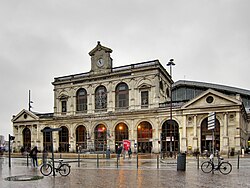
Lille-Flandres station
Lille-Flandres station (French: Gare de Lille-Flandres, Dutch: Station Lille-Flandres) is the main railway station of Lille, capital of French Flanders. It is a terminus for SNCF Intercity and regional trains. It opened in 1842 as the Gare de Lille, but was renamed in 1993 when Lille Europe station opened. There is a 500 metres (1,600 ft) walking distance between the two stations, which are also adjacent stops on one of the lines of the Lille Metro.
308 m
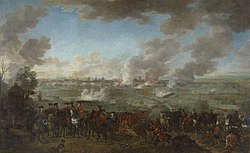
Siege of Lille (1708)
The siege of Lille (12 August – 10 December 1708) was the main operation of the 1708 campaign season during the War of the Spanish Succession. Following their victory in the Battle of Oudenaarde, the Allies decided to besiege Lille, an important French city and perhaps the strongest fortress in Europe. After an obstinate defence of 120 days, the French garrison surrendered the city and citadel of Lille, commanded by Marshal Boufflers, to the forces of the Duke of Marlborough and Prince Eugene of Savoy.