

 English
 Français

Rue de Tournai
La rue de Tournai est une rue de Lille.
Nearby Places View Menu
209 m
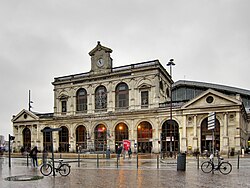
Lille-Flandres station
Lille-Flandres station (French: Gare de Lille-Flandres, Dutch: Station Lille-Flandres) is the main railway station of Lille, capital of French Flanders. It is a terminus for SNCF Intercity and regional trains. It opened in 1842 as the Gare de Lille, but was renamed in 1993 when Lille Europe station opened. There is a 500 metres (1,600 ft) walking distance between the two stations, which are also adjacent stops on one of the lines of the Lille Metro.

246 m
Euralille
Euralille is an urban quarter in the centre of Lille, France. Conceived as a major European business district in the late 1980s and early 1990s, it is strategically located at the intersection of the high-speed railway lines linking Paris, Brussels, and London, and incorporates the Gare de Lille Europe and Gare de Lille Flandres railway stations. The master plan was commissioned in 1988 to the Office of Metropolitan Architecture (OMA) led by Rem Koolhaas.
281 m
ESC Lille
ESC Lille is a French business school founded in 1892. It has two campuses, one in Lille and one in Paris. ESC Lille is EQUIS accredited by the EFMD (European Foundation for Management Education) and the Conference Of The Grandes Ecoles. In 2005, it was the first European business school to be accredited by Project Management Institute’s Global Accreditation Center for Project Management (GACPM), and is still the only PMI-accredited business school in France. In July 2009 the union of Ceram Business School and ESC Lille was announced. It will create the largest French business school in terms of student numbers. The new school, named Skema Business School (School of Knowledge Economy and MAnagement), span three sites in France in Lille, Paris and Sophia Antipolis near Nice and three sites: in China (Suzhou) United States (Raleigh, NC) and Brazil (Belo Orizonte).
In May 2019 SKEMA Business School announced the opening of a new site in Cape Town (South Africa) and the possibility to enter in Russia and India.

336 m
Braderie de Lille
The Lille Braderie (French: Braderie de Lille) is a braderie, or annual street market/flea market, that takes place on the weekend of the first Sunday of September in Lille, France, in the northern Hauts-de-France region. It dates back to the 12th century, attracting nearly three million visitors each year. The Braderie de Lille is one of the largest gatherings in France and the largest flea market in Europe. In 2014 the Braderie was reported to host 100km of market stalls to over 10,000 exhibitors.
During the Braderie, the city hosts a music festival. The traditional food eaten during the festival, moules-frites, typically results in built-up heaps of mussel shells around the city.
In 2016, the Braderie was cancelled by Lille mayor Martine Aubry, following terrorist incidents in France.

349 m
University of Lille
The University of Lille (French: Université de Lille, abbreviated as ULille, UDL or univ-lille) is a French public research university based in Lille, in the Nord department of Upper France. It has its origins in the University of Douai (1559), and resulted from the merger of three universities – Lille 1 University of Science and Technology, Lille 2 University of Health and Law, and Charles de Gaulle University – Lille III in 2018. With more than 80,000 students, it is one of the largest universities in France and one of the largest French-speaking universities in the world.
Since 2017, the university has been funded as one of the French universities of excellence. It benefits from an endowment of 500 million euros to accelerate its strategy in education, research, international development and outreach.
With 66 research labs, 350 PhD theses supported per year and 3,000 scientific publications each year, it is well represented in the research community; it collaborates with many organizations (Pasteur Institute of Lille, CHU Lille University Hospital, CNRS, INSERM, INRA, INRIA etc.) and schools (École Centrale de Lille, École des Mines-Télécom de Lille-Douai (IMT Lille Douai), Sciences Po Lille etc.).
Until 2019, the university was the main component of the Community of Universities and Institutions (COMUE) Lille Nord de France. It still operates the European Doctoral College, which federates universities and other higher learning institutes in the Hauts-de-France region.