

 English
 Français

The Eurovision Young Musicians 2018 was the 19th edition of the Eurovision Young Musicians contest. This edition was a co-production between the European Broadcasting Union (EBU), the Edinburgh International Festival, and the British Broadcasting Corporation (BBC) as host broadcaster. It was hosted in the United Kingdom, for the first time since the inaugural contest in 1982. Musicians representing eighteen countries participated in the contest, with Albania making their debut alongside seven returning countries, while Austria decided not to participate for the first time. The final concert took place at the Usher Hall in Edinburgh on 23 August 2018, with the BBC Scottish Symphony Orchestra under their principal conductor Thomas Dausgaard. It was produced by BBC Cymru Wales for broadcast by BBC Scotland and BBC Radio 3, with Petroc Trelawny and Josie d'Arby being the presenters for the show. Ivan Bessonov of Russia won the contest, marking the country's first win in the competition and the first pianist to win since Poland's Stanisław Drzewiecki in 2000.
1. Location
Usher Hall, the venue for the final, is a concert hall situated on Lothian Road, in the west end of Edinburgh, Scotland. It has hosted concerts and events since its construction in 1914 and can hold approximately 2,900 people in its recently restored auditorium, which is well loved by performers due to its acoustics. The Hall is flanked by The Royal Lyceum Theatre on the right and The Traverse Theatre on the left. Historic Scotland has registered the Hall with Category A listed building status. The hall previously hosted the Eurovision Song Contest 1972 after Monaco, which won the year before, was unable to provide a suitable venue. The last time the United Kingdom hosted a Eurovision network contest was the Eurovision Dance Contest 2008 in Glasgow.
1. = Bidding phase =
According to an earlier statement by Vladislav Yakovlev, the former executive supervisor of the event, Budapest could host the 2018 contest after bidding for the 2016 edition. On 27 October 2016, the European Broadcasting Union (EBU) launched a call to submit applications for the competition.
1. = Host city announcement =
In early October 2017, Norwegian broadcaster Norwegian Broadcasting Corporation (NRK) confirmed in an online article regarding its national selection Virtuos, that the United Kingdom would host this edition of the contest in August 2018. On 30 October 2017, the EBU announced that this edition of the contest would be held in Edinburgh between 16 and 24 of August 2018.
1. Format
The semi-final round returned in 2018, produced by BBC Radio 3 in the form of public chamber recitals, at the Studio of the Edinburgh Festival Theatre on 18 and 19 August 2018.
1. = Presenters =
On 6 August 2018, it was announced that Petroc Trelawny and Josie D'Arby would host the 2018 competition. Trelawny’s career started at BBC Radio Devon in 1989 as a reporter, before he made his transition to a career in classical music radio and television during the 1990s. Since 1998 he has been a presenter at BBC Radio 3, and is the face of classical magazine programme Music Matters, Radio 3’s Breakfast and concerts in Radio 3 Live in Concert. D’Arby started on Children's BBC (CBBC) in the 1990s before becoming the youngest woman to have her own chat show, Josie, in 1999 on Channel 5. She has co-presented a number of cultural programs for the BBC including; Young Musician of the Year since 2012, Cardiff Singer of the World since 2009, Songs of Praise since 2014 and Young Choir of the Year (2018). Her acting credits include playing series regular WPC Jodie Finn, in BBC One drama Merseybeat from 2002–04. On 11 August 2018, it was revealed that the semi-finals would be hosted by Trelawny, with D'Arby joining him in the final.
1. = Jury members =
The winner of the competition was decided by an international panel of classical music luminaries. On 10 August 2018, the EBU announced the jurors of the competition. The judges for the semi-finals are British bassoonist Ursula Leveaux, Spanish percussionist Noè Roderigo Gisbert, Korean pianist Sinae Lee, and the chair cellist and conductor David Watkin. Joining Watkin's at the final were American conductor and violinist Marin Alsop, composer and performer Anna Meredith, Scottish classical composer and conductor James MacMillan and Head of Music for the Edinburgh International Festival, Andrew Moore.
1. = Voting =
Altogether there are two set of juries: one for the two days of semi-finals and one for the final. In both juries, each juror was to independently rate each performer a score from 1–10 points. The following criteria were taken into account by the jurors in the semi-finals and finals:
Technical Accuracy Quality of Sound Interpretation Performance After each juror has awarded his points, these were added together and the result presented to the jury first. However following discussion, the jury may make changes to the numerical rankings by mutual agreement. The six finalists were announced in a random order after the semi-finals on a separate live stream. In addition, it was announced that the jury in the final would not know the results of the semi-final jury to avoid interference. In the final, only the winner was announced during the televised broadcast.
1. Participating countries
The final list of participants were announced on 2 February 2018, with eighteen countries confirming their participation, the highest number since 2006. Albania made their debut whilst seven countries, Belgium, Estonia, Greece, Israel, Russia, Spain and United Kingdom, all returned to the Eurovision Young Musicians in 2018. Belgium last participated in 2006, Estonia in 2004, Greece in 2014, Israel in 1986 and Spain in 2000. Russia and host country, the United Kingdom, most recently took part in 2010.
1. = Semi-finals =
The semi-finals consisted of six hour-long shows spread over two days. A total of eighteen countries took part, of which six qualified to the grand final. In each semi-final, three musicians performed, either solo or with piano accompaniment, for a total of 18 minutes each.
1. == 18 August ==


1. == 19 August ==


1. = Final =
Six contestants were selected by the first jury to progress to the Final and the second decided the winner of Eurovision Young Musicians 2018. Each finalist performed one or more movements of a single musical work, accompanied by the BBC Scottish Symphony Orchestra, for up to 12 minutes. During the live shows interval, the orchestra performed "Hedwig's Theme" from the Harry Potter score although this was not included in the televised broadcast. The winner received a custom-made engraved trophy, a cash prize of €7,000, and a performance opportunity with the BBC Scottish Symphony Orchestra in a forthcoming season. The runner-up received a cash prize of €3,000.
1. Broadcasting
The broadcasters in the following countries, listed in order of broadcasting dates, confirmed that they would broadcast the contest in their territories along with the dates of broadcasting schedules. The broadcasters in Belgium, Czech Republic, Estonia, Greece, Poland, San Marino, Slovenia, Spain, and the UK also livestreamed the contest on their online platforms. The semi-finals and the final were broadcast live on the internet via the official YouTube channel of the competition.
1. = Semi-finals =


1. = Final =


1. Other countries
For a broadcaster to be eligible to participate in the Eurovision Young Musicians, it needs to be an active member of the European Broadcasting Union (EBU). It is unknown whether the EBU issue invitations of participation to all 56 active members like they do for the Eurovision Song Contest and Junior Eurovision Song Contest. The EBU Active Members listed below have made the following announcements in regards to their decisions.
1. = Active EBU Members =
Austria – On 29 October 2017, Österreichischer Rundfunk (ORF) announced that they were discussing whether they will participate in Eurovision Young Musicians 2018. They decided to withdraw from the 2018 edition, after participating at every previous edition of the contest, with no reasons for their withdrawal being published. Bosnia and Herzegovina – On 24 October 2017, BHRT confirmed that due to financial difficulties it would not return to the contest in 2018. Bosnia and Herzegovina's last, and only, participation was in 2012. Cyprus – On 2 January 2018, Cyprus Broadcasting Corporation (CyBC) confirmed that due to financial difficulties it would not return to the contest in 2018. Cyprus last participated in 2010. Denmark – On 3 January 2018, Danish Broadcasting Corporation (DR) confirmed that it would not return to the contest in 2018 and are unlikely to participate in the competition in the coming years. Denmark last participated in 2002. Finland – On 12 January 2018, Yleisradio (YLE) confirmed that it would not return to the contest in 2018. Finland last participated in 2008. Ireland – On 28 October 2017, Raidió Teilifís Éireann (RTÉ) announced that it would not return to the contest in 2018. Ireland last participated in 2000. However, the Irish-language broadcaster, TG4, which was eligible to participate representing Ireland, had not released any statements regarding a return to the contest. Ireland was not on the final list of participants released by the EBU. Latvia – On 4 November 2017, Latvijas Televīzija (LTV) confirmed that it would not return to the contest in 2018. Latvia last participated in 2002. Netherlands – On 30 January 2018, Omroep NTR (NTR) confirmed that it would not return to the contest in 2018. The Netherlands last participated in 2014. Switzerland – On 11 November 2017, Schweizer Radio und Fernsehen (SRF) confirmed that SRG SSR would not return to the contest in 2018. Switzerland last participated in 2006. Ukraine – On 5 January 2018, National Public Broadcasting Company of Ukraine (UA:PBC) announced that it was considering a return to the contest in 2018. However, on 14 January 2018, UA:PBC confirmed that it would not return to the contest in 2018. Ukraine last participated in 2012.
1. See also
Junior Eurovision Song Contest 2018 Eurovision Song Contest 2018
1. Notes and references


1. = Notes =


1. = References =


1. External links
Official website Eurovision Young Musicians 2018 at BBC Online
55.9464°N 3.2069°W / 55.9464; -3.2069
Nearby Places View Menu

Edinburgh Filmhouse
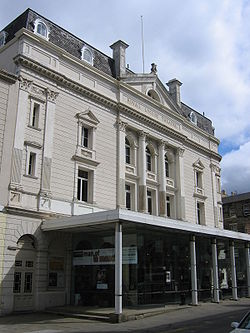
Royal Lyceum Theatre

Usher Hall
