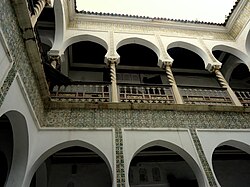
Le palais de la Jénina (arabe : قصر الجنينة) aussi appelée « Dar soltan el-kadîma » (vieille maison du Sultan) fut anciennement la résidence officielle de l’émir d'Alger Salim at-Toumi, chef de la tribu des Thaâliba. À la suite de la création de la régence d'Alger, ce palais devient la résidence d'Arudj Barberousse, devenu sultan d'Alger après la prise de la ville et l'assassinat de Salim at-Toumi. Dans ce palais vont aussi résider les Beylerbey « émir des émirs » de 1519 à 1585, les pachas (1585-1659), les aghas (1659-1671) et les deys (1671-1817), les deys iront ensuite habiter dans la citadelle d'Alger jusqu'en 1830.

Il fut détruit par l'administration coloniale française en 1857 . Le terrain devient une place d'armes pour les troupes françaises, puis une place baptisée place du Gouvernement. À l'indépendance de l'Algérie en 1962, la place du Gouvernement est renommée place des Martyrs. Le dernier témoin de cet ensemble est Dar Aziza, une aile palatiale avec patio datant du XVIe siècle.

Nearby Places View Menu
28 m

Serkadji Prison

Serkadji Prison, formerly Barberousse Prison, was a high-security prison in Algiers, Algeria; in 1995, about two-thirds of the 1,500 prisoners detained are (or were) accused or convicted of terrorism.
Location Image
92 m

Ben Farès Mosque

The Ben Farès Mosque, also known as Djamaa Ben Farès (Arabic: مسجد ابن فارس) and formerly as Djamâa Lihoud (Jewish Mosque), is a mosque located on Place Randon in Algiers, the capital of Algeria. The mosque is located in the Casbah of Algiers, a UNESCO World Heritage Site. Built by Napoleon III in 1865 as a synagogue and named as the Great Synagogue of Algiers (French: Synagogue de Rue Randon), the structure was abandoned by Jews in 1962, during the independence of Algeria, and repurposed as a mosque.
Location Image
179 m

Safir Mosque

The Safir Mosque (Arabic: مسجد سفير or جامع سفير) is a Sunni mosque in the city of Algiers, Algeria. The Moorish-style mosque was completed in 1534 CE and is located inside the medina quarter of the Casbah of Algiers, a UNESCO World Heritage Site.
Location Image
179 m

Ketchaoua Mosque

The Ketchaoua Mosque (Arabic: جامع كتشاوة), also known as Djamaa Ketchaoua, is a mosque in the city of Algiers, the capital of Algeria. Completed in the 17th century, during Ottoman period, the mosque is located at the foot of the Casbah of Algiers, a UNESCO World Heritage Site and is on the first of the Casbah's many steep stairways. Its construction was logistically and symbolically a cynosure of pre-colonial Algiers. The mosque is noted for its unique fusion of Moorish and Byzantine architecture. Built by Hayreddin Barbarossa as a mosque in 1020 AH (1611/1612 CE), in 1831 Muslims were evicted under French rule and the structure was converted to a Roman Catholic cathedral in 1832, renamed as the Cathedral of St Philippe (French: Cathédrale Saint-Philippe), which it remained until 1962. The former mosque-church was demolished between 1845 and 1860 and a new cathedral was built. Following Algerian independence in 1962, this structure was converted back into a mosque. In spite of these transitions, the mosque has retained its original grandeur and is one of the major tourist attractions of Algiers.
Location Image
221 m

Dar Aziza

Dar Aziza is a 16th-century Moorish palace located in the Casbah of Algiers in Algeria. Today, it houses the National Agency of Archaeology and Protection of Historic Sites and Monuments. Dar Aziza, arguably the most iconic surviving building of its era in Algiers, was part of a large governmental compound known as Janina Palace, which existed before the arrival of Turkish corsairs.