English
 Français

Ben Farès Mosque
The Ben Farès Mosque, also known as Djamaa Ben Farès (Arabic: مسجد ابن فارس) and formerly as Djamâa Lihoud (Jewish Mosque), is a mosque located on Place Randon in Algiers, the capital of Algeria. The mosque is located in the Casbah of Algiers, a UNESCO World Heritage Site. Built by Napoleon III in 1865 as a synagogue and named as the Great Synagogue of Algiers (French: Synagogue de Rue Randon), the structure was abandoned by Jews in 1962, during the independence of Algeria, and repurposed as a mosque.
1. History
Supported by funding from the French government, large synagogues were constructed in Algiers, Oran, and Setif, to establish a public Jewish presence in parallel to Roman Catholic cathedrals and grand mosques. In 1839 the French government tore down several buildings and synagogues in the Jewish quarter as part of urban renewal and promised in return to provide FF120,000 toward the construction of a grand synagogue. It took 25 years for the synagogue to be inaugurated on September 19, 1865, on the site of an ancient mosque on Place Randon. On 11 December 1960, Muslim rebels battling French rule took over the synagogue. Protesting against a visit by General de Gaulle, Muslim rebels claimed that Jews had fired on them from nearby balconies as an excuse to attack the synagogue. Muslims rampaged the synagogue, removed memorial plaques and monuments, and raised a green and white flag above the synagogue. “Death to the Jews” and swastikas were daubed on the walls. After two days of rioting, including attacks on nearby Jewish shops and homes, French forces restored order. The synagogue was abandoned. In 1962 the former synagogue was converted into the Ben Farès Mosque. Much of the exterior of the former synagogue was preserved, with the only major change was the addition of an octagonal minaret. Inside the former synagogue, all Jewish symbols were removed. The Torah ark was replaced by a mihrab. The building is sometimes referred to as the Mosque of the Jews.
1. Architecture
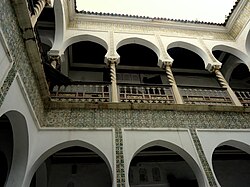
Designed by Pierre Guiauchain in the Moorish style, the square interior with a large dome and horse-shoe arches accommodate 900 men, plus 200 women in the second-floor balconies. A chandelier hung from the central dome, with light streaming in from stained-glass windows. Plaques on the walls saluted community benefactors, and in 1922 the synagogue added two large plaques on either side of the ark memorializing community members who died in World War I. The ark housed many scrolls, including a Sefer Torah from Spain, completed centuries before the synagogue was built. An organ was added at some point. The façade faces the market plaza with a large door flanked by two columns and two side doors, with a wide granite staircase.
1. See also
Islam in Algeria List of mosques in Algeria List of synagogues in Algeria
1. References


1. External links
Media related to Ben Farès Mosque at Wikimedia Commons
Nearby Places View Menu

Safir Mosque
Serkadji Prison

Ketchaoua Mosque