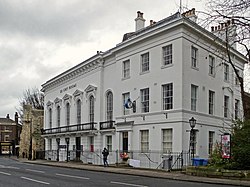
York Theatre Royal is a theatre in St Leonard's Place, in York, England, which dates back to 1744. The theatre currently seats 750 people. Whilst the theatre is traditionally a proscenium theatre, it was reconfigured for a season in 2011 to offer productions in-the-round. The theatre puts on many of its own productions, as well as hosting touring companies, one of which is Pilot Theatre, a national touring company which often co-produces its work with the theatre. Additionally the main stage and studio are regularly used by local amateur dramatic and operatic societies. York Theatre Royal was one of the co-producers of the historic York Mystery Plays 2012 which were staged in York Museum Gardens between 2–27 August. The theatre reopened on 22 April 2016 following a £6 million redevelopment, with a new roof, an extended and re-modelled front of house area, a refurbished and redecorated main auditorium and with major improvements to access and environmental impact.

Nearby Places View Menu
Location Image
26 m

St Leonard's Place

St Leonard's Place is a street in York, England.
Location Image
45 m

De Grey Rooms

The De Grey Rooms is a historic building in the city of York, England. It was built in 1841–1842 and is a Grade II* listed building.
Location Image
51 m

The Red House (York)

The Red House is a historic building in the city centre of York, in England. The house lies on Duncombe Place, on the corner of St Leonard's Place. Its site is believed to be that of the east gate of St Leonard's Hospital. This was later replaced by a house which formed part of Mint Yard, which was purchased by the York Corporation in 1675. In 1701, that house was leased by Sir William Robinson, MP for York, and in about 1714 he rebuilt the house, retaining only the basement and ground floor walls at each side. William Etty designed another house for Robinson, and he is sometimes claimed to have also designed The Red House. In 1725, the corporation asked Robinson to surrender his lease so that it could use the house, but he refused, and the corporation instead built York Mansion House. Robinson died in 1736, and passed the house to Richard Elcock. In 1740, it was leased to John Burton, and later passed through numerous hands. The house originally had an L-shaped plan, but in the late 18th century, an extension turned it into a near-rectangular plan. At the same time, a new cornice was added to the building. The front of the house is of brick, painted red, with quoins and various dressings in stone, painted white. It is of five bays, with two main storeys, a basement and an attic. Eight stone steps lead up to the front door, and there are early 19th-century cast iron railings in front. Inside, it has some original fireplaces, panelling and cornices. The main staircase is late 18th-century, while the secondary staircase is early 18th-century. In 1954, the house was Grade II* listed. In the late 20th century, it was used as the Leisure Services Department of the City of York Council. In 1999, the council sold it to the York Conservation Trust. The Trust lets it out for use as an antique centre, operated by Tim Hogarth.
Location Image
57 m

York Oratory

The Oratory Church of Saint Wilfrid, York (or York Oratory for short) is a Catholic church in York, England. A church dedicated to Saint Wilfrid has stood in York since medieval times. It is within the Diocese of Middlesbrough and was the second pro-Cathedral of the Diocese of Beverley until its dissolution in 1878.