

 English
 Français

Bute House
La Bute House (en gaélique écossais : Taigh Bhòid) est la résidence officielle du Premier ministre d'Écosse, depuis le Scotland Act et la dévolution des pouvoirs de 1999. Son adresse est le 6 Charlotte Square, dans la New Town d'Édimbourg. La résidence est actuellement occupée par John Swinney, du Parti national écossais.
1. Histoire
Entre 1970 et 1999, la résidence est utilisée par le secrétaire d'État pour l'Écosse. Willie Ross, baron Ross de Marnock, est le premier secrétaire d'État à occuper la résidence. Le siège officiel du gouvernement écossais se situe à St Andrew's House, à Édimbourg.
1. Galerie


1. Articles connexes
New Town Charlotte Square
1. Notes et références
Site officiel
Portail de l’Écosse Portail de la politique britannique Portail des monuments classés au Royaume-Uni
Nearby Places View Menu

0 m
Bute House
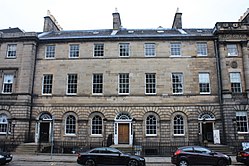
Bute House (Scottish Gaelic: Taigh Bhòid) is the official residence and workplace of the first minister of Scotland. Located at 6 Charlotte Square in the New Town of Edinburgh, it is the central house on the north side of the square and was designed by Robert Adam. It has served as the official residence of every first minister since Donald Dewar in 1999, and prior to that, the secretary of state for Scotland who headed the Scotland Office, from the 1970s until 1999. Bute House was conveyed to the National Trust for Scotland by the 6th Marquess of Bute in 1966.
The house is a Category A listed building and is constructed in an 18th century town house Neoclassical style, using sandstone materials. Designed by Robert Adam, Charlotte Square was designed by Adam as a single scheme, and it was part of architect James Craig’s First "New Town plan" which was unveiled in 1767, with Adam being commissioned in 1791 to design unified frontages for Charlotte Square. Together with Charlotte Square as a whole, Bute House has been described as "perhaps the finest architectural achievement of Georgian Edinburgh".
Alongside two other personal offices at the Scottish Parliament Building and St. Andrew's House, Bute House also contains a smaller office used by the first minister when in official residence. As well as serving as the official residence of the first minister, Bute House is frequently used by the First Minister to hold press conferences, media briefings, meetings of the cabinet of the Scottish Government and appointing members to the Scottish Cabinet.
The four-storey house contains the Cabinet Room, where the Scottish Cabinet meets each Tuesday, governmental and ministerial offices, conference, reception, sitting and dining rooms where the first minister works and where Scottish Government ministers, official visitors and guests are received and entertained. The second and third floors contain the private residence of the first minister.
11 m
The Georgian House, Edinburgh
The Georgian House is an 18th-century townhouse situated at No. 7 Charlotte Square in the heart of the historic New Town of the city of Edinburgh, Scotland. It has been restored and furnished by the National Trust for Scotland, and is operated as a popular tourist attraction, with over 40,000 visitors annually.

95 m
Charlotte Square
Charlotte Square is a garden square in Edinburgh, Scotland, part of the New Town, designated a UNESCO World Heritage Site. The square is located at the west end of George Street and was intended to mirror St. Andrew Square in the east. The gardens, one of the collection of New Town Gardens, are private and not publicly accessible.

138 m
West Register House
West Register House is a building of the National Records of Scotland, located on Charlotte Square in Edinburgh, Scotland, United Kingdom. The building was constructed between 1811 and 1814 as St George's Church and converted to its current purpose as a records office between 1964 and 1970.
The church's site in the centre of the western side of Charlotte Square had been designated for a church as part of James Craig's initial plan for the New Town. The building was designed by Robert Reid after a similar but more intricate plan by Robert Adam, who designed the square's surrounding terraces. Construction began in 1811 and, though initially projected to cost £18,000, the total cost came to £33,000. The facade centres on an Ionic portico, above which rises a substantial green copper dome on a tall, peristyle drum. The dome, topped by a gilt cupola and cross, is a prominent feature of the Edinburgh skyline and terminates the view west along George Street. The interior of the church was gutted during its conversion as a records office. It had been noted for its tall pulpit by William Trotter.
St George's Church opened in 1814 to serve as the Church of Scotland parish church for the western half of the New Town. In its early years, it was notable for the ministries of two leading evangelicals: Andrew Mitchell Thomson and Robert Smith Candlish. The latter led out a significant portion of the congregation during the Disruption of 1843. Thomson also established a strong musical tradition at St George's: this continued with prominent choirmasters and organists, including Alexander Mackenzie. By the early 1960s, severe structural damage in the church building had become apparent and, in 1964, the congregation united with that of St Andrew's on George Street to form St Andrew's and St George's. Between 1964 and 1970, Robert Saddler converted the building for use as a public records office. A restoration of the building was completed in 2021.

164 m
The Oxford Bar
The Oxford Bar is a public house situated on Young Street, in the New Town of Edinburgh, Scotland. The pub is chiefly notable for having been featured in Sir Ian Rankin's Inspector Rebus series of novels. The Oxford Bar, or The Ox, is John Rebus's favourite pub in Edinburgh.