

 English
 Français

The Oxford Bar
The Oxford Bar is a public house situated on Young Street, in the New Town of Edinburgh, Scotland. The pub is chiefly notable for having been featured in Sir Ian Rankin's Inspector Rebus series of novels. The Oxford Bar, or The Ox, is John Rebus's favourite pub in Edinburgh.
Nearby Places View Menu

74 m
Church of Scotland offices
The Church of Scotland offices are located in the centre of Edinburgh, Scotland (in the New Town), at 121 George Street. These imposing buildings are popularly known in Church circles as "one-two-one". They were designed in a Scandinavian-influenced style by the architect Sydney Mitchell and built in 1909–1911 for the United Free Church of Scotland. Following the union of the Church of Scotland and the United Free Church of Scotland in 1929 the church offices were henceforth used by the newly united church.
A matching extension, incorporating a ground floor bookshop, was built in the 1930s on the east side (119 George Street). A proposed matching extension on the west side (replacing the still-existing buildings at 123 George Street) was never built. 123 George Street is, however, owned by the Church of Scotland and has been incorporated into the offices. The church offices also incorporate a chapel near the main entrance and a staff canteen in the basement.
The title used is always "church offices" and never "headquarters". There are periodically suggestions within the Church of Scotland that the current church offices should be sold, relocating to new premises outside Edinburgh. Such a decision could only be taken by the General Assembly; so far no proposals have been made.
The offices of the Moderator, Principal Clerk, General Treasurer, Law Department and all the church councils are located at the church offices. The one major exception is the Social Care Council (CrossReach) which is located outside the city centre at Charis House, 47 Milton Road East, Edinburgh.
The building is managed and maintained by the Church of Scotland's Facilities Management Department.
110 m
Scottish Land Court
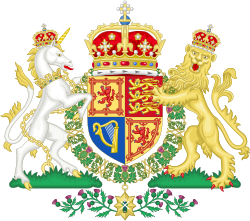
The Scottish Land Court (Scottish Gaelic: Cùirt an Fhearainn na h-Alba) is a Scottish court of law based in Edinburgh with subject-matter jurisdiction covering disputes between landlords and tenants relating to agricultural tenancies, and matters related to crofts and crofters. The Scottish Land Court is both a trial court and an appeal court; hearings at first-instance are often heard by a Divisional Court of one of the Agricultural Members advised by the Principal Clerk. Decisions of the Divisional Court can be appealed to the Full Court, which will consist of at least one legally qualified judicial member and the remaining Agricultural Member. Some cases are heard at first-instance by the Full Court, and these cases may be appealed to the Inner House of the Court of Session.
The Chairman of the Scottish Land Court is ranked as a Senator of the College of Justice, and is required to be meet the same eligibility criteria as a Senator. The Scottish Land Court has a legally qualified Deputy Chairman, with several Agricultural Members. The Agricultural Members (also called "practical Members") are lay (not legally qualified) members of the Court with significant experience of agriculture. They deal with many crofting cases, and sit in the Divisional Court, where they are supported by the Principal Clerk as legal assessor. However, the decisions of the Divisional Court rest with the Agricultural Member. The Court holds hearings throughout Scotland, and cases can be heard before a divisional court (consisting of one of the Agricultural Members), or the full court (consisting of the Agricultural Members and the legally qualified members.)
The court was established on 1 April 1912 under section 3 of the Small Landholders (Scotland) Act 1911, which was consolidated by the Scottish Land Court Act 1993. The current chairman is Lord Duthie who was appointed on 9 January 2023.

164 m
Bute House
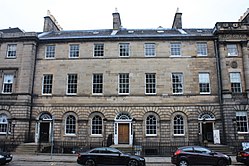
Bute House (Scottish Gaelic: Taigh Bhòid) is the official residence and workplace of the first minister of Scotland. Located at 6 Charlotte Square in the New Town of Edinburgh, it is the central house on the north side of the square and was designed by Robert Adam. It has served as the official residence of every first minister since Donald Dewar in 1999, and prior to that, the secretary of state for Scotland who headed the Scotland Office, from the 1970s until 1999. Bute House was conveyed to the National Trust for Scotland by the 6th Marquess of Bute in 1966.
The house is a Category A listed building and is constructed in an 18th century town house Neoclassical style, using sandstone materials. Designed by Robert Adam, Charlotte Square was designed by Adam as a single scheme, and it was part of architect James Craig’s First "New Town plan" which was unveiled in 1767, with Adam being commissioned in 1791 to design unified frontages for Charlotte Square. Together with Charlotte Square as a whole, Bute House has been described as "perhaps the finest architectural achievement of Georgian Edinburgh".
Alongside two other personal offices at the Scottish Parliament Building and St. Andrew's House, Bute House also contains a smaller office used by the first minister when in official residence. As well as serving as the official residence of the first minister, Bute House is frequently used by the First Minister to hold press conferences, media briefings, meetings of the cabinet of the Scottish Government and appointing members to the Scottish Cabinet.
The four-storey house contains the Cabinet Room, where the Scottish Cabinet meets each Tuesday, governmental and ministerial offices, conference, reception, sitting and dining rooms where the first minister works and where Scottish Government ministers, official visitors and guests are received and entertained. The second and third floors contain the private residence of the first minister.
166 m
The Georgian House, Edinburgh
The Georgian House is an 18th-century townhouse situated at No. 7 Charlotte Square in the heart of the historic New Town of the city of Edinburgh, Scotland. It has been restored and furnished by the National Trust for Scotland, and is operated as a popular tourist attraction, with over 40,000 visitors annually.