
Charlotte Square is a garden square in Edinburgh, Scotland, part of the New Town, designated a UNESCO World Heritage Site. The square is located at the west end of George Street and was intended to mirror St. Andrew Square in the east. The gardens, one of the collection of New Town Gardens, are private and not publicly accessible.

1. History

Initially named St. George's Square in James Craig's original plan, it was renamed in 1786 after King George III's Queen and first daughter, to avoid confusion with George Square to the south of the Old Town. Charlotte Square was the last part of the initial phase of the New Town to be "completed" in 1820 (note- the north-west section at Glenfinlas Street was not completed until 1990 due to a long-running boundary dispute). Much of it was to the 1791 design of Robert Adam, who died in 1792, just as building began. In 1939 a very sizable air-raid shelter was created under the south side of the gardens, accessed from the street to the south. In 2013 the south side was redeveloped in an award-winning scheme by Paul Quinn, creating major new office floorspace behind a restored series of townhouses. Edinburgh Collegiate School was located in Charlotte Square.

1. Gardens

The garden was originally laid out as a level circular form by William Weir in 1808. In 1861 a plan was drawn up by Robert Matheson, Clerk of Works for Scotland for a larger, more square garden, centred upon a memorial to the recently deceased Prince Albert, the consort of Queen Victoria. The commission for the sculpture was granted in 1865 to Sir John Steell. The main statue features an equestrian statue of the prince, in field marshal's uniform, dwarfing the four figures around the base. It was unveiled by Queen Victoria herself in 1876. The stone plinth was designed by the architect David Bryce and the four corner figures are by David Watson Stevenson (Science and Learning/Labour), George Clark Stanton (Army and Navy) and William Brodie (Nobility). The statue was originally intended to go in the centre of the eastern edge of the garden, facing down George Street. This remodelling featured major new tree-planting which took many years to re-establish. The central open space is a private garden, available to owners of the surrounding properties. For many years in the last three weeks in August each year Charlotte Square gardens was the site of the Edinburgh International Book Festival. They have since moved across town to the Edinburgh Futures Institute. The railings around the gardens were removed in 1940 as part of the war effort. The current railings date from 1947. Changes to street levels, contours and surfacing to accommodate modern traffic caused controversy in the late 1950s and early '60s.

1. Buildings

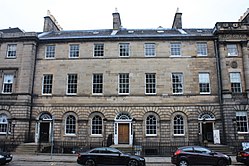
On the north side, No. 5 was the home of John Crichton-Stuart, 4th Marquess of Bute (1881–1947), who bought it in 1903 and gave it to the National Trust for Scotland on his death. It was the Trust headquarters from 1949 to 2000. Bute did much to promote the preservation of the square.

Nos. 6 and 7 are also owned by the National Trust for Scotland. No.6, Bute House is the official residence of the First Minister of Scotland. In 1806 it was home to Sir John Sinclair creator of the first Statistical Account of Scotland. No. 7 was internally restored by the Trust in 1975 to its original state, and is open to the public as The Georgian House. The upper floor was formerly the official residence of the Moderator of the General Assembly of the Church of Scotland. The building includes one fireplace brought from Hill of Tarvit in Fife in 1975. West Register House, formerly St. George's Church, forms the centre of the west side. It was designed by the architect Robert Reid in 1811, broadly to Adam's plan. The church opened in 1814 and was converted to its current use in 1964. It is one of the main buildings of the National Records of Scotland.

1. Residents

From the very inception of Charlotte Square in 1791, it was anticipated it would be one of the top addresses in Edinburgh. As the Victorian era commenced, the square was increasingly occupied by the elite of the middle class: legal and medical professionals. This is reflected in the notable residents listed below. As the 20th century began most buildings were still occupied as residential addresses, although more are offices, solely occupied by guardians.

Pioneer of the telephone, Alexander Graham Bell, was born in nearby South Charlotte Street.

1. References
Nearby Places View Menu
Location Image
84 m

The Georgian House, Edinburgh

The Georgian House is an 18th-century townhouse situated at No. 7 Charlotte Square in the heart of the historic New Town of the city of Edinburgh, Scotland. It has been restored and furnished by the National Trust for Scotland, and is operated as a popular tourist attraction, with over 40,000 visitors annually.
Location Image
95 m

Bute House

Bute House (Scottish Gaelic: Taigh Bhòid) is the official residence and workplace of the first minister of Scotland. Located at 6 Charlotte Square in the New Town of Edinburgh, it is the central house on the north side of the square and was designed by Robert Adam. It has served as the official residence of every first minister since Donald Dewar in 1999, and prior to that, the secretary of state for Scotland who headed the Scotland Office, from the 1970s until 1999. Bute House was conveyed to the National Trust for Scotland by the 6th Marquess of Bute in 1966. The house is a Category A listed building and is constructed in an 18th century town house Neoclassical style, using sandstone materials. Designed by Robert Adam, Charlotte Square was designed by Adam as a single scheme, and it was part of architect James Craig’s First "New Town plan" which was unveiled in 1767, with Adam being commissioned in 1791 to design unified frontages for Charlotte Square. Together with Charlotte Square as a whole, Bute House has been described as "perhaps the finest architectural achievement of Georgian Edinburgh". Alongside two other personal offices at the Scottish Parliament Building and St. Andrew's House, Bute House also contains a smaller office used by the first minister when in official residence. As well as serving as the official residence of the first minister, Bute House is frequently used by the First Minister to hold press conferences, media briefings, meetings of the cabinet of the Scottish Government and appointing members to the Scottish Cabinet. The four-storey house contains the Cabinet Room, where the Scottish Cabinet meets each Tuesday, governmental and ministerial offices, conference, reception, sitting and dining rooms where the first minister works and where Scottish Government ministers, official visitors and guests are received and entertained. The second and third floors contain the private residence of the first minister.
Location Image
98 m

West Register House

West Register House is a building of the National Records of Scotland, located on Charlotte Square in Edinburgh, Scotland, United Kingdom. The building was constructed between 1811 and 1814 as St George's Church and converted to its current purpose as a records office between 1964 and 1970. The church's site in the centre of the western side of Charlotte Square had been designated for a church as part of James Craig's initial plan for the New Town. The building was designed by Robert Reid after a similar but more intricate plan by Robert Adam, who designed the square's surrounding terraces. Construction began in 1811 and, though initially projected to cost £18,000, the total cost came to £33,000. The facade centres on an Ionic portico, above which rises a substantial green copper dome on a tall, peristyle drum. The dome, topped by a gilt cupola and cross, is a prominent feature of the Edinburgh skyline and terminates the view west along George Street. The interior of the church was gutted during its conversion as a records office. It had been noted for its tall pulpit by William Trotter. St George's Church opened in 1814 to serve as the Church of Scotland parish church for the western half of the New Town. In its early years, it was notable for the ministries of two leading evangelicals: Andrew Mitchell Thomson and Robert Smith Candlish. The latter led out a significant portion of the congregation during the Disruption of 1843. Thomson also established a strong musical tradition at St George's: this continued with prominent choirmasters and organists, including Alexander Mackenzie. By the early 1960s, severe structural damage in the church building had become apparent and, in 1964, the congregation united with that of St Andrew's on George Street to form St Andrew's and St George's. Between 1964 and 1970, Robert Saddler converted the building for use as a public records office. A restoration of the building was completed in 2021.
Location Image
149 m

Rose Theatre, Edinburgh

The Rose Theatre, a Category B listed building on Rose Street, Edinburgh, Scotland, is a former Baptist chapel and, more recently, arts & entertainment venue. Following deconsecration, the building re-opened in 2017 to provide year-round venues for the performing arts, hosting events for the Edinburgh Festival Fringe on a number of occasions.