
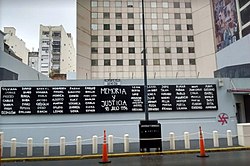
L'attentat de l'Amia est une attaque à la voiture piégée perpétrée le 18 juillet 1994 à Buenos Aires, la capitale de l'Argentine, et visant un bâtiment abritant plusieurs associations juives, dont l'Association mutuelle israélite argentine (Amia). Avec un bilan de 85 morts et 230 blessés, c'est l'attentat le plus meurtrier de l'histoire du pays, mais il n'a jamais été revendiqué. L'enquête, toujours en cours[Quand ?], a souffert de nombreuses irrégularités et a conduit à l'inculpation de plusieurs policiers argentins. En 2005, le juge fédéral Juan José Galeano, chargé de l'affaire, est démis de ses fonctions à la suite de « graves irrégularités ». En 2006, le nouveau procureur chargé du dossier, Alberto Nisman, accuse formellement le gouvernement iranien d'être le commanditaire de l'attentat, et le Hezbollah d'en être l'auteur. Selon lui, l'Argentine aurait été visée à la suite de sa décision de suspendre son transfert de technologies nucléaires vers l'Iran. Un mandat d'arrêt international est alors réclamé à l'encontre de plusieurs hauts responsables iraniens, dont l’ancien président Hachemi Rafsandjani. Le procureur Alberto Nisman accuse également l'ancien président argentin Carlos Menem et ses collaborateurs de l'époque d'avoir subtilisé des preuves afin de mettre hors de cause un entrepreneur argentino-syrien soupçonné d'avoir participé à la planification de l'opération. Alberto Nisman est retrouvé mort en janvier 2015 à son domicile dans des conditions mystérieuses. Quatre jours avant son décès, il avait incriminé l'ancienne présidente argentine Cristina Kirchner, estimant qu'elle avait favorisé l'impunité de suspects iraniens. Dans son dossier d'accusation, le magistrat n'avait finalement pas inclus cette requête. Des membres des services de renseignement argentins semblent avoir manipulé Alberto Nisman afin de le pousser à retenir la piste iranienne, malgré le manque de preuves. Un agent du FBI américain qui a participé à l’enquête reconnait en 2020 que tout a été fait pour arriver à « une conclusion décidée à l’avance », qui arrangeait les États-Unis et Israël dans un contexte de fortes tensions avec l'Iran.

Lieux à Proximité Voir Menu
Location Image
15 m

Asociación Mutual Israelita Argentina

Asociación Mutual Israelita Argentina (AMIA; transl. "Argentine Israelite Mutual Association") is a Jewish Community Centre located in Buenos Aires, Argentina. Established as Jevrá Kedushá in 1894, its mission was conceived to promote the well-being and development of Jewish life in Argentina and to secure the continuity and values of the Jewish community. The association established one of Buenos Aires' first Jewish cemeteries, and later founded the Tsedaká Foundation for charity. Serving the largest Jewish community in Latin America by the 1920s, AMIA inaugurated a new headquarters in Balvanera, a neighbourhood of Buenos Aires, in 1945; AMIA also became the headquarters of the Federation of Jewish Argentine Communities. It grew to provide and sponsor a variety of formal and informal educational, recreational, and cultural activities, as well as a healthcare cooperative. It became a centre for participation and involvement for people of all ages in Jewish life, and in the community at large. It has an employment agency service that provides connections between employers with potential employees as well as providing training and resources directed to both Jewish and non-Jewish people, with more than 500,000 applicants in its database. The AMIA also maintains the largest Jewish cemetery in Latin America, La Tablada Israelite Cemetery, established in 1936.
Location Image
210 m

Museum of Foreign Debt

The Museum of Foreign Debt (Spanish: Museo de la Deuda Externa) is a public museum located in Buenos Aires, Argentina, within the Faculty of Economic Sciences, University of Buenos Aires. The museum's expositions and collection aim to depict the impact that foreign debt has had on Argentine economic development throughout its history.
Location Image
290 m

Facultad de Medicina (Buenos Aires Underground)

Facultad de Medicina is a station on Line D of the Buenos Aires Underground. The station was opened on 23 February 1940 as part of the extension of Line D from Tribunales to Palermo. It owes its name to the UBA Faculty of Medical Sciences, which previously had its seat above the station. The complex above the station is now home to the Faculty of Economic Sciences.
Location Image
300 m

Pasteur - AMIA (Buenos Aires Underground)

Pasteur - AMIA is a station on Line B of the Buenos Aires Underground. It was opened on 17 October 1930 as part of the inaugural section of the line between Federico Lacroze and Callao. It is located in the Balvanera barrio, at the intersection of Avenida Corrientes and Calle Pasteur, and named after the latter. In 2015, murals and monuments commemorating the 1994 AMIA bombing (which took place nearby) were set up in the station, while proposals were put forward to change the name of the station to Pasteur - AMIA. This was approved in July 2015, and the station was renamed.
Location Image
354 m

Hospital de Clínicas "José de San Martín"

The Hospital de Clínicas "José de San Martín" is a teaching hospital located in Buenos Aires, Argentina. It belongs to the University of Buenos Aires (UBA) Faculty of Medical Sciences, currently the best ranked university in that country.