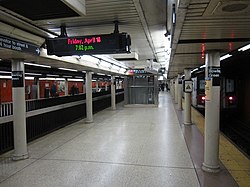
The Battery Place station was a station on the demolished Ninth Avenue and Sixth Avenue elevated train lines in Manhattan, New York City. It was located at the southern terminus of Greenwich Street at the north end of Battery Park. The station had two tracks and two side platforms. It was served by trains from the IRT Sixth Avenue Line and IRT Ninth Avenue Line. It opened June 5, 1883. One block north of the station, the Sixth Avenue El diverged to the east at Morris Street. It closed on June 11, 1940, though Sixth Avenue line trains stopped serving it when that EL line was closed in 1938. The next southbound stop was South Ferry. The next northbound stops were Rector Street for Ninth Avenue Line trains (which replaced the earlier Morris Street station), Rector Street for local Sixth Avenue Line trains, and Park Place for Sixth Avenue Line express trains.

Nearby Places View Menu
Location Image
51 m

1 Broadway

1 Broadway (formerly known as the International Mercantile Marine Company Building, the United States Lines Building, and the Washington Building) is a 12-story office building in the Financial District of Manhattan, New York City. It is located at the intersection of Battery Place and Broadway, adjacent to Bowling Green to the east and the Battery to the south. 1 Broadway was built in 1882 as the Queen Anne-style Washington Building on the site of the former Washington Hotel. The building was acquired by the International Mercantile Marine Company (IMM) in 1919 to serve as its corporate headquarters and extensively altered to its present Neoclassical style. It was the headquarters of IMM and its successor company United States Lines until 1979, when the firm relocated to Cranford, New Jersey. The structure continued to host office tenants as well as a bank. The building was added to the National Register of Historic Places (NRHP) on March 2, 1991, and was designated a city landmark by the New York City Landmarks Preservation Commission in 1995. It is also a contributing property to the Wall Street Historic District, a NRHP district created in 2007.
Location Image
63 m

Bowling Green station

The Bowling Green station is a station on the IRT Lexington Avenue Line of the New York City Subway, located at Broadway and Battery Place (at Bowling Green), in the Financial District of Manhattan. It is served by the 4 train at all times and the 5 train at all times except late nights. It is the southern terminal for the 5 train on weekends. The station opened in 1905 as an extension of the Interborough Rapid Transit (IRT)'s original subway line to South Ferry. At the time, there was a single island platform with one exit at Battery Park and another in Bowling Green. When the Lexington Avenue Line was expanded to Brooklyn in 1908, some trains continued going to South Ferry, resulting in the creation of a short island platform at the Bowling Green station for the Bowling Green–South Ferry shuttle. The shuttle operated until 1977. During the 1970s, the station was completely renovated, a new exit was built, and a third, side platform was created for northbound trains. The Bowling Green station contains two island platforms and one side platform. The westernmost island platform, formerly used by the shuttle, has been closed since 1977. The station retains its original head house in Battery Park, which is listed on the National Register of Historic Places and a New York City designated landmark. There are two other exits to Bowling Green, one of which contains an elevator that makes the station compliant with the Americans with Disabilities Act of 1990.
Location Image
81 m

United States Bankruptcy Court for the Southern District of New York

The United States Bankruptcy Court for the Southern District of New York is the United States bankruptcy court within the Southern District of New York. The Southern District of New York is a major venue for bankruptcy, as it has jurisdiction over the corporate headquarters and major financial institutions located in Manhattan. Originally, the District Court itself handled bankruptcies; these and admiralty court cases dominated nearly to the exclusion of all other cases, which were primarily handled by a Circuit Court for the District of New York and its successor Circuit Court for the Southern District of New York, until that court was abolished and its cases handled by the District Court as well. The district became widely recognized for its expertise in handling large bankruptcies, leading companies to seek a way to file in this court. Modern examples include the General Motors Chapter 11 reorganization and the Enron and WorldCom bankruptcies. From 1980 through 2014, the Southern District Bankruptcy Court for New York handled over 18% of all large, public-company bankruptcy filings in the United States while the Delaware District Bankruptcy Court handled nearly 36%.
Location Image
95 m

Government House (New York City)

The Government House was a Georgian-style mansion at the foot of Broadway, south of Bowling Green, on the site previously occupied by Fort George in Manhattan, New York City. Built in 1790 by the state of New York, it was intended to be the executive mansion for President George Washington, but he never occupied it. Before it was completed, the federal government moved temporarily to Philadelphia; then permanently to Washington, D.C. It then became the state governor’s residence and was used by George Clinton and John Jay. Later it was leased to John Avery and was known as the Elysian Boarding House. After the passage of the Customs Administration Act in 1799, it was converted into the Custom House in New York. Parts of the building were later leased to the American Academy of Arts, who then offered space to the New-York Historical Society in 1809. In 1813, the property was sold to the city. In 1815, the land was sold to the public and the building demolished.