

 English
 Français

Carlos Pellegrini (Buenos Aires Underground)
Carlos Pellegrini is a station on Line B of the Buenos Aires Underground. From here, passengers may transfer to the Diagonal Norte Station on Line C and the 9 de Julio Station on Line D and Metrobus 9 de Julio. The station was opened on 22 July 1931 as the eastern terminus of the extension of the line from Callao. In December 1931, the line was extended further east to Leandro N. Alem.
Nearby Places View Menu

67 m
Buenos Aires
Buenos Aires, officially the Autonomous City of Buenos Aires, is the capital and largest city of Argentina. It is located on the southwest of the Río de la Plata. Buenos Aires is classified as an Alpha− global city, according to the GaWC 2024 ranking. The city proper has a population of 3.1 million and its urban area has a population of 16.7 million, making it the 21st largest metropolitan area in the world.
It is known for its preserved eclectic European architecture and rich cultural life. It is a multicultural city that is home to multiple ethnic and religious groups, contributing to its culture as well as to the dialect spoken in the city and in other parts of the country. Since the 19th century, the city, and the country in general, has been a major recipient of millions of immigrants from all over the world, making it a melting pot where many ethnic groups live together. Buenos Aires is considered one of the most diverse cities of the Americas.
The city of Buenos Aires is an autonomous district and is neither part of Buenos Aires Province nor its capital. In 1880, after the Argentine Civil War, Buenos Aires was federalized and split from Buenos Aires Province. The city limits were enlarged to include the towns of Belgrano and Flores, both now neighborhoods of the city. The 1994 constitutional amendment granted the city autonomy, hence its formal name of Autonomous City of Buenos Aires. Citizens elected their first Chief of Government in 1996. Previously, the Mayor was directly appointed by the President of Argentina.
The Greater Buenos Aires conurbation includes several surrounding cities, which are located in the neighbouring districts of the Buenos Aires Province. It constitutes the fourth-most populous metropolitan area in the Americas. It is also the second largest city south of the Tropic of Capricorn. Buenos Aires has the highest human development of all Argentine administrative divisions. Its quality of life was ranked 97th in the world in 2024, being one of the best in Latin America.

72 m
Plaza de la República (Buenos Aires)
Plaza de la República (Republic Square) is a city square in Buenos Aires, capital of Argentina. It is located in the San Nicolás quarter, at the intersection of the city's three main arteries: Ninth of July Avenue, Corrientes Avenue, and Diagonal Norte. It derives its name and associations from a church once sited on the square, San Nicolás de Bari (demolished in the 1930s for the creation of 9 July Avenue), where the country's national flag was hoisted for the first time.
The plaza is the site of the Obelisk of Buenos Aires, designed by Alberto Prebisch and inaugurated in 1937. The plaza, originally a circular esplanade paved in stone, was enlarged to its current dimensions in 1962. Its present layout was established in 1971, when Corrientes Avenue was rerouted through the plaza and around the obelisk to ease car traffic into the city's financial district.
86 m
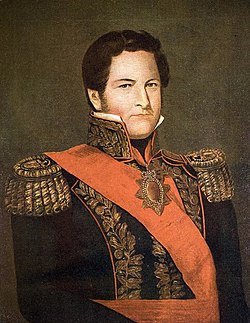
French blockade of the Río de la Plata
The French blockade of the Río de la Plata was a two-year-long naval blockade imposed by France on the Argentine Confederation ruled by Juan Manuel de Rosas. It closed Buenos Aires to naval commerce. It was imposed in 1838 to support the Peru–Bolivian Confederation in the War of the Confederation, but continued after the end of the war. France did not land ground forces, but instead took advantage of the Uruguayan Civil War and the Argentine Civil Wars, supporting Fructuoso Rivera and Juan Antonio Lavalleja against Manuel Oribe and Rosas.
After two years without the expected results, France signed the Mackau-Arana treaty with the Argentine Confederation, ending the hostilities.

86 m
Obelisco de Buenos Aires
The Obelisco de Buenos Aires (Obelisk of Buenos Aires) is a national historic monument and icon of Buenos Aires. Located in the Plaza de la República in the intersection of avenues Corrientes and 9 de Julio, the reinforced concrete structure was erected in 1936 to commemorate the quadricentennial of the first foundation of the city.