Location Image

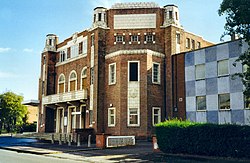
Church of St Nicholas, Burnage

The Church of St Nicholas, Kingsway, Burnage, Manchester, is a Modernist church of 1930–2 by N. F. Cachemaille-Day, Lander and Welch. It was enlarged in 1964 with a bay on the west side, also by Cachemaille-Day. Pevsner describes the church as "a milestone in the history of church architecture in England". The church was designated a Grade II* listed building on 10 October 1980. St Nicholas is one of a relatively small group of Modernist churches in England, and one of the earliest. It is "of brick, high, sheer and sculptural, with a German-inspired passion for brick grooves and ribbing, both vertical and horizontal." The building cost £11,600. The interior was plainly furnished, "the walls bare, the windows clear, but the ceiling is coffered in blue, red and gold". In 2001–3, the church underwent significant conservation, at a cost of over 1 million pounds. The conservation included a re-ordering of the interior to provide additional meeting space, and offices, including the insertion of a "striking glass circular meeting room", designed by Anthony Grimshaw Associates from Wigan. "The church's spatial complexity is not spoiled, but rather added to", by "hanging the meeting room above head height".

Nearby Places View Menu
Location Image
244 m

Burnage railway station

Burnage railway station serves the suburb of Burnage in south Manchester, England. It is a stop on the Styal Line between Manchester Piccadilly, Manchester Airport and Wilmslow. It caters mainly for commuter traffic, with regular services between Crewe, Manchester Airport and Manchester Piccadilly.
646 m

The Barlow Roman Catholic High School

The Barlow RC High School is a comprehensive school in Didsbury, Manchester, England. The school is in the Roman Catholic Diocese of Salford, maintained by the Education Authority. The parish communities served by the school are St Ambrose, St Bernard's, St Bernadette's, St Catherine's and St Cuthbert's. The school's associated primary schools are St Ambrose's RC Primary School, St Bernard's RC Primary School, St Catherine's RC Primary School and St Cuthbert's RC Primary School.
Location Image
659 m

Capitol Theatre, Manchester

The Capitol Theatre was a cinema in Didsbury, Manchester later used as television studios by ITV contractor ABC Weekend TV from 1956 to 1968. The building opened as a cinema in 1931, but was badly damaged by fire in April 1932 and was closed for repairs until August 1933. The cinema was equipped for the production of live shows, and was used for occasional pantomimes and amateur theatrical performances. In 1956 it was converted into television studios for ABC Weekend TV. Programmes such as Opportunity Knocks and Police Surgeon were made in the studios. Following the merger of Associated Rediffusion and ABC to create Thames Television (on air from July 1968) the studios were leased to Yorkshire Television in 1967 for recording pre-launch programming whilst their own studios were being constructed and in 1970 was sold to Manchester Polytechnic and was the base for their theatre and television school from 1971. Renamed the Horniman Theatre, it staged performances by students of the college, including early performances by Julie Walters, Bernard Hill, and David Threlfall. The theatre reverted to its original name in 1987, and the polytechnic was granted university status as "Manchester Metropolitan University" on 15 September 1992 under the provisions of the Further and Higher Education Act 1992. As part of the university restructuring in 1997, the building was sold to a development company and demolished to make way for blocks of flats. The School of Theatre moved its faculty and performance space to the All Saints campus on Oxford Road, where there is now a new Capitol Theatre, a 140-seat studio space.
Location Image
711 m

Burnage

Burnage is an area of Manchester, in Greater Manchester, England, 4 miles (6.4 km) south of the city centre and bisected by Kingsway. The population at the 2011 census was 15,227. It lies within the Greater Manchester Metropolitan area, in the historic county of Lancashire, between Withington to the west, Levenshulme to the north, Heaton Chapel to the east and Didsbury and Heaton Mersey to the south.