

 English
 Français
Avenue Charles-Saint-Venant
L'avenue Charles Saint-Venant est une avenue de Lille.
Nearby Places View Menu
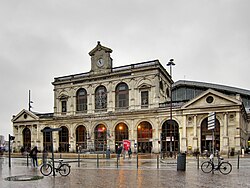
232 m
Lille-Flandres station
Lille-Flandres station (French: Gare de Lille-Flandres, Dutch: Station Lille-Flandres) is the main railway station of Lille, capital of French Flanders. It is a terminus for SNCF Intercity and regional trains. It opened in 1842 as the Gare de Lille, but was renamed in 1993 when Lille Europe station opened. There is a 500 metres (1,600 ft) walking distance between the two stations, which are also adjacent stops on one of the lines of the Lille Metro.

289 m
Saint-Maurice, Lille
The Église Saint-Maurice is a church on Rue Pierre-Mauroy, in the historic centre of Lille, northern France. Its construction began at the end of the 14th century and completed at the end of the 19th century, and it was extended over more than four centuries. A hall church in the Gothic style, it was made a monument historique in 1914.
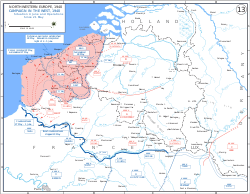
291 m
Siege of Lille (1940)
The siege of Lille or Lille pocket (28–31 May 1940) took place during the Battle of France in the Second World War. The siege of the French IV Corps and V Corps (about 40,000 men) of the First Army (General René Prioux) was conducted by four German infantry divisions supported by three panzer divisions.
The III Corps of the First Army had managed to retreat to the Lys river with the British Expeditionary Force (BEF) divisions nearby. The two surrounded French corps resisted German attacks until forced to surrender at midnight on 31 May/1 June. The defence of the Lille Pocket enabled more Allied troops to retreat into the Dunkirk perimeter and take part in the Battle of Dunkirk.

301 m
Braderie de Lille
The Lille Braderie (French: Braderie de Lille) is a braderie, or annual street market/flea market, that takes place on the weekend of the first Sunday of September in Lille, France, in the northern Hauts-de-France region. It dates back to the 12th century, attracting nearly three million visitors each year. The Braderie de Lille is one of the largest gatherings in France and the largest flea market in Europe. In 2014 the Braderie was reported to host 100km of market stalls to over 10,000 exhibitors.
During the Braderie, the city hosts a music festival. The traditional food eaten during the festival, moules-frites, typically results in built-up heaps of mussel shells around the city.
In 2016, the Braderie was cancelled by Lille mayor Martine Aubry, following terrorist incidents in France.

344 m
University of Lille
The University of Lille (French: Université de Lille, abbreviated as ULille, UDL or univ-lille) is a French public research university based in Lille, in the Nord department of Upper France. It has its origins in the University of Douai (1559), and resulted from the merger of three universities – Lille 1 University of Science and Technology, Lille 2 University of Health and Law, and Charles de Gaulle University – Lille III in 2018. With more than 80,000 students, it is one of the largest universities in France and one of the largest French-speaking universities in the world.
Since 2017, the university has been funded as one of the French universities of excellence. It benefits from an endowment of 500 million euros to accelerate its strategy in education, research, international development and outreach.
With 66 research labs, 350 PhD theses supported per year and 3,000 scientific publications each year, it is well represented in the research community; it collaborates with many organizations (Pasteur Institute of Lille, CHU Lille University Hospital, CNRS, INSERM, INRA, INRIA etc.) and schools (École Centrale de Lille, École des Mines-Télécom de Lille-Douai (IMT Lille Douai), Sciences Po Lille etc.).
Until 2019, the university was the main component of the Community of Universities and Institutions (COMUE) Lille Nord de France. It still operates the European Doctoral College, which federates universities and other higher learning institutes in the Hauts-de-France region.