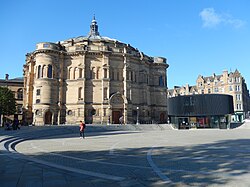
Le McEwan Hall (en gaélique écossais : Talla MhicEòghainn) est la salle de remise des diplômes de l'Université d'Édimbourg, à Édimbourg, la capitale de l'Écosse. Elle a été présentée à l'Université en 1897 par William McEwan, brasseur et homme politique, au prix de 115 000 £. Sir Robert Rowand Anderson en est l'architecte. Le McEwan Hall est un bâtiment classé de catégorie A .

1. Histoire et description

La conception a été commencée en 1876 et a été en grande partie entreprise par George Mackie Watson alors qu'il travaillait dans les bureaux de Robert Rowand Anderson (le plan directeur étant de Rowand Anderson lui-même). Il a été construit en utilisant la pierre de Prudham Quarry, Hexham dans le Northumberland . L'extérieur de la salle en forme de D a été achevé en 1894. L'intérieur, terminé en 1897, est construit dans le style de la Renaissance italienne et présente des décorations murales de la main de William Mainwaring Palin . L'œuvre d'art centrale est une grande œuvre peinte connue sous le nom de «Temple de la renommée» représentant un grand nombre de philosophes et d'étudiants. L'orgue McEwan Hall a été construit en 1897 par Robert Hope-Jones, et a été reconstruit et modifié à plusieurs reprises par la suite . Une autre caractéristique du McEwan Hall est son grand dôme. À l'intérieur du dôme se trouve une inscription biblique: la sagesse est la chose principale, donc obtenez la sagesse, et avec tout ce que vous obtenez, obtenez la compréhension. Exaltez-la et elle vous honorera. (Proverbes 4: 7). En 2015, le hall et Bristo Square ont été fermés pour rénovation et rouverts à temps pour les remises de diplômes de juillet 2017 (coût prévu de 35 millions de livres sterling). Le nouveau chauffage, la ventilation et l'éclairage ont été intégrés à l'intérieur d'origine et de nouvelles salles de séminaire créées au sous-sol et au-dessous de Bristo Square. L'un des principaux objectifs du projet était de fournir un accès facile à toutes les zones, y compris la galerie du deuxième étage. Le McEwan Hall est utilisé pour des remises de diplômes, des conférences et des meetings publics, certains événements du Festival Fringe d'Édimbourg et des récitals d'orgue.

1. Galerie


1. Notes et références

(en) Cet article est partiellement ou en totalité issu de l’article de Wikipédia en anglais intitulé « Mc Ewan Hall » (voir la liste des auteurs).

1. Liens externes

« McEwan Hall », Edinburgh First, The University of Edinburgh (consulté le 3 juillet 2018) « McEwan Hall, Edinburgh », edinburgharchitecture.co.uk (consulté le 27 février 2010) Portail de l’architecture et de l’urbanisme Portail de l’Écosse Portail des monuments classés au Royaume-Uni

Nearby Places View Menu
Location Image
184 m

George Square, Edinburgh

George Square (Scottish Gaelic: Ceàrnag Sheòrais) is a city square in Edinburgh, Scotland. It is in the south of the city centre, adjacent to the Meadows. It was laid out in 1766 outside the overcrowded Old Town, and was a popular residential area for Edinburgh's better-off citizens. In the 1960s, much of the square was redeveloped by the University of Edinburgh, although the Cockburn Association and the Georgian Group of Edinburgh protested. Most but not all buildings on the square now belong to the university (among the exceptions being the Dominican priory of St Albert the Great). Principal buildings include the Gordon Aikman Lecture Theatre, Edinburgh University Library, 40 George Square and Appleton Tower.
Location Image
197 m

Edinburgh University Press

Edinburgh University Press (EUP) is a scholarly publisher of academic books and journals, based in Edinburgh, Scotland.
198 m

Inspace

Inspace is an events and exhibition space within the campus of the University of Edinburgh, situated in Crichton Street in the southside of the city. Currently the space is the home for the Institute for Design Informatics. Inspace presents a programme of public exhibitions and events that span art, technology and design, including festival events that are part of the programme of the Edinburgh Science Festival. It was designed by Architects Reiach and Hall within the University of Edinburgh’s Informatics Forum and opened in 2010. The gallery features large street-facing windows with back-projection screens to display media to the public outside the building.
Location Image
225 m

Edinburgh Central Mosque

The Edinburgh Central Mosque (officially known as the King Fahd Mosque and Islamic Centre of Edinburgh) is located on Potterrow near the University of Edinburgh central area and the National Museum of Scotland. The mosque and Islamic centre was designed by Dr. Basil Al Bayati, and took more than six years to complete at a cost of £3.5M. The main hall can hold over one thousand worshippers, with women praying on a balcony overlooking the hall. The mosque holds chandeliers and a vast carpet, with very little furniture. The architecture combines traditional Islamic features with a Modernist Scots baronial style. Geza Fehervari, Professor of Islamic Art & Archaeology at London University, said "The architectural elements and decorative details, while basically relying on Islamic, mainly Turkish traditions, successfully interact with the architectural and decorative age-old customs of Scotland."
229 m

University of Edinburgh School of Literatures, Languages and Cultures

The School of Literatures, Languages and Cultures is a department within the College of Arts, Humanities and Social Sciences at the University of Edinburgh in Scotland. The unit was formed in 2002 as a result of administrative restructuring, when several departments of what was then the Faculty of Arts were brought together. The School currently covers seven major subject areas: Asian Studies (Chinese, Japanese and Sanskrit) Celtic and Scottish Studies (Scottish Gaelic: Ceiltis agus Eòlas na h-Alba) English Literature European Languages and Cultures (French, German, Hispanic Studies, Italian, Russian and Scandinavian Studies) Film studies Islamic studies and Middle Eastern Studies Theatre Studies Translation Studies Founded in 1762 when King George III appointed the Reverend Hugh Blair as the first Regius Professor of Rhetoric and Belles-Lettres, the English Literature department is the oldest centre for the study of Literature in the UK, and one of the oldest in the world. The college also includes a sizeable Graduate School which includes Masters and PhDs in Film Studies, Theatre Studies, Translation Studies, Cultural Studies and other subjects. The School also supports interdisciplinary research areas such as Word and Music Studies.