

 English
 Français
Astley Bridge railway station
Astley Bridge railway station served the village of Astley Bridge, England, from 1877 to 1879 on the Astley Branch Railway.
Nearby Places View Menu

266 m
Church of All Souls, Bolton
The Church of All Souls is a redundant Anglican church on Astley Street in Astley Bridge, a predominantly residential district of Bolton, Greater Manchester, England. Historically in Lancashire, it is recorded in the National Heritage List for England as a Grade II* listed building and was formerly under the care of the Churches Conservation Trust. As of 2014, the church is in use as a business and community centre.

388 m
Sharples, Greater Manchester
Sharples is a suburb of Bolton, in the county of Greater Manchester, England. It was a township of the civil and ecclesiastical parish of Bolton le Moors in the Salford hundred of Lancashire, England.
It lay 2+1⁄2 miles north of Bolton.
It contained the smaller settlements of Banktop, Sweet-Loves, High-Houses, Gale, Folds, Belmont, Piccadilly, Water-Meetings, Old Houses and part of Astley Bridge.
434 m
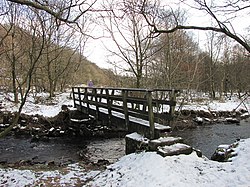
Astley Brook
Astley Brook is a river in Greater Manchester, England.
Rising at the confluence of Dean Brook and Raveden Brook near Halliwell in the Metropolitan Borough of Bolton, it travels eastward to "Meeting of the Waters", where it meets Eagley Brook to form the River Tonge.
434 m
Eagley Brook
Eagley Brook (also known during the formative part of its course as Belmont Brook) is a small river of Lancashire and Greater Manchester in England.
Rising at the confluence of several smaller streams at Old Man's Hill in the West Pennine Moors, the brook almost immediately feeds Belmont Reservoir, after which it moves south and south east, passing the village of Belmont and collecting several tributaries and traversing the Longworth Clough, emerging close to Egerton.
From there, the river goes south, through Eagley near Bromley Cross, towards Astley Bridge, after which it joins Astley Brook at Meeting of the Waters to form the River Tonge.
Eagley Brook was historically important to the industrial and economic life of the north Bolton area. Its fast-flowing streams provided power to the water-wheels of the early industrial period, steam power at a later date, and soft water for bleaching and paper making.