Location Image

Castle Terrace Car Park

Castle Terrace Car Park is a car park in Edinburgh in the brutalist style which was designated as a listed building in October 2019. It is situated across from Argyle House on Castle Terrace road. Opened in 1964 and finished around 1966, it is the first modern multistorey car park built in Scotland, and an early European example of the continuous ramp model. It has remained broadly unaltered since 1966 and is noted for being sensitively designed so as not to interfere with views of Edinburgh Castle. Commissioned by the Edinburgh Corporation, the car park was designed and built by Kinnear & Gordon and T. Waller Marwick & Associates between 1959 and 1966. The continuous ramp was inspired by a car park built in Nyropsgade, Copenhagen in 1958. The car park features in the film T2 Trainspotting.

1. References


1. External links

Media related to Castle Terrace Car Park at Wikimedia Commons

Nearby Places View Menu
Location Image
96 m

Highland Church

The Highland Church was a Gaelic-speaking congregation of the Church of Scotland, based in Tollcross, Edinburgh. Formed by the union of St Oran's Church and St Columba's Gaelic Church in 1948, the congregation continued united with Tolbooth St John's in 1956. Gaelic worship in Edinburgh began in the early 18th century, leading to the opening of the Gaelic Chapel in 1769. At the Disruption of 1843, all the office-bearers of the Gaelic congregation joined Free Church along with most of the congregation's members. The Free congregation met at a building off Lothian Road before moving nearby to a permanent church at Cambridge Street in Tollcross. From 1849 to 1846, Thomas McLauchlan served as the congregation's minister. An active pastor, he strengthened congregation's activities and served as the moderator of the Free Church's general assembly in 1876. The congregation adopted the name St Columba's Gaelic Free Church, after Columba of Iona, in 1864. In 1900, most of the congregation joined the United Free Church, which had been formed by the union of the Free and United Presbyterian churches. Disputes and schisms around the union diminished the congregation, however. By 1931, the regular English service, introduced in 1886, had become the congregation's main act of worship. The union of United Free Church with the Church of Scotland in 1929 brought St Columba's and the congregation from which it had split – known, by this point, as St Oran's – into the same denomination. Edinburgh's two Gaelic congregations united in 1948. They continued to use the St Columba's buildings until uniting with Tolbooth St John's in 1956. Via Highland, Tolbooth, St John's union with Greyfriars Kirk in 1979, the latter congregation maintains a weekly Gaelic service. St Columba's occupied a simple building in the Early English style by Patrick Wilson, completed in 1851. The building afterwards served as an arts venue before being demolished in 1989. The Saltire Court development, incorporating the Traverse Theatre, now occupies the site.
Location Image
98 m

Traverse Theatre

The Traverse Theatre is a theatre in Edinburgh, Scotland. It was founded as The Traverse Theatre Club in 1962 by John Calder, John Malcolm, Jim Haynes, Richard Demarco, Terry Lane, Andrew Muir, John Martin and Sheila Colvin. The Traverse Theatre company commissions and develops new plays or adaptations from contemporary playwrights, often describing itself as "Scotland’s new writing theatre". The Traverse also presents productions from visiting companies and acts as a host venue for Edinburgh Festival Fringe shows in August. It is also the home of 'Imaginate' the Edinburgh International Children's Festival.
Location Image
128 m

Royal Lyceum Theatre

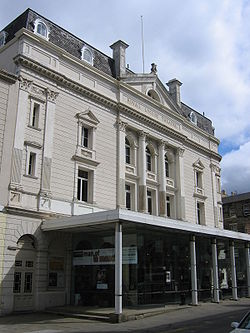
The Royal Lyceum Theatre is a theatre in Edinburgh, Scotland, named after the Theatre Royal Lyceum and English Opera House, the residence at the time of legendary Shakespearean actor Henry Irving. It was built in 1883 by architect C. J. Phipps at a cost of £17,000 on behalf of James B. Howard and Fred. W. P. Wyndham, two theatrical managers and performers whose partnership became the renowned Howard & Wyndham Ltd created in 1895 by Michael Simons of Glasgow. With only four minor refurbishments, in 1929, 1977, 1991 and 1996, the Royal Lyceum remains one of the most original and unaltered of the architect's works. Opening night was 10 September 1883 with a performance of Much Ado About Nothing by the company of the London Lyceum Theatre, and starring Henry Irving and Ellen Terry. In 1965, the building was purchased by the Edinburgh Corporation from Meyer Oppenheim to house the newly formed Royal Lyceum Theatre Company, who are now the permanent residents, leasing it from the City of Edinburgh Council. The Royal Lyceum has been one of the principal venues for the Edinburgh International Festival since the festival's inception in 1947, its owners renting out the building for three weeks every August for visiting companies, and often for a further week to Fringe companies. The Royal Lyceum has primarily been known for its provision of drama. It has also presented some significant opera, from the first tours of Carl Rosa in the latter part of the 19th century, through to the early decades of Scottish Opera in the 1960s and 1970s. Some important operas received their first Scottish performance at the Lyceum, including Madam Butterfly, Manon and Die Meistersinger. The theatre was the first in Britain to be fitted with an iron safety curtain, and the first in Scotland to use electricity for house lighting. David Greig took over from Mark Thomson as artistic director in 2016. James Brining became artistic director in 2025.
Location Image
140 m

Usher Hall

The Usher Hall (Scottish Gaelic: Talla Usher) is a concert hall in the West End of Edinburgh, Scotland. The hall is owned and managed by the City of Edinburgh Council, and has hosted concerts and events since its construction in 1914. The venue can hold approximately 2,200 people in its recently restored auditorium, which is well loved by performers due to its acoustics. In March 1972, the Eurovision Song Contest was held at the Hall and compèred by Moira Shearer. This marked the first time that the Eurovision Song Contest had been held in Scotland. It was also the venue of Eurovision Young Musicians in August 2018. In 1986, the Commonwealth Games was hosted by Edinburgh, with the Usher Hall providing the venue for the boxing tournament. The Hall is flanked by The Royal Lyceum Theatre to the south and The Traverse Theatre to the north. Historic Environment Scotland has registered the Hall with Category A listed building status.