

 English
 Français

I. P. Pavlova is a Prague Metro station on Line C. It is in the Vinohrady district of Prague. Above the station is I. P. Pavlov Square (Czech: náměstí I. P. Pavlova), which is named after Russian physiologist Ivan Petrovich Pavlov. Both the station and the square are shortened by locals to diminutive names such as Ípák, Pavlák or Ípáč. I. P. Pavlova is the busiest station on the Prague Metro, serving daily more than 118,000 people as of 2008.
Nearby Places View Menu

220 m
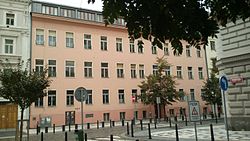
University of New York in Prague
The University of New York in Prague (UNYP) is a private higher education institution in Prague, Czech Republic. It was established in 1998 in cooperation with the State University of New York at New Paltz and Empire State University, both part of the State University of New York (SUNY). UNYP was recognized by the Czech Ministry of Education, Youth and Sports in 2001 on the basis of accreditation of its study programs in Business Administration and International European Relations. UNYP is a member of the British Accreditation Council for Independent Further and Higher Education.
Originally located in the historic old town of Prague, on the corner of Mikovcova and Legerova streets, in 2014 UNYP moved to a new campus on Londýnská 41 in Vinohrady (Prague 2).
372 m
Lauder Schools of Prague
The Lauder Schools of Prague (Czech: Lauderovy školy v Praze) are the only Jewish schools in Prague and in the entire Czech Republic. The schools consists of an elementary school called The Lauder Gur Arje Jewish Day School and a secondary school called The Lauder Or Chadaš Jewish Community High School. The names of the schools refer to an important figure of the Jewish Ghetto in Prague, Rabbi Judah Loew ben Bezalel, who was also known as the Maharal of Prague and Rabbi Loew.
The schools were founded in 1997 by the Prague Jewish Community together with the R. S. Lauder Foundation and the Czech Ministry of Education, they operate on the site of a former orphanage for Jewish children who had lost their families in the Holocaust and man of whom have perished themselves.
More than 450 students attend the Lauder Schools of Prague as of 2024.
All subjects are taught in Czech, except for foreign languages (Hebrew, English, German and French). Three hours a week of Judaism is also taught. The school operates a kosher kitchen and runs according to the Jewish calendar.
Even though there is a kindergarten, an elementary school and a secondary school in the Lauder School of Prague, it only has one principal: Mr. Petr Karas.
There are similar schools in other countries. Poland has the Lauder - Morasza School, Hungary the Lauder Javne Jewish Community School, etc.

384 m
New Town, Prague
New Town (Czech: Nové Město) is a quarter in the city of Prague in the Czech Republic. New Town is the youngest and largest of the five independent (from the Middle Ages until 1784) towns that today comprise the historic center of modern Prague. New Town was founded in 1348 by Charles IV just outside the city walls to the east and south of the Old Town and encompassed an area of 7.5 km2; about three times the size of the Old Town. The population of Prague in 1378 was well over 40,000, perhaps as much as twice that, making it the 4th most populated city north of the Alps and, by area, the 3rd largest city in Europe. Although New Town can trace its current layout to its construction in the 14th century, only few churches and administrative buildings from this time survive. There are many secular and educational buildings in New Town, but also especially magnificent gothic and baroque churches. These nevertheless are not the main drawing points for tourists. New Town's most famous landmark is Wenceslas Square, which was originally built as a horsemarket and now functions as a center of commerce and tourism. In the 15th century, the Novoměstská radnice, or New Town Hall, was the site of the first of the three defenestrations of Prague.

415 m
St. Longin's Rotunda
St. Longin's Rotunda (Prague, Na Rybníčku) (Czech: Rotunda svatého Longina) is one of the few preserved romanesque rotundas in Prague, in the Czech Republic. It was founded in the 12th century as a parish church for a village called "Rybníček" which was there before the founding of the Prague New Town in the middle of the 14th century.
Originally, it was a Pagan temple before the arrival of Christianity, when it was transformed into a Catholic chapel.
Up until the 14th century, it was consecrated to St Stephen, before Charles IV founded the New Town and changed the consecration to Saint Longinus, who was one of the men who took part in Jesus' crucifixion, and supposedly pierced the side of Jesus. Longinus came to deeply regret this action, causing him to desert the army and become a hermit, later leading to his arrest and execution.
The rotunda was nearly demolished in the 19th century while the nearby street (Na Rybníčku) was being built, but it was saved by František Palacký.