The A1107 is a road in south-east Scotland, in the Scottish Borders. It is a non-trunk route from near Cockburnspath to near Burnmouth.

1. Route

It follows the route Burnmouth – Eyemouth – Coldingham – Old Cambus – Pease Bay – Cockburnspath. The route offers an excellent view of the relatively flat area to the east of Dunbar (East Lothian), namely the Torness Power Station and the Isle of May at the end of the Firth of Forth and across to Fife.

1. Settlements

Only at the southern end are there any settlements (Eyemouth and Coldingham). The route is closer to the east coast than the main A1 road inland, therefore providing a touristic alternative route along the sea shore.

1. History

The road contains what was once the highest bridge in Europe, a masonry structure over the gorge that leads out to the nearby Pease Bay, now a holiday caravan site. At its southern end, this bridge crosses the Southern Upland Way and Sir Walter Scott Way long-distance footpaths.

1. Proposed additions

There was a proposal to construct a wind farm straddling the road consisting of 22 wind turbines with a maximum height of 76 m. The planning officials of the Scottish Borders Council recommended refusal of the application of the developers PM Renewable Ltd. The planning application was rejected by a unanimous decision of the Scottish Borders Council.

1. References


1. External links

Media related to A1107 road (Scotland) at Wikimedia Commons

Nearby Places View Menu
1.2 km

Press Castle

Press Castle is a village with 17th-century manor house and country estate in the Scottish Borders, 2m (3 km) west of Coldingham, by the Ale Water. NT871654. The area is renowned for its colonies of red squirrels.
Location Image
3.2 km

Coldingham

Coldingham is a village and parish in Berwickshire in the Scottish Borders. It lies a short distance inland from Coldingham Bay, three miles northeast of the fishing village of Eyemouth.
Location Image
3.6 km

Coldingham Loch

Coldingham Loch is a freshwater loch in the parish of Coldingham, in the Scottish Borders area of Scotland, in the former Berwickshire, between Coldingham Moor and St Abb's Head. The loch is a natural spring-fed 22-acre (8.9 ha) loch, about 300 yards (270 m) from the sea and about 300 feet (91 m) above sea level; it is used for fly fishing for rainbow trout and brown and blue trout. The area is also used for pheasant shooting. The Scottish Borders Council has described Coldingham Loch as "eutrophic open water, with high levels of plant nutrient, turbid water caused by high plankton levels; coarse fish generally dominant; in natural state supports high levels of biodiversity; often important wildfowl sites".
Location Image
3.9 km

Coldingham Priory

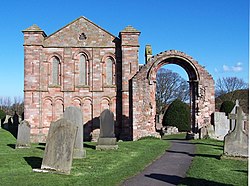
Coldingham Priory was a house of Benedictine monks. It lies on the south-east coast of Scotland, in the village of Coldingham, Berwickshire. Coldingham Priory was founded in the reign of David I of Scotland, although his older brother and predecessor King Edgar of Scotland had granted the land of Coldingham to the Church of Durham in 1098, and a church was constructed by him and presented in 1100. The first prior of Coldingham is on record by the year 1147, although it is likely that the foundation was much earlier. The earlier monastery at Coldingham was founded by St Æbbe sometime c. AD 640. Although the monastery was largely destroyed by Oliver Cromwell in 1650, some remains of the priory exist, the choir of which forms the present parish church of Coldingham and is serviced by the Church of Scotland.