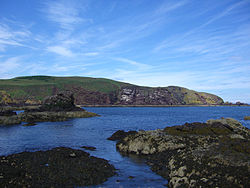
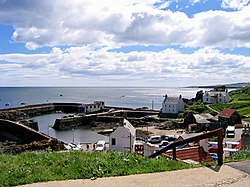
Coldingham Loch is a freshwater loch in the parish of Coldingham, in the Scottish Borders area of Scotland, in the former Berwickshire, between Coldingham Moor and St Abb's Head. The loch is a natural spring-fed 22-acre (8.9 ha) loch, about 300 yards (270 m) from the sea and about 300 feet (91 m) above sea level; it is used for fly fishing for rainbow trout and brown and blue trout. The area is also used for pheasant shooting. The Scottish Borders Council has described Coldingham Loch as "eutrophic open water, with high levels of plant nutrient, turbid water caused by high plankton levels; coarse fish generally dominant; in natural state supports high levels of biodiversity; often important wildfowl sites".

1. See also

List of places in the Scottish Borders List of places in Scotland

1. References

'Freshwater Biology', vol.17, issue3, pp. 419–428: A. E. BAILEY-WATTS: Coldingham Loch, S.E. Scotland. II. Phytoplankton succession and ecology in the year prior to mixer installation

1. External links

RCAHMS record of Coldingham Loch, or Biter's Craig CANMORE/RCAHMS record of Coldingham Loch, Long cist National Archives of Scotland: Parish of Coldingham Scottish Borders Council: Standing Open Water Habitat Action Plan British Listed Buildings: Coldingham Loch, Boat House, Coldingham Geograph image: Coldingham Loch Panorama

Nearby Places View Menu
Location Image
1.8 km

Mire Loch

Mire Loch is a man made freshwater loch situated on St Abb's Head in the Scottish Borders, just over a kilometre NW of the village of St. Abbs at grid reference NT912687. The loch lies on land owned by the National Trust for Scotland (NTS) and is approximately 600 metres long by 50 metres at its widest point.
Location Image
2.0 km

St Abb's Head

St Abb's Head is a rocky promontory by the village of St Abbs in Berwickshire, Scotland, and a national nature reserve administered by the National Trust for Scotland. St Abb's Head Lighthouse was designed and built by the brothers David Stevenson and Thomas Stevenson and began service on 24 February 1862.
Location Image
2.0 km

St Abb's Head Lighthouse

St Abb's Head Lighthouse stands on the cliffs at the rocky promontory of St Abb's Head, near the village of St Abbs in Berwickshire. A signal station was established on the cliffs before 1820 and the facilities were shared by Trinity House and Her Majesty's Coastguard. The Northern Lighthouse Board recommended the building of a lighthouse at St Abb's Head after the sinking of the Martello on Carr Rock in 1857. The lighthouse was designed and built by the brothers David Stevenson and Thomas Stevenson and assisted navigation before and after sight of the Bell Rock and Isle of May lights disappeared from view. The light began service on 24 February 1862 and initially used oil to generate its light, it was converted to incandescent power in 1906 and to electricity in 1966 and finally automated in 1993. Before automation the lighthouse was staffed by three full-time keepers whose duties included keeping detailed weather records. The lighthouse has two km of single-track tarmaced road leading to it from the main road near St Abbs village, however it is suggested by the National Trust for Scotland that it is only used by disabled visitors, and there is limited parking. Visitors can walk to the Head where the lighthouse's buildings, though still in good repair, are not open to the public. A foghorn was established at the Head in 1876, being the first audible fog signal in Scotland. The original foghorn was driven by hot air engines before being replaced by oil driven ones in 1911 and then by diesel engines in December 1955. The fog signal was discontinued in 1987 although the horn is still in place and can be reached at the edge of the cliffs by a railed path from the lighthouse.
Location Image
2.8 km

St Abbs

St Abbs is a small fishing village on the southeastern coast of Scotland, within the Coldingham parish of Scottish Borders. The village was originally known as Coldingham Shore, the name St Abbs being adopted in the 1890s. The new name was derived from St Abb's Head, a rocky promontory located to the north of the village, itself named after the 7th-century saint Æbbe of Coldingham.