

 English
 Français
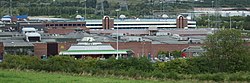
MetroCentre
Metrocentre (previously styled as MetroCentre) is a shopping centre and entertainment complex in the Dunston area of Gateshead. It is located on the former site of Dunston Power Station, near to the River Tyne. Metrocentre opened in stages, with the first phase opening on 28 April 1986, and the official opening being held on 14 October that year. It has 210 shops, 63 restaurants, an Odeon cinema, a Clip n’ Climb, a bowling alley, a Namco Funscape, The Escapologist and Treetop Golf, occupying over 2,000,000 sq ft (190,000 m2) of retail floor space, making it one of the largest shopping centres in the UK. Additional retail space can be found in the adjoining Metro Retail Park and MetrOasis.
Nearby Places View Menu

260 m
MetroCentre Interchange
Metrocentre Interchange serves the Metrocentre in Gateshead. The bus station was originally constructed in the late 1980s, opened in 1987. In the early 2000s, the former bus station was demolished, with the current bus station opened in October 2004.
A footbridge connects Metrocentre Interchange with the railway station and coach park. Rail services from the station are operated by Northern Trains.

336 m
MetroCentre railway station
MetroCentre is a railway station on the Tyne Valley Line, which runs between Newcastle and Carlisle via Hexham. The station, situated 3 miles 39 chains (3.49 mi; 5.61 km) west of Newcastle, serves Metrocentre, Gateshead in Tyne and Wear, England. It is owned by Network Rail and managed by Northern Trains.

741 m
Dunston Power Station
Sometimes confused with the nearby Stella power stations.
Dunston Power Station refers to a pair of adjacent coal-fired power stations in the North East of England, now demolished. They were built on the south bank of the River Tyne, in the western outskirts of Dunston in Gateshead. The two stations were built on a site which is now occupied by the MetroCentre. The first power station built on the site was known as Dunston A Power Station, and the second, which gradually replaced it between 1933 and 1950, was known as Dunston B Power Station. The A Station was, in its time, one of the largest in the country, and as well as burning coal had early open cycle gas turbine units. The B Station was the first of a new power station design, and stood as a landmark on the Tyne for over 50 years. From the A Station's opening in 1910 until the B Station's demolition in 1986, they collectively operated from the early days of electricity generation in the United Kingdom, through the industry's nationalisation, and until a decade before its privatisation.
Dunston A had a generating capacity of 48.85 megawatts (MW) in 1955, and Dunston B had a generating capacity of 300 MW. Electricity from the stations powered an area covering Northumberland, County Durham, Cumberland, Yorkshire and as far north as Galashiels in Scotland.

994 m
River Derwent, North East England
The River Derwent is a river which flows between the historic county boundaries of Durham and Northumberland, and in the ceremonial county of Tyne and Wear, in North East England. It broadens into the Derwent Reservoir, west of Consett. The Derwent is a tributary of the River Tyne, which it joins at Derwenthaugh near Gateshead. River Derwent flows next to the Gibside estate.