


Morecambe Harbour railway station was on the "little" North Western Railway's Morecambe Harbour and Railway in Morecambe, Lancashire, England. It was opened in 1848 and closed in 1904. The line remained open to serve the harbour until an unknown date. Today the station building still exists as a cafe.
Gallery


Sponsored
Location

55 m
The Stone Jetty is a jetty in Morecambe, Lancashire, England. It was built by the North Western Railway in 1853 as a wharf and rail terminal for both passenger and cargo transport. The former station building with adjoining lighthouse stand on the jetty and are Grade II-listed. The jetty was resurfaced and partly rebuilt in the 1990s as part of coastal defence works, which was combined with the installation of public art and sculptures.
340 m
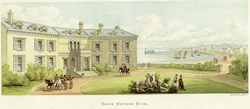
The North Western Hotel in Morecambe, Lancashire, England, was built in 1847–48. It was designed by the Lancaster architects Paley and Austin for the "Little" North Western Railway. Including furnishings, it cost £4,795. It was a two-storey building containing 40 bedrooms. In 1871, when the railway became part of the Midland Railway, its name was changed to the Midland Hotel. It was demolished and replaced by a new hotel, also called the Midland Hotel, in 1932.
340 m
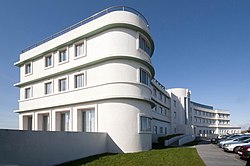
The Midland Hotel is a Streamline Moderne building in Morecambe, Lancashire, England. It was built by the London, Midland and Scottish Railway, in 1933, to the designs of architect Oliver Hill, with sculpture by Eric Gill, and murals by Eric Ravilious. It is a Grade II* listed building. The hotel has been restored by Urban Splash with architects Union North, Northwest Regional Development Agency and Lancaster City Council.

447 m
The Morecambe and Heysham War Memorial stands on the Promenade at Morecambe, Lancashire, England.
It has two inscriptions in black lettering, after which are listed the names of those remembered
The memorial remembers the 216 men who died in the First World War, the 180 in the Second World War and the single man
who was killed in the Korean War.
The war memorial, made of bronze and granite, was completed in 1921 and designed by Thomas Hayton Mawson. A bronze lion sits atop a stepped base. On 20 January 1993 the monument was registered as a Grade II structure at British Listed Buildings.

449 m
Morecambe Promenade was a railway station in Morecambe, Lancashire, England. It was opened on 24 March 1907 by the Midland Railway and closed in February 1994. After twelve weeks break in passenger service for the revision of track work and signalling, a new Morecambe station was opened on a site closer to the town centre.
The station opened as Morecambe and was renamed Morecambe Promenade in 1924. It reverted to its original name in 1968 and remained so until closure.