

 English
 Français

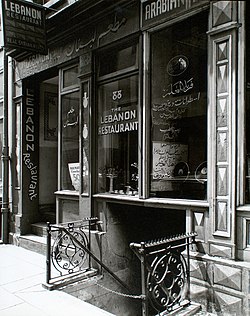
Little Syria
Little Syria (la Petite Syrie), aussi appelée le quartier syrien, était un quartier du Lower Manhattan habité des années 1880 aux années 1940 par des émigrés en majorité chrétiens de la Syrie ottomane. Paul Morand évoque dans New York (1930) la « Petite Syrie », qui « représente la vieille colonie car la nouvelle, et c'est également vrai pour les Grecs, a émigré à Brooklyn. »
1. Bibliographie
« Little Syria, quartier oublié de Manhattan, revient à la vie », Le Point, 3 octobre 2016 (lire en ligne).
1. Liens externes
Société historique pour la préservation et la promotion du patrimoine de "la Petite Syrie"
Portail de New York
Nearby Places View Menu
5 m
Little Syria, Manhattan
Little Syria (Arabic: سوريا الصغيرة) was a diverse neighborhood that existed in the New York City borough of Manhattan from the late 1880s until the 1940s. The name for the neighborhood came from the Arabic-speaking Christian population who emigrated from Ottoman Syria, an area which today includes the nations of Lebanon, Syria, Jordan, Israel, and Palestine. Also called the Syrian Quarter, or Syrian Colony in local newspapers it encompassed a few blocks reaching from Washington Street in Battery Park to above Rector Street. This neighborhood became the center of New York's first community of Arabic-speaking immigrants. In spite of this name the neighborhood was never exclusively Syrian or Arab, as there were also many Irish, German, Slavic, and Scandinavian immigrant families present.
The neighborhood declined as the inhabitants began moving out to other areas, Brooklyn Heights, the Sunset Park area and Bay Ridge, with many shops relocating to Atlantic Avenue, in Brooklyn. The community disappeared almost entirely when a great deal of lower Washington Street was demolished to make way for the entrance ramps to the Brooklyn-Battery Tunnel. The quarter was located at the southern edge of the site that would become the World Trade Center. After the September 11 terrorist attacks the cornerstone of the Syrian St. Joseph's Maronite Church was found in the rubble.
30 m
Rector Street station (IRT Ninth Avenue Line)
The Rector Street station was a station on the demolished IRT Ninth Avenue Line in Manhattan, New York City. It was built in 1874, and had two tracks and two side platforms, though two additional tracks ended at a bumper just south of the station. It was served by trains from the IRT Ninth Avenue Line, and was one block west of Rector Street El Station on the IRT Sixth Avenue Line. In 1918, the IRT extended what is today known as the Broadway–Seventh Avenue Line from Times Square down to South Ferry and built their own Rector Street station as one of the stations, serving as competition for the Ninth Avenue Line station. The el station closed on June 11, 1940. The next southbound stop was Battery Place. The next northbound stop was Cortlandt Street for Ninth Avenue Line trains.

30 m
88 Greenwich Street
88 Greenwich Street, also known as the Greenwich Club Residences and previously as 19 Rector Street, is a building located on the southern side of Rector Street between Greenwich and Washington Streets in the Financial District of Manhattan, New York City. Constructed in 1929–30, this 37-story structure was designed in the Art Deco style by Lafayette A. Goldstone and Alexander Zamshnick.
An entrance to the Rector Street station of the New York City Subway was located in the basement of the building and opened in 1931. However, this entrance was closed by 1941.
88 Greenwich Street was added to the National Register of Historic Places in 2002. In 2006, the building was renovated into residential condominium use. In 2012, the building was severely affected by flooding from Hurricane Sandy. Approximately three million cubic feet of saltwater entered the building's basement, leading to extensive damage. Additionally, during the flooding, water dislodged an oil tank, causing it to crack upon hitting a ceiling beam.
37 m
Downtown Community House
The Downtown Community House at 105-107 Washington Street is a six-story, five-bay red brick building that is among the last vestiges of the Lower West Side of Manhattan's former life as an ethnic neighborhood known as “Little Syria.” From the time of its establishment, the Bowling Green Neighborhood Association, housed in the Downtown Community House beginning in 1926, was a pioneering organization that served the local immigrant population as a settlement house and continued to provide services for the area well after the community house became defunct. Built in 1925 with philanthropic funds from William H. Childs, the founder of the Bon Ami household cleaner company, the Downtown Community House was designed by John F. Jackson, architect of over 70 Y.M.C.A. buildings and community centers, and through its Colonial Revival style speaks to an underlying desire for the neighborhood's immigrant population to become Americanized and associate themselves with the country's foundations. In recent years, a collection of historic preservationists and Arab-American activists have lobbied the Landmarks Preservation Commission and its chairman Robert Tierney to designate the building as a city landmark.

42 m
St. George's Syrian Catholic Church
St. George's Syrian Catholic Church is a former church located at 103 Washington Street between Rector Street and Carlisle Street in the Financial District of Manhattan, New York City. The church is the last physical reminder of the Syrian American and Lebanese American community that once lived in Little Syria.