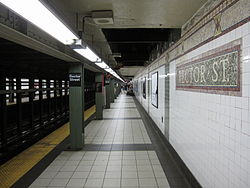
Rector Street station (IRT Ninth Avenue Line)

The Rector Street station was a station on the demolished IRT Ninth Avenue Line in Manhattan, New York City. It was built in 1874, and had two tracks and two side platforms, though two additional tracks ended at a bumper just south of the station. It was served by trains from the IRT Ninth Avenue Line, and was one block west of Rector Street El Station on the IRT Sixth Avenue Line. In 1918, the IRT extended what is today known as the Broadway–Seventh Avenue Line from Times Square down to South Ferry and built their own Rector Street station as one of the stations, serving as competition for the Ninth Avenue Line station. The el station closed on June 11, 1940. The next southbound stop was Battery Place. The next northbound stop was Cortlandt Street for Ninth Avenue Line trains.

Nearby Places View Menu
Location Image
26 m

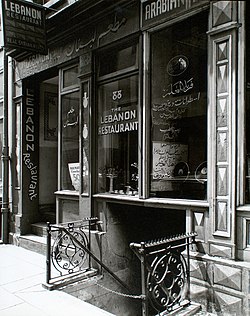
Little Syria, Manhattan

Little Syria (Arabic: سوريا الصغيرة) was a diverse neighborhood that existed in the New York City borough of Manhattan from the late 1880s until the 1940s. The name for the neighborhood came from the Arabic-speaking Christian population who emigrated from Ottoman Syria, an area which today includes the nations of Lebanon, Syria, Jordan, Israel, and Palestine. Also called the Syrian Quarter, or Syrian Colony in local newspapers it encompassed a few blocks reaching from Washington Street in Battery Park to above Rector Street. This neighborhood became the center of New York's first community of Arabic-speaking immigrants. In spite of this name the neighborhood was never exclusively Syrian or Arab, as there were also many Irish, German, Slavic, and Scandinavian immigrant families present. The neighborhood declined as the inhabitants began moving out to other areas, Brooklyn Heights, the Sunset Park area and Bay Ridge, with many shops relocating to Atlantic Avenue, in Brooklyn. The community disappeared almost entirely when a great deal of lower Washington Street was demolished to make way for the entrance ramps to the Brooklyn-Battery Tunnel. The quarter was located at the southern edge of the site that would become the World Trade Center. After the September 11 terrorist attacks the cornerstone of the Syrian St. Joseph's Maronite Church was found in the rubble.
Location Image
37 m

Trinity Court Building

Trinity Court Building, also known as Trinity Commons, is a structure at 68–76 Trinity Place, between Rector and Albany Streets, in the Financial District of Lower Manhattan in New York City. It replaces a building on the site with the same name, constructed in 1927. The 1927 building, in turn, had been erected to replace a structure built in 1879. Trinity Church, which owns the site, had its offices and preschool in the 1927 building. In 2015, the church faced a choice of a $33 million renovation to bring it up to code, or to replace it with a new building at a cost of about $35 million. The vestry decided on the latter and tore the structure down. In its place, it planned to construct a new building with an address of 68-74 Trinity Place. Originally, 310,000 square feet (29,000 m2) of primarily luxury condominiums with a modern glass facade was planned. Due to community opposition the plans were changed, with a smaller commercial building incorporating community-friendly uses. The new design also uses bronzed aluminum to better fit in with the church and a preserved footbridge from the previous building, and incorporates stained glass and terra cotta embellishments salvaged form the 1927 edifice. The third building, known as Trinity Commons, topped out in 2018 and opened in 2021.
Location Image
45 m

88 Greenwich Street

88 Greenwich Street, also known as the Greenwich Club Residences and previously as 19 Rector Street, is a building located on the southern side of Rector Street between Greenwich and Washington Streets in the Financial District of Manhattan, New York City. Constructed in 1929–30, this 37-story structure was designed in the Art Deco style by Lafayette A. Goldstone and Alexander Zamshnick. An entrance to the Rector Street station of the New York City Subway was located in the basement of the building and opened in 1931. However, this entrance was closed by 1941. 88 Greenwich Street was added to the National Register of Historic Places in 2002. In 2006, the building was renovated into residential condominium use. In 2012, the building was severely affected by flooding from Hurricane Sandy. Approximately three million cubic feet of saltwater entered the building's basement, leading to extensive damage. Additionally, during the flooding, water dislodged an oil tank, causing it to crack upon hitting a ceiling beam.
Location Image
54 m

Rector Street station (IRT Broadway–Seventh Avenue Line)

The Rector Street station is a station on the IRT Broadway–Seventh Avenue Line of the New York City Subway. Located at the intersection of Rector Street and Greenwich Street in Financial District of Manhattan, it is served by the 1 train at all times. The station was built by the Interborough Rapid Transit Company (IRT) as part of the Dual Contracts with New York City, and opened on July 1, 1918. The station's platforms were lengthened in the 1960s, and the station was renovated after being out of service for a year in the aftermath of the September 11, 2001 attacks.