

 English
 Français
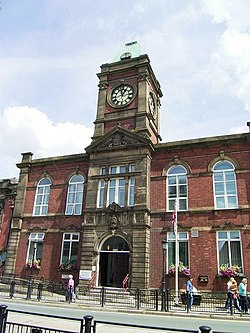
Royton Town Hall
Royton Town Hall is a municipal building in Rochdale Road, Royton, Greater Manchester, England. The town hall was the headquarters of Royton Urban District Council.
Nearby Places View Menu

92 m
Royton
Royton is a town in the Metropolitan Borough of Oldham, Greater Manchester, England, with a population of 21,284 in 2011. Close to the source of the River Irk, near undulating land at the foothills of the South Pennines, it is 2 miles (3.2 km) northwest of Oldham, 3 miles (4.8 km) southeast of Rochdale and 8 miles (12.9 km) northeast of Manchester.
Within the boundaries of the historic county of Lancashire, Royton and its surroundings have provided evidence of ancient British, Roman and Viking activity in the area. During the Middle Ages, Royton formed a small township centred on Royton Hall, a manor house owned by a long succession of dignitaries which included the Byrons and Radcliffes. A settlement expanded outwards from the hall which, by as late as 1780, "contained only a few straggling and mean-built cottages". Farming was the main industry of this rural area, with locals supplementing their incomes by hand-loom woollen weaving in the domestic system.
Royton has the distinction of being the first town where a powered cotton mill was built; at Thorp in 1764, and is one of the first localities in the world to have adopted the factory system. The introduction of textile manufacture during the Industrial Revolution facilitated a process of unplanned urbanisation in the area, and by the mid-19th century Royton had emerged as a mill town. At its zenith, there were 40 cotton mills—some of the largest in the United Kingdom—employing 80% of the local population. Imports of foreign cotton goods began the decline in Royton's textile industry during the mid-20th century, and its last mill closed in 2002.
Today, fewer than a dozen mills are still standing, the majority of which are used for light engineering or as distribution centres. Despite an economic depression brought about by the demise of cotton spinning, Royton's population has continued to grow as a result of intensive housing redevelopment which has modernised its former Edwardian districts.
252 m
Royton railway station
Royton railway station served the town of Royton, England. It opened on 21 March 1864, and was at the end of a short branch line from Royton Junction railway station on the Oldham Loop Line. Royton closed to goods services on 2 November 1964, and to passenger services on 16 April 1966.
511 m
Our Lady's Roman Catholic High School, Royton
Our Lady's R.C. High School was a Roman Catholic high school and sixth form for 11- to 18-year-olds, located in Royton, in the Metropolitan Borough of Oldham, Greater Manchester, England. The school was a specialist school in Mathematics and Computing, and contained over 80 members of staff, with over 1200 students. The sixth form college offered 19 (as of the 2007/08 academic year) courses.
The school had a dispute in 2010 after Headteacher R. Whittaker was suspended. His Deputy Headteacher, C. Spillaine became Acting Headteacher, but left the school at the end of 2010 after disagreements with the students. The most recent Headteacher was Mr Thornton who left when the school merged with St Augustine of Canterbury RC High School to form Blessed John Henry Newman RC College, a joint Roman Catholic School.

701 m
Church of St Anne, Royton
The Church of St Anne is an Anglican parish church on St Anne's Avenue in Royton, a town within the Metropolitan Borough of Oldham, Greater Manchester, England. It is an active church in the Diocese of Manchester and is recorded in the National Heritage List for England as a Grade II* listed building. The church was designed by the architect Temple Moore and built in 1908–09, forming part of his later ecclesiastical output and regarded as one of his most accomplished parish churches. The tower was added in 1926–27 by Moore's son-in-law, Leslie Moore, following the original designs.