55 Wall Street, anciennement connu sous le nom de National City Bank Building, est un immeuble de banque situé dans le Financial District du centre-ville de Manhattan, à New York. Il a été construit en 1836-1841 sous le nom de Merchants 'Exchange et conçu par Isaiah Rogers en style néo-grec. Le bâtiment a été agrandi entre 1907 et 1908 par McKim, Mead & White et a servi de siège social à la National City Bank (banque précédente de la Citibank) jusqu'en 1961. Par la suite, le bâtiment a été transformé en hôtel puis en lotissement. L'extérieur du bâtiment a été désigné monument de la ville de New York en 1965, et l'intérieur a été désigné en 1999. Le bâtiment a été nommé monument historique national en 1978 . Gural, Gosin et Pilevsky ont dépensé plus de 20 millions de dollars pour rénover le bâtiment. Pendant que la rénovation était en cours, l'ingénieur en chef du bâtiment a remporté un jackpot de loterie de 3 millions de dollars et a démissionné. Le groupe a vendu le 55 Wall Street en 1990 à un groupe d'investisseurs privés japonais pour 69 millions de dollars. L'acheteur a ensuite été identifié comme étant les constructeurs basés à Tokyo, Kajima.

1. Personnalités

Les personnalités ayant passé du temps au 55 Wall Street incluent le président Chester A. Arthur, qui a travaillé comme percepteur des douanes dans les années 1870, et l'écrivain Herman Melville, qui a travaillé comme inspecteur des douanes et a écrit une partie de Moby Dick pendant qu'il y travaillait .

1. Galerie


1. Réception et désignations de monuments

Selon James Stillman, l'expansion de 55 Wall Street dans les années 1900 était censée être un "signe extérieur et visible de pouvoir et de combinaison". Un écrivain a caractérisé le design comme "un temple de la finance" qui était "l'une des maisons de banque les plus opulentes des États-Unis", et The New York Times l'a surnommé un "temple du capitalisme". Les critiques architecturales étaient mitigées. Certains critiques ont félicité Stillman pour avoir conservé la vieille structure plutôt que de la remplacer par un gratte-ciel moderne. Le successeur immédiat de Stillman, Frank A. Vanderlip, avait préféré une telle tour parce qu'il prévoyait que la National City Bank dépasserait rapidement l'espace. L'auteur Peter James Hudson écrit que d'autres critiques "ont considéré la rénovation comme une aberration esthétique", surtout en ce qui concerne la juxtaposition des colonnades. Après que le bâtiment a été rénové à la fin des années 1970, la critique d'architecture Ada Louise Huxtable a décrit les rénovations comme "louables" et que "ce serait bien de pouvoir dire que les résultats sont aussi bons que les intentions". L'intérieur a été salué par la critique : la quatrième édition du AIA Guide to New York City a qualifié l'intérieur de "facilité inégalée en Amérique", et le hall bancaire converti a été décrit comme l'un des "salons de bal les plus élégants" du monde. L'historien Leland M. Roth a écrit que le hall de la banque était "l'un des grands espaces de la ville" en raison de sa "grandeur pure". En 1972, le Times a décrit le hall bancaire de 55 Wall Street comme l'un des plusieurs "espaces intérieurs remarquables" de New York, avec les halls bancaires de 14 Wall Street, 23 Wall Street, et 110 East 42nd Street; le grand hall du Chamber of Commerce Building; le hall d'entrée du Cunard Building; et la rotonde de la Bowling Green Custom House. La Commission de préservation des monuments de la ville de New York a désigné l'extérieur du bâtiment comme monument historique le 21 décembre 1965 même si la First National City Bank s'était opposée à cette désignation. 55 Wall Street a également été inscrit au Registre national des lieux historiques en 1972, désigné comme un Site historique national en 1978 et ajouté au Registre des lieux historiques de l'État de New York en 1980. La LPC a désigné l'intérieur de l'étage bancaire comme monument de la ville le 12 janvier 1999. De plus, en 2007, le bâtiment a été désigné comme propriété contributive au District historique de Wall Street, un district NRHP.

1. Références

Bibliographie 55 Wall Street: A Working Landmark, Citibank, 1979 (lire en ligne)

1. Liens externes

Mémoire américaine de la Bibliothèque du Congrès La montée de Wall Street Le Musée des gratte-ciel Portail de l’architecture et de l’urbanisme Portail du néo-classicisme Portail du Registre national des lieux historiques Portail de New York

Nearby Places View Menu
Location Image
0 m

55 Wall Street

55 Wall Street, formerly the National City Bank Building, is an eight-story building on Wall Street between William and Hanover streets in the Financial District of Lower Manhattan in New York City, New York, United States. The lowest three stories were completed in either 1841 or 1842 as the four-story Merchants' Exchange and designed by Isaiah Rogers in the Greek Revival style. Between 1907 and 1910, McKim, Mead & White removed the original fourth story and added five floors to create the present building. Since 2006, the banking room has functioned as an event venue called the Cipriani Wall Street, while the upper stories have been a condominium development known as the Cipriani Club Residences. 55 Wall Street's granite facade includes two stacked colonnades facing Wall Street, each with twelve columns. Inside is a cruciform banking hall with a 60-foot (18 m) vaulted ceiling, Corinthian columns, marble floors and walls, and an entablature around the interior. The banking hall was among the largest in the United States when it was completed. The offices of Citibank's predecessor National City Bank were in the corners of the banking hall, while the fourth through eighth floors were used as office space. The facade and part of the interior are New York City designated landmarks, and the building is listed on both the New York State Register of Historic Places and the National Register of Historic Places (NRHP) as a National Historic Landmark. It is also a contributing property to the Wall Street Historic District, listed on the NRHP. The Merchants' Exchange building replaced a structure that had burned down in the Great New York City Fire of 1835. 55 Wall Street subsequently hosted the New York Stock Exchange, then the United States Custom House until a new Custom House building was developed on Bowling Green in the 1900s. After 55 Wall Street was expanded, it served as the headquarters of National City Bank from 1908 to 1961; Citibank continued to own the building until 1992. The upper stories operated as a hotel from 2000 to 2003. Cipriani S.A. and Steve Witkoff began converting the upper stories to condominiums in 2004, while Cipriani operated the banking room as an event venue.
Location Image
23 m

Wall Street station (IRT Broadway–Seventh Avenue Line)

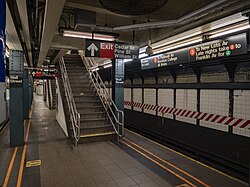
The Wall Street station is a station on the IRT Broadway–Seventh Avenue Line of the New York City Subway, located at the intersection of Wall Street and William Street in the Financial District of Manhattan. It is served by the 2 train at all times and the 3 train at all times except late nights.
Location Image
23 m

William Street (Manhattan)

William Street is a street in the Financial District of Lower Manhattan, New York City. It runs generally southwest to northeast, crossing Wall Street. At Beaver Street, William Street splits in two. The western segment is known as South William Street and terminates at Broad Street, while the eastern segment continues as William Street and terminates at Stone Street. The northern terminal is Spruce Street. North of Beekman Street, in front of New York Downtown Hospital, William Street is a pedestrian-only street.
Location Image
39 m

48 Wall Street

48 Wall Street, formerly the Bank of New York & Trust Company Building, is a 32-story, 512-foot-tall (156 m) skyscraper on the corner of Wall Street and William Street in the Financial District of Lower Manhattan in New York City. Built in 1927–1929 in the Neo-Georgian and Colonial Revival styles, it was designed by Benjamin Wistar Morris. The current structure is the third to be erected on the same plot, as the Bank of New York had previously erected buildings on the site in 1797 and 1858. The structure was erected during a period when many skyscrapers were being erected in Lower Manhattan. 48 Wall Street is designed with many neo-Georgian details. The lowest three stories, built over a raised basement, were used as the banking floor and feature large arched windows on the second story, as well as pediments over the entrances. The top of the building contains a cupola designed in the Federal style and topped by a statue of an eagle. The Bank of New York moved out of 48 Wall Street in 1998, after which it was renovated extensively. Museum of American Finance occupied the former banking hall from 2007 to 2018; it was replaced by Will & Wall, a multi-purpose event venue. The building was designated a city landmark by the New York City Landmarks Preservation Commission in 1998 and was added to the National Register of Historic Places (NRHP) in 2003. It is also a contributing property to the Wall Street Historic District, a NRHP district created in 2007.
55 m

New York Gold Exchange

The New York Gold Exchange was an exchange formed shortly after the beginning of the American Civil War for the purpose of creating an open market for transactions involving gold and the government-created paper currency, the greenback. Established in 1862, it closed in 1897.