

 English
 Français

William Street (Manhattan)
William Street is a street in the Financial District of Lower Manhattan, New York City. It runs generally southwest to northeast, crossing Wall Street. At Beaver Street, William Street splits in two. The western segment is known as South William Street and terminates at Broad Street, while the eastern segment continues as William Street and terminates at Stone Street. The northern terminal is Spruce Street. North of Beekman Street, in front of New York Downtown Hospital, William Street is a pedestrian-only street.
Nearby Places View Menu

23 m
55 Wall Street
55 Wall Street, formerly the National City Bank Building, is an eight-story building on Wall Street between William and Hanover streets in the Financial District of Lower Manhattan in New York City, New York, United States. The lowest three stories were completed in either 1841 or 1842 as the four-story Merchants' Exchange and designed by Isaiah Rogers in the Greek Revival style. Between 1907 and 1910, McKim, Mead & White removed the original fourth story and added five floors to create the present building. Since 2006, the banking room has functioned as an event venue called the Cipriani Wall Street, while the upper stories have been a condominium development known as the Cipriani Club Residences.
55 Wall Street's granite facade includes two stacked colonnades facing Wall Street, each with twelve columns. Inside is a cruciform banking hall with a 60-foot (18 m) vaulted ceiling, Corinthian columns, marble floors and walls, and an entablature around the interior. The banking hall was among the largest in the United States when it was completed. The offices of Citibank's predecessor National City Bank were in the corners of the banking hall, while the fourth through eighth floors were used as office space. The facade and part of the interior are New York City designated landmarks, and the building is listed on both the New York State Register of Historic Places and the National Register of Historic Places (NRHP) as a National Historic Landmark. It is also a contributing property to the Wall Street Historic District, listed on the NRHP.
The Merchants' Exchange building replaced a structure that had burned down in the Great New York City Fire of 1835. 55 Wall Street subsequently hosted the New York Stock Exchange, then the United States Custom House until a new Custom House building was developed on Bowling Green in the 1900s. After 55 Wall Street was expanded, it served as the headquarters of National City Bank from 1908 to 1961; Citibank continued to own the building until 1992. The upper stories operated as a hotel from 2000 to 2003. Cipriani S.A. and Steve Witkoff began converting the upper stories to condominiums in 2004, while Cipriani operated the banking room as an event venue.
28 m
Wall Street station (IRT Broadway–Seventh Avenue Line)
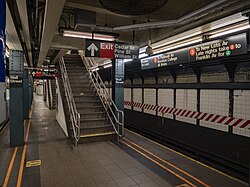
The Wall Street station is a station on the IRT Broadway–Seventh Avenue Line of the New York City Subway, located at the intersection of Wall Street and William Street in the Financial District of Manhattan. It is served by the 2 train at all times and the 3 train at all times except late nights.
46 m
New York Gold Exchange
The New York Gold Exchange was an exchange formed shortly after the beginning of the American Civil War for the purpose of creating an open market for transactions involving gold and the government-created paper currency, the greenback. Established in 1862, it closed in 1897.

56 m
48 Wall Street
48 Wall Street, formerly the Bank of New York & Trust Company Building, is a 32-story, 512-foot-tall (156 m) skyscraper on the corner of Wall Street and William Street in the Financial District of Lower Manhattan in New York City. Built in 1927–1929 in the Neo-Georgian and Colonial Revival styles, it was designed by Benjamin Wistar Morris.
The current structure is the third to be erected on the same plot, as the Bank of New York had previously erected buildings on the site in 1797 and 1858. The structure was erected during a period when many skyscrapers were being erected in Lower Manhattan. 48 Wall Street is designed with many neo-Georgian details. The lowest three stories, built over a raised basement, were used as the banking floor and feature large arched windows on the second story, as well as pediments over the entrances. The top of the building contains a cupola designed in the Federal style and topped by a statue of an eagle.
The Bank of New York moved out of 48 Wall Street in 1998, after which it was renovated extensively. Museum of American Finance occupied the former banking hall from 2007 to 2018; it was replaced by Will & Wall, a multi-purpose event venue. The building was designated a city landmark by the New York City Landmarks Preservation Commission in 1998 and was added to the National Register of Historic Places (NRHP) in 2003. It is also a contributing property to the Wall Street Historic District, a NRHP district created in 2007.