Temple protestant de Limoges

Le temple protestant de Limoges est un édifice religieux situé 14 rue de la Réforme à Limoges, en Haute-Vienne. La paroisse est membre de l'Église protestante unie de France.

1. Histoire


1. = Sous l'Ancien Régime =

Au XVIe siècle, la reine de Navarre Jeanne d'Albret est également vicomtesse de Limoges. Elle est la fille de Marguerite de Valois-Angoulême, sœur aînée de François Ier favorable aux humanistes et la mère de Henri IV, chef du parti réformé avant d'hériter de la couronne de France, et impose la Réforme protestante dans ses états. En 1572, durant le massacre de la Saint-Barthélemy, le Consul assure la sécurité publique et protège la communauté calviniste, qui forme 10 % de la population. En 1598, Henri IV signe Édit de Nantes, qui accorde la liberté de culte aux protestants. Colin Nouailher, né vers 1514 et mort vers 1588, est un peintre émailleur et miniaturiste protestant, qui exerça à Limoges et représente des scènes d'inspiration religieuse. En 1654 est élevé un temple au « Four aux Huguenots » situé à la Croix-Mandonnaud, au niveau de l'ancienne maison des religieuses rues de Nazarteh. Après sa destruction durant les dragonnades, les protestants louent une salle faubourg des Arènes. La liberté de culte, révoqué par Louis XIV avec l'Édit de Fontainebleau de 1685 n'est rétablie qu'avec la Révolution française et la Déclaration des droits de l'homme et du citoyen de 1789.

1. = Depuis la Révolution =

Le protestantisme renaît avec l'industrialisation de la ville, notamment les manufactures de porcelaine de Limoges dont Haviland, fondé par Charles Edward Haviland, protestant quaker d'origine américaine. En 1833, l'abbé Lhote, de la commune de Villefavard, à 50 km de Limoges, se convertit au protestantisme et entraîne toute sa paroisse. En 1840, les réformés de Limoges s'installent place Maison-Dieu, puis au 5 de l'actuel cours Bugeaud. Le bâtiment est détruit en 1848, pour construire la gare de Limoges-Bénédictins. En 1857, le pasteur Le Savoureux achète un nouveau terrain, et finance la construction d'un nouveau temple grâce aux dons d'Églises étrangères, presbytériennes écossaises et anglaises. L'édifice est inauguré le 6 juin 1858 par le pasteur Edmond de Pressensé. Pendant la Seconde Guerre mondiale, le pasteur Chaudier défend des réfugiés et porte assistance aux juifs et aux persécutés. À la Libération, il est élu président du comité départemental de la Libération.

1. Références


1. Annexes


1. = Articles connexes =

Protestantisme en France

1. = Liens externes =

Site officiel

Portail du protestantisme Portail de Limoges Portail de l’architecture chrétienne

Nearby Places View Menu
Location Image
273 m

Limoges

Limoges ( lih-MOHZH, US also lee-, French: [limɔʒ] ; Occitan: Lemòtges, locally Limòtges [liˈmɔdzes]) is a city and commune, and the prefecture of the Haute-Vienne department in west-central France. It was the administrative capital of the former Limousin region. Situated on the first western foothills of the Massif Central, Limoges is crossed by the river Vienne, of which it was originally the first ford crossing point. The second most populated town in the Nouvelle-Aquitaine region after Bordeaux, a university town, an administrative centre and intermediate services with all the facilities of a regional metropolis, it has an urban area of 323,789 inhabitants in 2018. The inhabitants of the city are called the Limougeauds. Founded around 10 BC under the name of Augustoritum, it became an important Gallo-Roman city. During the Middle Ages Limoges became a large city, strongly marked by the cultural influence of the Abbey of Saint-Martial, where the Dukes of Aquitaine were invested and crowned. From the 12th century onwards, its enamels were exported throughout the Christian world. In 1765, during the industrial revolution, the discovery of a deposit of kaolin in the Saint-Yrieix-la-Perche region enabled the development of the Limoges porcelain industry. It is sometimes nicknamed "the red city" or "the Rome of socialism" because of its tradition of voting on the left and the workers' events it experienced from the 19th to the beginning of the 20th century. Since the 1990s, the city has had a basketball club, Limoges CSP, which has won several French championships and the European championship in 1993. Because of its heritage policy, it has held the label "City of Art and History" since 2008. Economic activities include butchering, electrical equipment for the building industry, and luxury goods. It is home to porcelain houses and art workshops working with enamel or stained glass. This craft expertise led it to join the UNESCO Creative Cities Network in 2017 in the thematic category "Crafts and Popular Arts".
Location Image
273 m

Siege of Limoges

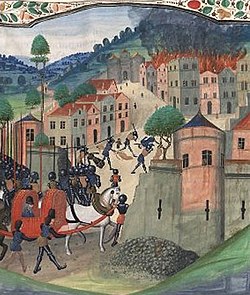
The town of Limoges had been under English control but in August 1370 it surrendered to the French, opening its gates to the Duke of Berry. The siege of Limoges was laid by the English army led by Edward the Black Prince in the second week in September. On 19 September, the town was taken by storm, followed by much destruction and the deaths of numerous civilians. The sack effectively ended the Limoges enamel industry, which had been famous across Europe, for around a century.
273 m

1958 UCI Cyclo-cross World Championships

The 1958 Cyclo-cross World Championship was the ninth edition of the UCI Cyclo-cross World Championships. It was held on Sunday, February 23 1958 in France. The city of Limoges is located 25 kilometers south of Razès, the birthplace of the then four-time (and reigning) world champion André Dufraisse. The course had a total length of 21.38 kilometers. The 31 participants came from eight countries, each sending a team of three or four riders and one rider from the Netherlands. Dufraisse secured his fifth consecutive title with his eighth consecutive podium finish after the same number of participations.
334 m

Limoges Conservatory

Limoges Conservatory or Conservatoire à rayonnement régional de Limoges is a musical conservatory in Limoges, France. As of 2012 it had an enrollment of 2000 students and 79 teachers.
Location Image
530 m

Church of St. Pierre du Queyroix

The Church of St. Pierre du Queyroix (French: église Saint-Pierre-du-Queyroix; Limousin Occitan: egleisa de Sant Peire dau Cairoi) is one of the main churches of Limoges, Haute-Vienne, France. It is located in the neighborhood Le Château in the greater city centre of Limoges.