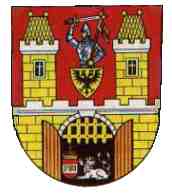
Nové Město (« nouvelle ville » en tchèque) est un quartier pragois fondé par Charles IV du Saint-Empire le 8 avril 1348.

1. Origines légendaires

Selon la légende, alors qu'il contemplait Prague avec sa cour et se réjouissait de sa beauté, un astrologue lui annonça que Mala Strana serait victime d'un incendie et que Staré Město serait inondé. D'abord abasourdi, Charles IV du Saint-Empire déclara que Prague continuerait à exister et il décida alors de la construction d'une nouvelle ville (Nové Město), là où s'étendaient alors des villages comme Rybnik.

1. Histoire de Nové Město

La conception de l'édification de ce quartier prenait en compte trois emplacements centraux :

Le marché au bétail (l'actuelle place Charles) Le marché aux chevaux (l'actuelle place Venceslas) Le marché au foin (l'actuelle place Senovazne) Nové Město est le fruit d'une conception urbanistique médiévale réfléchie, avec des axes principaux et des grands marchés, devenus les places Charles, Venceslas et Senovazne. Le 12 février 1784, Nové Město devient une partie de la capitale royale de Prague (Královské hlavní město Praha) avec Staré Město, Hradčany et Mala Strana.

1. Les places de Nové Město


1. = La place Charles ou Karlovo náměstí =

Le marché au bétail occupait le plus grand emplacement de la nouvelle ville. Dès l'époque de Charles IV, on mit en chantier l'hôtel de ville du nouveau quartier. C'est ici qu'a eu lieu la première défenestration de Prague en 1419. Karlovo náměstí est la plus grande place de la Réplubique tchèque avec une superficie de 80 550 m2. C'est en 1848 que cette place prend le nom de Karlovo náměstí. Elle appartient administrativement à l'arrondissement de Prague 2. Plusieurs bâtiments historiques bordent cette place, comme l'église Saint-Ignace, l'hôtel de ville, la maison de Faust (située dans le palais Mladotovský selon une légende pragoise), ou le palais Charitas. En outre l'abbaye d'Emmaüs ne se trouve pas loin.

1. = La Place Venceslas ou Václavské náměstí =

Le marché aux chevaux était le deuxième centre de la nouvelle ville. Il constituait une jonction entre la vieille ville et la nouvelle ville. La partie haute était close par la porte aux chevaux où se tenait le marché. Au fil du temps, c'est sur cette place que les Tchèques ont accueilli les grands moments de leur histoire.

1. = Senovážné náměstí =

La troisième place de la nouvelle ville est sans doute la moins connue. Son centre est occupé par la tour Henri (Jindřišská věž). À proximité se trouve la synagogue jubilaire de style mauresque.

1. Notes et références


1. Voir aussi


1. = Articles connexes =

Vieille Ville (Prague) Maison dansante Sedmikostelí (Les Sept Églises), roman se déroulant dans Nové Město Palais Petschek Palais Žofín Rotonde Saint-Longin, une église romane du XIIe siècle Tour Henri, un clocher-tour de style gothique Église Sainte-Ursule

1. = Liens externes =

Portail de l’architecture et de l’urbanisme Portail de Prague

Nearby Places View Menu
Location Image
4 m

New Town, Prague

New Town (Czech: Nové Město) is a quarter in the city of Prague in the Czech Republic. New Town is the youngest and largest of the five independent (from the Middle Ages until 1784) towns that today comprise the historic center of modern Prague. New Town was founded in 1348 by Charles IV just outside the city walls to the east and south of the Old Town and encompassed an area of 7.5 km2; about three times the size of the Old Town. The population of Prague in 1378 was well over 40,000, perhaps as much as twice that, making it the 4th most populated city north of the Alps and, by area, the 3rd largest city in Europe. Although New Town can trace its current layout to its construction in the 14th century, only few churches and administrative buildings from this time survive. There are many secular and educational buildings in New Town, but also especially magnificent gothic and baroque churches. These nevertheless are not the main drawing points for tourists. New Town's most famous landmark is Wenceslas Square, which was originally built as a horsemarket and now functions as a center of commerce and tourism. In the 15th century, the Novoměstská radnice, or New Town Hall, was the site of the first of the three defenestrations of Prague.
Location Image
61 m

St. Longin's Rotunda

St. Longin's Rotunda (Prague, Na Rybníčku) (Czech: Rotunda svatého Longina) is one of the few preserved romanesque rotundas in Prague, in the Czech Republic. It was founded in the 12th century as a parish church for a village called "Rybníček" which was there before the founding of the Prague New Town in the middle of the 14th century. Originally, it was a Pagan temple before the arrival of Christianity, when it was transformed into a Catholic chapel. Up until the 14th century, it was consecrated to St Stephen, before Charles IV founded the New Town and changed the consecration to Saint Longinus, who was one of the men who took part in Jesus' crucifixion, and supposedly pierced the side of Jesus. Longinus came to deeply regret this action, causing him to desert the army and become a hermit, later leading to his arrest and execution. The rotunda was nearly demolished in the 19th century while the nearby street (Na Rybníčku) was being built, but it was saved by František Palacký.
Location Image
293 m

University of New York in Prague

The University of New York in Prague (UNYP) is a private higher education institution in Prague, Czech Republic. It was established in 1998 in cooperation with the State University of New York at New Paltz and Empire State University, both part of the State University of New York (SUNY). UNYP was recognized by the Czech Ministry of Education, Youth and Sports in 2001 on the basis of accreditation of its study programs in Business Administration and International European Relations. UNYP is a member of the British Accreditation Council for Independent Further and Higher Education. Originally located in the historic old town of Prague, on the corner of Mikovcova and Legerova streets, in 2014 UNYP moved to a new campus on Londýnská 41 in Vinohrady (Prague 2).
Location Image
302 m

The Drama Club

The Drama Club (Czech: Činoherní klub) is a theatre located in Prague. The Drama Club was founded by Ladislav Smoček and Jaroslav Vostrý. The opening performance of Piknik took place on 3 March 1965. The actors in the 1970s and 1980s included Petr Čepek, Pavel Landovský, Josef Somr, Jiří Kodet, Jirina Trebicka, Libuše Šafránková and Josef Abrhám. On 19 November 1989, two days after the Velvet revolution, the Civic Forum was founded there. The Drama Club was awarded Alfréd Radok Award in category Theatre of the Year in 2002, and 2008. The current actors include Jaromír Dulava, Ivana Chýlková, Ondřej Vetchý and Petr Nárožný. Founder Jaroslav Vostry died on 18 March 2025.
Location Image
336 m

Almanac X Alcron Prague

The Almanac X Alcron Prague is a historic hotel opened in 1932 as the Hotel Alcron, located in the Czech capital of Prague on Štěpánská, just off Wenceslas Square.