Ubu Repertory Theater

Le Ubu Repertory Theater est le seul théâtre américain consacré à la présentation de pièces de langue française avec des productions anglaises et françaises. Le Ubu Repertory Theater offre aux Américains une perspective sur le monde des cultures francophones, les pays européens francophones, ainsi que ceux situés en Amérique du Nord, en Afrique et dans les Caraïbes.

1. Histoire

Fondé en 1982 par Françoise Kourilsky, « Ubu Rep » sert de forum pour l'échange interculturel à New York. Le groupe théâtral encourage la collaboration de traducteurs, de réalisateurs, d'acteurs, de dramaturges et de professionnels du théâtre afin de favoriser la coopération internationale.

1. Le théâtre

Au début, Ubu Rep se trouvait au deuxième étage d'un petit théâtre situé dans la Mercer Street, à Chelsea. La compagnie a déménagé en 1989 sur West 28th Street dans un théâtre de 99 places. En 1999, Ubu Rep a déménagé dans de nouveaux bureaux situés au 95 Wall Street (au bas de Wall Street) et a partagé son bureau avec le French Institute Alliance Française (FIAF). Le nouvel espace n'incluait cependant pas son propre théâtre. L'entreprise a travaillé sur un certain nombre de productions Off-Broadway plus importantes, telles que le théâtre annexe de La MaMa Experimental Theatre Club et le Florence Gould Hall du FIAF pour répondre à sa popularité croissante. Ubu Rep a également fourni une grande sélection de pièces francophones tout au long de l'année grâce à sa série de lectures. Parmi les anciens membres de l'équipe figurent le réalisateur franco-australien Morgan Dowsett et l'auteur-réalisateur franco-américain Frederic Colier.

1. La compagnie bilingue Ubu

Toujours sous la direction de Kourilsky, Ubu Rep a également fondé la société bilingue Ubu. La troupe a interprété des productions bilingues dont Huis clos (No Exit) de Jean-Paul Sartre (1985), Le Malentendu (The Misunderstanding) d'Albert Camus et Les Justes (The Just Assassins, 1998), Antigone de Jean Anouilh (2000), In Transit de Denise Bonal et Murder in Mind de Xavier Durringer (2001), et bien d'autres.

1. Publications

Les traductions et les publications sont une étape importante de la mission d'Ubu Rep. De nombreux auteurs ont été chargés de faire traduire, interpréter et publier leur pièce : Aimé Césaire, Jean Tardieu, Jean-Claude Grumberg, Simone Schwarz-Bart, Sony Labou Tansi, Bernard-Marie Koltès, Tilly, Kateb Yacine, Maryse Condé, Koffi Kwahulé et Michel Tremblay, pour ne citer que quelques-uns de son vaste catalogue de pièces de théâtre individuelles et anthologisées. À partir de 2002, Theatre Communications Group (TCG) s'occupe de toute la distribution du catalogue d'Ubu Rep.

1. Fin du premier chapitre

Les attentats du 11 septembre 2001, en particulier contre le World Trade Center, ont pesé lourdement sur l'avenir du groupe, compte tenu de la proximité de ses bureaux. Le feu continu sur le site de l'attaque, aggravé par une contamination dangereuse de l'air, a interdit l'accès aux locaux pendant des semaines. Françoise Kourilsky a décidé de prendre sa retraite et a dissous la société au début de l'été 2002, mais pas avant de produire un grand spectacle final, Bravo Ubu, célébrant les 20 ans de présence à New York, avec Ellen Stewart et Tom Bishop agissant en tant que maîtres des cérémonies. La célébration a eu lieu au Florence Gould Hall en mai 2002. Françoise Kourilsky est décédée à Paris en 2012.

1. Nouveau chapitre

Depuis l'été 2017, un groupe composé d'anciens membres du personnel, d'acteurs et de dramaturges, travaille afin de ramener Ubu Rep sur la scène théâtrale new-yorkaise.

1. Notes et références

Portail de New York Portail des arts du spectacle

Nearby Places View Menu
4 m

Ubu Repertory Theater

The Ubu Repertory Theater is the only US theater dedicated to presenting French-language plays both in English and French productions. The Ubu Repertory Theater provides Americans with a unique perspective into the world of Francophone cultures: the French-speaking European countries, as well as the ones located in North America, Africa, and the Caribbean islands.
Location Image
40 m

75 Wall Street

75 Wall Street is a 43-story mixed-use building in the Financial District of Lower Manhattan in New York City. It contains Hyatt Centric Wall Street New York, a hotel with 253 rooms managed by Blue Sky Hospitality. Designed by Welton Becket & Associates and developed by London & Leeds as an office building, 75 Wall Street was announced in 1984 as the North American headquarters of British bank Barclays. After the building opened in 1987, several firms leased space in the building. JPMorgan Chase acquired 75 Wall Street from Barclays in 2005, and the Hakimian Organization and Peykar Brothers Realty purchased the building later that year. The upper floors were converted to 346 residential condominiums in 2009, while the lower floors opened as the Andaz Wall Street hotel in January 2010. Navika Capital acquired the hotel in 2022 and rebranded it as Hyatt Centric Wall Street New York.
Location Image
72 m

Tontine Coffee House

The Tontine Coffee House was a coffeehouse in Manhattan, New York City, established in early 1793. Situated at 88 Wall Street, on the northwest corner with Water Street, it was built by a group of stockbrokers to serve as a meeting place for trade and correspondence. It was organized as a tontine, a type of investment plan, and funded by the sale of 203 shares of £200 each. The May 17, 1792, creation of the Buttonwood Agreement, which bound its signatories to trade only with each other, effectively gave rise to a new organization of tradespeople.
Location Image
75 m

1 Wall Street Court

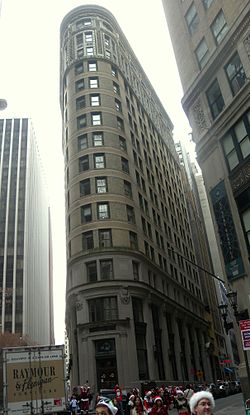
1 Wall Street Court (also known as the Beaver Building and the Cocoa Exchange) is a residential building in the Financial District of Manhattan in New York City, New York. The 15-story building, designed by Clinton and Russell in the Renaissance Revival style, was completed in 1904 at the intersection of Wall, Pearl, and Beaver Streets. The building is shaped similarly to a flatiron because of its position at an acute angle formed by the junction of Pearl and Beaver Streets. 1 Wall Street Court's articulation consists of three horizontal sections similar to the components of a column, namely a base, shaft, and capital. The base is faced with stone, the shaft contains alternating bands of buff and tan brick, and the capital contains multicolored terracotta ornamentation depicting geometric shapes. There are carved beavers over the main entrance facing Pearl and Beaver Streets, signifying the building's original name. The superstructure is of steel frame construction. The Beaver Building was constructed between 1903 and 1904 as a speculative development. The building served as the headquarters of the Munson Steamship Line from 1904 until 1921, and the company owned 1 Wall Street Court from 1919 to 1937. The building was foreclosed upon in 1937, and ownership subsequently passed to several other entities, including the Bowery Savings Bank. The New York Cocoa Exchange was another large tenant, occupying the building between 1931 and 1972. The commercial spaces on ground level, as well as the interior offices, were significantly altered from their original design, with major renovations in 1937 and the mid-1980s. 1 Wall Street Court was converted into a residential condominium building in 2006. The building was designated a city landmark by the New York City Landmarks Preservation Commission in 1995 and was added to the National Register of Historic Places (NRHP) in 2005. It is also a contributing property to the Wall Street Historic District, a NRHP district created in 2007.
Location Image
112 m

63 Wall Street

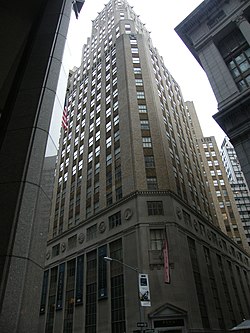
63 Wall Street, originally the Wall and Hanover Building, is a 37-story skyscraper on Wall Street in the Financial District of Manhattan in New York City. Built in 1929, it was designed by Delano & Aldrich as the headquarters of Brown Brothers & Co.