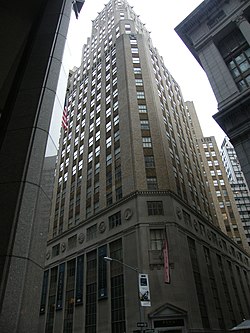
63 Wall Street, originally the Wall and Hanover Building, is a 37-story skyscraper on Wall Street in the Financial District of Manhattan in New York City. Built in 1929, it was designed by Delano & Aldrich as the headquarters of Brown Brothers & Co.

1. History

63 Wall Street was the headquarters of Brown Brothers & Co., a merchant bank that became Brown Brothers Harriman & Co., a private bank, by merger in 1931. Originally known as 59 Wall Street, it was occupied by BBH until 2003 when it moved to 140 Broadway. BBH established a family of mutual funds in 1983 and named it "59 Wall Street Funds". That fund family was later renamed "BBH Funds" in 2002 when the company made plans to relocate its headquarters. In 2003 and 2004, the building was converted to rental apartments by Metro Loft Management. The leasing company rebranded the building as The Crest, named for the ornate circular depictions on the outside of the building, and began using the address 63 Wall Street. The ground floor of the building is now retail space, including the United States Post Office for zip code 10005. The building was added to the National Register of Historic Places on November 16, 2005. It is also a contributing property to the Wall Street Historic District, a NRHP district created in 2007.

Today, 63 Wall Street is held by Luxembourg-based Eastbridge Group (through DTH Capital) and AG Real Estate.

1. See also

National Register of Historic Places listings in Manhattan below 14th Street

1. References


1. External links

Media related to 63 Wall Street at Wikimedia Commons

The Crest, Emporis.com 63 Wall Street

Nearby Places View Menu
Location Image
39 m

1 Wall Street Court

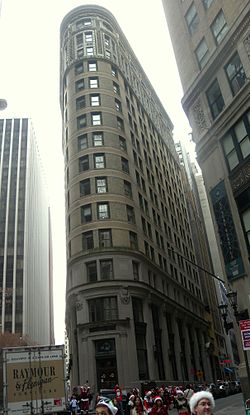
1 Wall Street Court (also known as the Beaver Building and the Cocoa Exchange) is a residential building in the Financial District of Manhattan in New York City, New York. The 15-story building, designed by Clinton and Russell in the Renaissance Revival style, was completed in 1904 at the intersection of Wall, Pearl, and Beaver Streets. The building is shaped similarly to a flatiron because of its position at an acute angle formed by the junction of Pearl and Beaver Streets. 1 Wall Street Court's articulation consists of three horizontal sections similar to the components of a column, namely a base, shaft, and capital. The base is faced with stone, the shaft contains alternating bands of buff and tan brick, and the capital contains multicolored terracotta ornamentation depicting geometric shapes. There are carved beavers over the main entrance facing Pearl and Beaver Streets, signifying the building's original name. The superstructure is of steel frame construction. The Beaver Building was constructed between 1903 and 1904 as a speculative development. The building served as the headquarters of the Munson Steamship Line from 1904 until 1921, and the company owned 1 Wall Street Court from 1919 to 1937. The building was foreclosed upon in 1937, and ownership subsequently passed to several other entities, including the Bowery Savings Bank. The New York Cocoa Exchange was another large tenant, occupying the building between 1931 and 1972. The commercial spaces on ground level, as well as the interior offices, were significantly altered from their original design, with major renovations in 1937 and the mid-1980s. 1 Wall Street Court was converted into a residential condominium building in 2006. The building was designated a city landmark by the New York City Landmarks Preservation Commission in 1995 and was added to the National Register of Historic Places (NRHP) in 2005. It is also a contributing property to the Wall Street Historic District, a NRHP district created in 2007.
Location Image
55 m

Tontine Coffee House

The Tontine Coffee House was a coffeehouse in Manhattan, New York City, established in early 1793. Situated at 88 Wall Street, on the northwest corner with Water Street, it was built by a group of stockbrokers to serve as a meeting place for trade and correspondence. It was organized as a tontine, a type of investment plan, and funded by the sale of 203 shares of £200 each. The May 17, 1792, creation of the Buttonwood Agreement, which bound its signatories to trade only with each other, effectively gave rise to a new organization of tradespeople.
Location Image
62 m

1831 City Bank of New York theft

The 1831 City Bank of New York theft took place on March 19, 1831, in New York City, New York, United States, when burglars stole $245,000 (1831 values) from the City Bank (now Citibank) on Wall Street, using a set of copied keys. The theft is regarded as one of the first bank heists in U.S. history. The amount stolen would come to over $52 million in 2013 currency. Initial reports variously reported the names of the culprits as Edward Smith, Edward Jones, James Honeyman and James Murray. A modern source, drawing on period newspapers, identifies the thieves as James Honeyman and William J. Murray. Murray and Honeyman, who used both "Smith" and "Jones" as aliases, spent $60,000 before their arrest. Murray fled to Philadelphia, while Honeyman remained in New York under an alias. Both were captured, convicted, and sentenced to five years in Sing Sing Prison. The Connecticut Courant reported that the suspect, Smith (Honeyman), was apprehended "due to the acuteness and indefatigable vigilance of High Constable Hays." Honeyman had been apprehended in the previous year for robbing "Mr. Schenck's store" in Brooklyn. He was a "Morocco (leather) dresser" by trade who kept a small shoe store on the Bowery where he allowed "dissipated profligates" to gather. Constable Hays found nothing during his first search of the Division Street rooms where Honeyman lived with his wife and two children. Tipped off by the keeper of the lodging house, who saw Honeyman carrying a trunk out of his rooms, the "acute" Constable Hays returned later in the week, and he decided to search the trunks remaining in the apartment. This time, he found most of the stolen money hidden under clothing in one of the trunks. The suspect was seized and taken to New York's colonial-era Bridewell prison. Authorities recovered: $57,328 in City Bank notes; $501,118 in "various city notes;" $44,000 in Lansingburgh Bank Notes (a bank in Lansingburgh, New York); $20,000 in notes issued by the "Morris Canal"; $8,272 recorded as "uncurrent - belonging to S. & M. Allen"; and $40 worth of counterfeit notes. $63,000 of stolen money was never recovered, a sum that included 398 doubloons.
Location Image
72 m

75 Wall Street

75 Wall Street is a 43-story mixed-use building in the Financial District of Lower Manhattan in New York City. It contains Hyatt Centric Wall Street New York, a hotel with 253 rooms managed by Blue Sky Hospitality. Designed by Welton Becket & Associates and developed by London & Leeds as an office building, 75 Wall Street was announced in 1984 as the North American headquarters of British bank Barclays. After the building opened in 1987, several firms leased space in the building. JPMorgan Chase acquired 75 Wall Street from Barclays in 2005, and the Hakimian Organization and Peykar Brothers Realty purchased the building later that year. The upper floors were converted to 346 residential condominiums in 2009, while the lower floors opened as the Andaz Wall Street hotel in January 2010. Navika Capital acquired the hotel in 2022 and rebranded it as Hyatt Centric Wall Street New York.