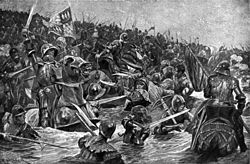
The Battle of Towton took place on 29 March 1461 during the Wars of the Roses, near Towton in North Yorkshire. Yorkist forces decisively defeated Lancastrian supporters of Henry VI, securing the English throne for Edward IV. Fought for ten hours between an estimated 50,000 soldiers from both sides in a snowstorm on Palm Sunday, it was "probably the largest and bloodiest battle on English soil". Henry VI succeeded his father, Henry V, when he was nine months old in 1422, but was a weak, ineffectual and mentally unsound ruler, which encouraged the nobles to scheme for control over him. The situation deteriorated in the 1450s into a civil war between his Beaufort relatives and his wife, Queen Margaret, on one side, with those of his cousin Richard, Duke of York, on the other. In October 1460, Parliament named York as Henry's successor, but the Lancastrians refused to accept the disinheritance of Edward of Westminster, Prince of Wales. In December, their army defeated and killed York at Wakefield. His eldest son Edward now declared himself king, and marched north with his own forces. On reaching the battlefield, the Yorkists found themselves heavily outnumbered, since levies under the Duke of Norfolk had yet to arrive. However, Yorkist archers under Lord Fauconberg took advantage of the strong wind to outrange their enemies, provoking the Lancastrians into abandoning their defensive positions. The ensuing combat lasted hours, exhausting the combatants. The arrival of Norfolk's men reinvigorated the Yorkists who routed their foes. Many Lancastrians were killed while fleeing, with several high-ranking prisoners executed, while Henry fled the country, leaving Edward to rule England. In 1929, the Towton Cross was erected on the battlefield to commemorate the event. Various archaeological remains and mass graves related to the battle have been found in the area.

Nearby Places View Menu
Location Image
1.2 km

Towton Hall

Towton Hall is a mansion, a home, near the village of Towton in North Yorkshire, England. The building, known to been built as a residence in the seventeenth century and renovated and expanded since, is also believed to include the remnants of Richard III’s commemorative chantry chapel, which was built after the Battle of Towton. The commemorative chantry chapel at the Towton Battlefield was built to remember the victory of the House of York in the battle of Towton in the years after the 1461 battle. Many male skeletons of the soldiers were discovered beneath the floor of the dining room of Towton Hall.
Location Image
1.2 km

Towton

Towton is a small village and civil parish in the county of North Yorkshire, England. It was historically part of the West Riding of Yorkshire until 1974. From 1974 to 2023 it was part of the district of Selby, it is now administered by the unitary North Yorkshire Council.
Location Image
1.2 km

Saxton with Scarthingwell

Saxton with Scarthingwell is a civil parish just south of Tadcaster in North Yorkshire, England. The parish contains the villages of Saxton and Scarthingwell, with two churches and the remains of a castle. Historically the area was a township, however it has been its own civil parish since 1866. Although the main part of the Battle of Towton was fought to the north out of the parish, some of the dead were interred in the parish, and at least one minor skirmish was fought within the parish boundaries. The parish shares a grouped parish council with Lead.
Location Image
1.7 km

All Saints' Church, Saxton

All Saints' Church is the parish church of Saxton, North Yorkshire, a village in England. The church was built in the 11th century, initially serving as a chapel of ease in the parish of All Saints' Church, Sherburn in Elmet. The nave and chancel survive from this period. A south chapel was added in the 14th century, followed by a tower in the early 15th century. The church was restored in 1867, the work including the addition of a vestry, and was again restored in 1907. It was grade I listed in 1967. The church consists of a nave with a chapel to the south, a chancel with a north vestry, and a west tower. The tower has two stages, a chamfered plinth, a narrow round-arched south door, a three-light west window with a hood mould, a clock face, two-light bell openings with hood moulds, a corbel table, and an embattled parapet with corner pinnacles. The south doorway is Norman, and has a round arch, and shafts with waterleaf capitals. At the east end are three stepped lancet windows. Inside, there is a Mediaeval octagonal stone font on a 19th-century base, an aumbry dating from about 1180, four 17th-century tombstones, three of which are set into the wall, and two late-18th century memorials. In the churchyard is the tomb of Ralph, Lord Dacre, who died at the Battle of Towton in 1461. The tomb is made of limestone, and has an oblong plan, measuring about 1.75 metres (5 ft 9 in) by 1 metre (3 ft 3 in) and is about 1 metre (3 ft 3 in) in height. It is plain, and has weathered coats of arms on the sides and ends. It is grade II listed.