

 English
 Français

Towton Hall
Towton Hall is a mansion, a home, near the village of Towton in North Yorkshire, England. The building, known to been built as a residence in the seventeenth century and renovated and expanded since, is also believed to include the remnants of Richard III’s commemorative chantry chapel, which was built after the Battle of Towton. The commemorative chantry chapel at the Towton Battlefield was built to remember the victory of the House of York in the battle of Towton in the years after the 1461 battle. Many male skeletons of the soldiers were discovered beneath the floor of the dining room of Towton Hall.
Nearby Places View Menu

126 m
Towton
Towton is a small village and civil parish in the county of North Yorkshire, England.
It was historically part of the West Riding of Yorkshire until 1974. From 1974 to 2023 it was part of the district of Selby, it is now administered by the unitary North Yorkshire Council.
1.2 km
Battle of Towton
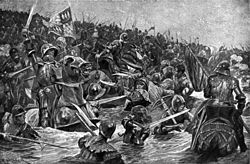
The Battle of Towton took place on 29 March 1461 during the Wars of the Roses, near Towton in North Yorkshire. Yorkist forces decisively defeated Lancastrian supporters of Henry VI, securing the English throne for Edward IV. Fought for ten hours between an estimated 50,000 soldiers from both sides in a snowstorm on Palm Sunday, it was "probably the largest and bloodiest battle on English soil".
Henry VI succeeded his father, Henry V, when he was nine months old in 1422, but was a weak, ineffectual and mentally unsound ruler, which encouraged the nobles to scheme for control over him. The situation deteriorated in the 1450s into a civil war between his Beaufort relatives and his wife, Queen Margaret, on one side, with those of his cousin Richard, Duke of York, on the other.
In October 1460, Parliament named York as Henry's successor, but the Lancastrians refused to accept the disinheritance of Edward of Westminster, Prince of Wales. In December, their army defeated and killed York at Wakefield. His eldest son Edward now declared himself king, and marched north with his own forces. On reaching the battlefield, the Yorkists found themselves heavily outnumbered, since levies under the Duke of Norfolk had yet to arrive. However, Yorkist archers under Lord Fauconberg took advantage of the strong wind to outrange their enemies, provoking the Lancastrians into abandoning their defensive positions. The ensuing combat lasted hours, exhausting the combatants. The arrival of Norfolk's men reinvigorated the Yorkists who routed their foes.
Many Lancastrians were killed while fleeing, with several high-ranking prisoners executed, while Henry fled the country, leaving Edward to rule England. In 1929, the Towton Cross was erected on the battlefield to commemorate the event. Various archaeological remains and mass graves related to the battle have been found in the area.

2.2 km
Stutton railway station
Stutton railway station was a railway station in Stutton, North Yorkshire, on the Harrogate to Church Fenton Line. The station opened on 10 August 1847 and closed to passenger traffic on 30 June 1905. It remained open to goods traffic until it closed completely on 6 July 1964.
The station master at Stutton in the 1890s was named Wilson Mortimer and his story, along with the traffic dealt with at this small station, is covered in a research paper.
The two-storey brick and sandstone station building was designed by George Townsend Andrews in the form of two side-by-side railway cottages. It was built on the up platform and is now used as a private residence. The roof of its single-storey northern extension was extended as a narrow canopy over the platform. The goods yard consisted only of one siding and a headshunt and had a cattle dock. A wooden signal box stood at the northern end of the station next to the level crossing with Weedling Gate. It was pulled down towards the end of the 1960s. Since the village that was served by the station was rather small, and Tadcaster station very close, passenger numbers remained low, causing the early closure to regular passenger services. Only chartered holiday trains occasionally called at Stutton afterwards.

2.2 km
Grimston Park
Grimston Park is a grade II* listed Georgian country house in Grimston, North Yorkshire, England, some 1.7 miles (3 km) south of Tadcaster. Since being owned by the Fielden family, it has been converted into a number of luxury homes.
The house is built on two storeys of Tadcaster limestone ashlar with a Welsh slate roof. It has a 7-bay frontage with a projecting portico, and a three-storey tower and a single-storey entrance lodge at each end. A limestone tower in the grounds, designed like the house by Decimus Burton, is also grade II listed.