

 English
 Français

Rowlands Gill railway station served the village of Rowlands Gill, Tyne and Wear, England from 1867 to 1963 on the Derwent Valley Railway.
Nearby Places View Menu

242 m
Rowlands Gill
Rowlands Gill is a village on the north bank of the River Derwent, in the Metropolitan Borough of Gateshead, Tyne and Wear, England. The Gibside Estate is near the town.
1.0 km
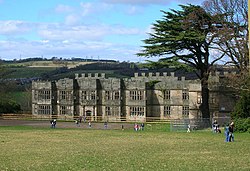
Gibside
Gibside is an estate in Tyne and Wear, England. It is located in the valley of the River Derwent on the border with County Durham, between Rowlands Gill and Burnopfield. The estate is the surviving part of a Georgian landscaped park, primarily created under the ownership of Sir George Bowes (1701–60) and designed in large part by Stephen Switzer and William Joyce.
The park contains structures designed by James Paine, including a Palladian chapel; Daniel Garrett, including a banqueting house; and William Newton, but several are now ruined shells or have been demolished. Gibside Hall, the house at the centre of the estate, dates in part from the 17th century, is Grade II* listed, but is also a shell.
Gibside descended by marriage from the mid-13th century, and passed to the Bowes family in 1693. It was sold piecemeal during the 20th century; the banqueting house is now owned by the Landmark Trust, and much of the rest of the estate by the National Trust.

1.3 km
Derwent Park (Rowlands Gill)
Derwent Park is situated in Rowlands Gill, Tyne and Wear, England. The park is often incorrectly called Rowlands Gill Park as a result. The park has a caravan site and has many play areas for children. Fishing on the River Derwent, which runs through the park, is priced at £2.50 per permit. The fish include brown trout, grayling and Atlantic salmon.

1.3 km
Whinfield coke works
Whinfield coke works was a large industrial complex located near Rowlands Gill in Tyne and Wear, North East England. The complex comprised a coking plant, alloy factory and power station. Waste heat from the plant provided heat for a power station. This was later converted to generate electricity by burning coke.