

 English
 Français

Église du Saint-Nom-de-Jésus de Manchester
L'église du Saint-Nom-de-Jésus (en anglais : The Holy Name of Jesus) est un édifice religieux catholique de Manchester en Angleterre. Cette église de style néo-gothique a été construite pour les Jésuites de 1869 à 1872 par Joseph Hansom. Sa tour, dessinée par Adrian Gilbert Scott, a été érigée en 1928 en l'honneur du père Bernard Vaughan qui y fut un des plus éminents prédicateurs à la fin du XIXe siècle. L'église est inscrite à la National Heritage List of England.
Nearby Places View Menu
252 m
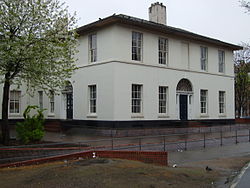
Grove House, Manchester
Grove House, on Oxford Road, Chorlton-on-Medlock, Manchester, England, is an early Victorian building, originally three houses, of 1838–40. It is a Grade II* listed building as of 18 December 1963.
Pevsner described it as "a large detached house set back from the street." The house is of "scored stucco on brick with a hipped slate roof. It has a round-headed central doorway with keystone and a fanlight with slender radiating tracery." It was first occupied by the university c. 1952 and has had various uses since then, including as a student health centre.

287 m
Pankhurst Centre
The Pankhurst Centre, also known as The Pankhurst Museum, at 60–62 Nelson Street in Manchester, England, comprises a pair of Victorian villas, of which No. 62 was the home of Emmeline Pankhurst and her daughters Sylvia, Christabel and Adela and the birthplace of the suffragette movement in 1903.
The Pankhurst Centre is home to the Pankhurst Trust. The building is currently used as the Pankhurst Museum, as well as being the headquarters of Manchester Women's Aid.

328 m
Manchester Royal Eye Hospital
Manchester Royal Eye Hospital is an ophthalmic hospital in Oxford Road, Manchester, England, managed by the Manchester University NHS Foundation Trust. It is on the same site as Manchester Royal Infirmary and St Mary's Hospital for Women and Children.

330 m
St Saviour's Church, Chorlton on Medlock
St Saviour's Church on the corner of Plymouth Grove and Upper Brook Street, Chorlton on Medlock, Manchester, was an Anglican parish church. Construction began in 1835, with the estimated £6000 cost being met by public subscription. It was consecrated on 11 November 1836. The primary benefactor for the construction was Scholes Birch, whose son, Edward, became the first rector. The foundation stone was laid on 2 July 1835.
In May 1868, a part of the parish of St Saviour's was assigned to the church of St John Chrysostom, Rusholme. A further change came in December 1955 when some of the parish was exchanged with St Thomas's, Ardwick, and another reorganisation in July 1967 saw some of it was assigned to St Ambrose, Chorlton upon Medlock. In June 1971, what remained of the parish joined with that of St Paul with St Luke as Christ Church, Brunswick.
The original church building was demolished after a final service on 28 August 1960. Services were thereafter held in temporary location until 1964. The plan had been to construct a new building, and indeed a) foundation stone was laid in May 1963 and dedication mass held on 21 March 1964 when completed, but because of a lack of parishioners due to Council wholesale clearance of local housing, the parish joined Christ Church, on Brunswick Street in 1974 (actually the building was constructed and photos are extent of it in the city archives).
341 m
Manchester Academic Health Science Centre
The Manchester Academic Health Science Centre (MAHSC; ) is an academic health science centre based in Manchester, United Kingdom. It is a partnership between the University of Manchester and four NHS organizations in Greater Manchester. It was originally established in June 2008, with re-designation most recently in April 2020 by the National Institute for Health and Care Research (NIHR) and NHS England/NHS Improvement. The most recent designation is from April 2020 to March 2025. It is now (2025) one of eight academic health science centres in England designated for excellence in health research, education, and patient care.