
Location Image

St Saviour's Church, Chorlton on Medlock

St Saviour's Church on the corner of Plymouth Grove and Upper Brook Street, Chorlton on Medlock, Manchester, was an Anglican parish church. Construction began in 1835, with the estimated £6000 cost being met by public subscription. It was consecrated on 11 November 1836. The primary benefactor for the construction was Scholes Birch, whose son, Edward, became the first rector. The foundation stone was laid on 2 July 1835. In May 1868, a part of the parish of St Saviour's was assigned to the church of St John Chrysostom, Rusholme. A further change came in December 1955 when some of the parish was exchanged with St Thomas's, Ardwick, and another reorganisation in July 1967 saw some of it was assigned to St Ambrose, Chorlton upon Medlock. In June 1971, what remained of the parish joined with that of St Paul with St Luke as Christ Church, Brunswick. The original church building was demolished after a final service on 28 August 1960. Services were thereafter held in temporary location until 1964. The plan had been to construct a new building, and indeed a) foundation stone was laid in May 1963 and dedication mass held on 21 March 1964 when completed, but because of a lack of parishioners due to Council wholesale clearance of local housing, the parish joined Christ Church, on Brunswick Street in 1974 (actually the building was constructed and photos are extent of it in the city archives).

Nearby Places View Menu
Location Image
298 m

Pankhurst Centre

The Pankhurst Centre, also known as The Pankhurst Museum, at 60–62 Nelson Street in Manchester, England, comprises a pair of Victorian villas, of which No. 62 was the home of Emmeline Pankhurst and her daughters Sylvia, Christabel and Adela and the birthplace of the suffragette movement in 1903. The Pankhurst Centre is home to the Pankhurst Trust. The building is currently used as the Pankhurst Museum, as well as being the headquarters of Manchester Women's Aid.
Location Image
383 m

Manchester Royal Infirmary

Manchester Royal Infirmary (MRI) is a large NHS teaching hospital in Chorlton-on-Medlock, Manchester, England. Founded by Charles White in 1752 as part of the voluntary hospital movement of the 18th century, it is now a major regional and national medical centre. It is the largest hospital within Manchester University NHS Foundation Trust, and based on its Oxford Road Campus in central Manchester where it shares a site with the Royal Manchester Children's Hospital, Manchester Royal Eye Hospital and Saint Mary's Hospital as well as several other educational and research facilities. The hospital is also a key site for medical education within Manchester, serving as a main teaching hospital for the School of Medical Sciences, University of Manchester.
Location Image
422 m

Holy Trinity Armenian Church, Manchester
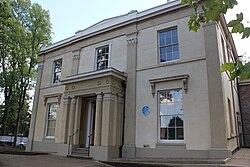
Holy Trinity Armenian Church is an Armenian Apostolic Church in the Chorlton-on-Medlock area of Manchester, England and a Grade II listed building. Consecrated in 1870, it is the oldest purpose-built Armenian Church in Western Europe.
Location Image
425 m

84 Plymouth Grove

84 Plymouth Grove, now known as Elizabeth Gaskell's House, is a writer's house museum in Manchester, England. The Grade II* listed neoclassical villa was the residence of William and Elizabeth Gaskell from 1850 until their deaths in 1884 and 1865 respectively. The Gaskell household continued to occupy the villa after the deaths of Elizabeth and William. The death of Elizabeth's daughter, Margaret Emily "Meta" Gaskell, in 1913, brought to an end the Gaskells' residence there. The house itself was granted listed building status in 1952, partly due to its association with the Gaskells. This granted it protection from demolition, however, 84 Plymouth Grove slowly descended into a state of disrepair due to neglect. The Manchester Historic Buildings Trust commenced a restoration project in 2009, aiming to see 84 Plymouth Grove returned to its state as the Gaskells left it. By 2011, the Trust had finished the exterior, which included structural repairs and removing the pink paint that had coated the house for various years. However, in May 2011 their project was marred by the theft of the lead roof, which caused "extensive damage" according to the BBC. On completion of the £2.5 million restoration, the building was reopened to the public on 5 October 2014.