Location Image

St Saviour's Church, Chorlton on Medlock

St Saviour's Church on the corner of Plymouth Grove and Upper Brook Street, Chorlton on Medlock, Manchester, was an Anglican parish church. Construction began in 1835, with the estimated £6000 cost being met by public subscription. It was consecrated on 11 November 1836. The primary benefactor for the construction was Scholes Birch, whose son, Edward, became the first rector. The foundation stone was laid on 2 July 1835. In May 1868, a part of the parish of St Saviour's was assigned to the church of St John Chrysostom, Rusholme. A further change came in December 1955 when some of the parish was exchanged with St Thomas's, Ardwick, and another reorganisation in July 1967 saw some of it was assigned to St Ambrose, Chorlton upon Medlock. In June 1971, what remained of the parish joined with that of St Paul with St Luke as Christ Church, Brunswick. The original church building was demolished after a final service on 28 August 1960. Services were thereafter held in temporary location until 1964. The plan had been to construct a new building, and indeed a) foundation stone was laid in May 1963 and dedication mass held on 21 March 1964 when completed, but because of a lack of parishioners due to Council wholesale clearance of local housing, the parish joined Christ Church, on Brunswick Street in 1974 (actually the building was constructed and photos are extent of it in the city archives).

Lieux à Proximité Voir Menu
Location Image
330 m

Église du Saint-Nom-de-Jésus de Manchester

L'église du Saint-Nom-de-Jésus (en anglais : The Holy Name of Jesus) est un édifice religieux catholique de Manchester en Angleterre. Cette église de style néo-gothique a été construite pour les Jésuites de 1869 à 1872 par Joseph Hansom. Sa tour, dessinée par Adrian Gilbert Scott, a été érigée en 1928 en l'honneur du père Bernard Vaughan qui y fut un des plus éminents prédicateurs à la fin du XIXe siècle. L'église est inscrite à la National Heritage List of England.
Location Image
383 m

Manchester Royal Infirmary

Le Manchester Royal Infirmary (MRI) est un centre hospitalier situé à Manchester, en Angleterre qui a été fondé en 1752 par Charles White sous la forme d'un hôpital rural pouvant s'occuper de douze patients. Le Manchester Royal Infirmary fait partie d'un ensemble plus important, le NHS Trust qui comprend plusieurs hôpitaux regroupés au sein du Central Manchester University Hospitals NHS Foundation Trust. Il s'agit d'un Centre hospitalier universitaire dépendant de l'école de Médecin de l'Université de Manchester. les autres centre hospitaliers universitaires membres du NHS trust sont: St Mary's Hospital (fondé en 1790), le Manchester Royal Eye Hospital (1814), le University Dental Hospital of Manchester (1884) et le Royal Manchester Children's Hospital (1829).
Location Image
411 m

Manchester Academy

Manchester Academy est le nom par lequel l'union des étudiants de l'université de Manchester désigne ses quatre salles de spectacle à Manchester, en Angleterre, sur Oxford Road. 'Manchester Academy' désignait à l'origine la plus importante de ces quatre salles, mais dans les années 2000 on a utilisé ce terme pour désigner l'ensemble des salles. Ces salles ont notamment accueilli Ian Brown, Biffy Clyro, The Stranglers, Super Furry Animals, You Me At Six, Billy Talent, Pink Floyd, Owl City, David Bowie, The Cure, The Coral, Blur, Oasis, John Butler Trio, George Clinton, Nirvana, Wolfmother, Manic Street Preachers, The Libertines, The Ramones, Death Cab for Cutie, Supergrass, Katy Perry, Lady Gaga, Marilyn Manson, Prodigy et Slash, parmi d'autres.
Location Image
461 m

Contact Theatre

Contact est une salle de Manchester destinée à accueillir toute sorte d'évènements. Il s'agissait à l'origine d'un théâtre mais depuis 1999 elle a été modifiée pour recevoir divers évènements, notamment pour les jeunes.
Location Image
521 m

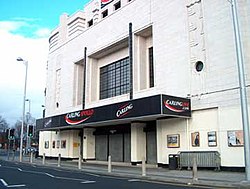
Manchester Apollo

L'O2 Apollo Manchester (à l'origine Manchester Apollo) est une salle de concert de Manchester, en Angleterre. Appelée localement The Apollo, c'est un monument classé qui a une capacité de 3 500 places, dont 986 places assises. L'O2 Apollo Manchester a été construite pour accueillir un cinéma, qui devint plus tard l'ABC Cinema Ardwick. Il a été dessiné par les architectes Peter Cummings, Alex Irvine et R. Gillespie Williams et inauguré le 28 août 1938 par l'actrice Margaret Lockwood. Jusque dans les années 1970, la salle continue à servir de cinéma, jusqu'à ce que cette industrie ne décline et qu'elle s'oriente alors vers les concerts.