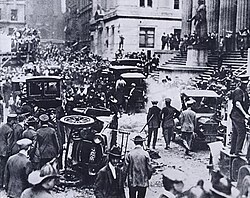
L'attentat de Wall Street a lieu le 16 septembre 1920, quelques mois après l'arrestation de Nicola Sacco et Bartolomeo Vanzetti. Un chariot garé au carrefour de Wall Street et Broad Street explose devant le siège de la banque J.P. Morgan & Co. situé au 23 Wall Street.

1. Vague d'attentats en 1919

En avril 1919, les forces de police arrêtent un complot visant à l'envoi de 36 bombes à des membres et institutions éminents de l'establishment politique et économique américain : J. P. Morgan, John D. Rockefeller, le juge de la Cour suprême Oliver Wendell Holmes ou encore le procureur général Alexander Mitchell Palmer. Le 2 juin 1919, dans sept villes du Nord-Est des États-Unis, huit bombes de forte puissance ont explosé quasi simultanément (une église catholique de Philadelphie étant la cible de deux bombes). L'un des objectifs était la maison du procureur général Palmer, à Washington. L'explosion tue le poseur de bombe, qui sera la seule victime, et des témoignages confirment qu'il s'agit d'une organisation radicale d'origine italienne dont l'antenne américaine se trouverait à Philadelphie, mais l'affaire n'a jamais été résolue.

1. Attentat


1. Bilan et enquête

Le bilan de l'attentat varie selon les sources ; la dernière victime, Francis D. Stoba, décède en novembre, presque deux mois après l'explosion. Trente-huit personnes trouvent la mort, plus de 200 sont blessées. Trois corps ne peuvent être identifiés, leurs blessures étant trop sévères. Les dégâts matériels s'élèvent à plus de deux millions de dollars. Pour la première fois dans l'histoire des États-Unis, les autorités suspendent l'activité de la bourse de New York, et des soldats sont dépêchés sur les lieux depuis la base militaire de Governors Island afin de sécuriser le périmètre. À quelques rues de là, un postier trouve une pile de tracts signés « Les Combattants anarchistes américains » et portant l'avertissement suivant :

« Libérez les prisonniers politiques ou bien aucun de vous n'échappera à la mort ! »

Les autorités ne tardent pas à réagir. L'enquête est confiée à William J. Flynn, directeur entre 1919 et 1921 du Bureau of Investigation, ancêtre du FBI. À propos de Flynn, le procureur général Palmer déclarait : « Flynn est un pisteur d'anarchiste… le plus grand spécialiste des milieux anarchistes aux États-Unis ». Après avoir enquêté sur les lieux de l'attentat, Flynn suspecte aussitôt les Galleanistes, un groupe anarchiste organisé autour du journal Cronaca Sovversiva (La chronique subversive) publié par Luigi Galleani et condamné en 1918 par le ministère de la Justice américain comme « le journal le plus dangereux du pays ». Comme de nombreux compagnons, Luigi Galleani est partisan de la « propagande par le fait », une stratégie d'action politique basée sur la violence et ayant pour but de favoriser une prise de conscience populaire. Pour William J. Flynn, la motivation anarchiste de l'attentat était de venger l'emprisonnement de Nicola Sacco et Bartolomeo Vanzetti.
En se basant sur les souvenirs de militants anarchistes contemporains de Mario Buda, l'historien américain Paul Avrich établit la responsabilité de ce dernier dans l'attentat, lequel parvient néanmoins à partir pour l'Italie sans être inquiété. Les organisateurs de l'attentat n'ont jamais été identifiés même si, d'après le FBI, la thèse selon laquelle il s'agirait d'un groupement anarchiste reste, en 2007, la plus probable. Une seconde bombe a explosé devant la maison du procureur général des États-Unis et seize autres sont trouvées dans des colis postaux destinés à des politiciens et financiers influents. Ces événements, entre autres, contribuèrent à la « Peur rouge ».

1. Les prédictions d'Edwin Fisher

Edwin Fisher, joueur de tennis américain, fut soupçonné par la police après que celle-ci eut découvert l'existence de lettres dans lesquelles Edwin Fisher semble prédire l'attentat. Dans celles-ci, il implorait ses amis de quitter New York avant le 16 septembre par peur qu'une bombe y explose. Edwin Fisher déclara à la police avoir reçu le message « dans l'air, de la part de Dieu ». Après avoir découvert qu'il envoyait régulièrement de telles lettres, il fut par la suite déclaré « fou mais sans danger » et envoyé à l'asile d'Amityville.

1. Références


1. Voir aussi


1. = Articles connexes =

Propagande par le fait Liste d'attentats meurtriers

1. = Liens externes =

Stéphane Baillargeon. « L'attentat oublié », Le Devoir, 16 septembre 2020. Portail du terrorisme Portail de l’anarchisme Portail de New York Portail des années 1920

Lieux à Proximité Voir Menu
Location Image
0 m

Wall Street bombing

The Wall Street bombing was an act of terrorism on Wall Street at 12:01 pm on Thursday, September 16, 1920. The blast killed 30 people immediately, and another eight later died of wounds that they sustained in the blast. There were 143 seriously injured, and the total number of injured was in the hundreds. The bombing was never solved, although investigators and historians believe it was carried out by Galleanists, a group responsible for a series of bombings the previous year.
Location Image
22 m

23 Wall Street

23 Wall Street (also known as the J.P. Morgan Building) is a four-story office building in the Financial District of Manhattan in New York City, United States. Located at the southeast corner of Wall Street and Broad Street, it was designed by Trowbridge & Livingston in the neoclassical style and constructed from 1913 to 1914. It was originally the headquarters of J.P. Morgan & Co. Since the late 2000s, the building has remained unoccupied for long periods, although it has occasionally been used for events. The building has a facade of ashlar masonry and pink Tennessee marble. The first floor consists of a piano nobile over a low basement; above are the second story, the main cornice, and two more stories. After its completion, the building became known as the headquarters of J.P. Morgan & Co.—the "House of Morgan"—although its exterior was never signed with the Morgan name. The banking room, which took up nearly the entire ground floor, included offices and was used for banking transactions. This space was designed with a domed, coffered ceiling and, later, a large crystal chandelier. Mechanical systems and vaults were in the basement, and executive offices were placed on the upper floors. 23 Wall Street replaced the Drexel Building, which was the banking headquarters for J.P. Morgan & Co.'s predecessor Drexel, Morgan & Co. When the building was damaged during the Wall Street bombing in 1920, J.P. Morgan & Co. refused to make repairs, in defiance of the bombing's perpetrators. The building was linked to neighboring 15 Broad Street in 1957, and the two buildings served as the J.P. Morgan & Co. headquarters until 1988, when the firm moved to 60 Wall Street. During the 2000s, there were plans to convert both 23 Wall Street and 15 Broad Street into a condominium complex. In 2008, 23 Wall Street was sold to interests associated with the billionaire industrialist Sam Pa but mostly remained empty afterward. Depicted in several media works, 23 Wall Street's simple design was generally praised upon its completion. The building is a New York City designated landmark and is listed on the National Register of Historic Places (NRHP); it is also a contributing property to the NRHP-listed Wall Street Historic District.
Location Image
25 m

Federal Hall

Federal Hall was the first capitol building of the United States established under the Constitution. Serving as the meeting place of the First United States Congress and the site of George Washington's first presidential inauguration, the building was located on Wall Street facing the northern end of Broad Street in Lower Manhattan, New York City, from 1703 to 1812. The site is occupied by the Federal Hall National Memorial, a Greek Revival–style building completed in 1842 as the New York Custom House. The National Park Service now operates the building as a national memorial commemorating the historic events that occurred at Federal Hall. The original structure on the site was built from 1699 to 1703 as New York's second city hall. The building hosted the 1765 Stamp Act Congress, before the American Revolution. After the United States became an independent nation, it served as the meeting place for the Congress of the Confederation, the nation's first central government under the Articles of Confederation, from 1785 to 1789, and the building was expanded and updated. With the establishment of the United States federal government in 1789, it hosted the 1st Congress and the inauguration of George Washington as the nation's first president. It was demolished in 1812. The current structure, designed by Ithiel Town and Alexander Jackson Davis, was built as New York's U.S. Custom House, before serving as a Subtreasury building from 1862 to 1925. The Subtreasury building continued to be used as a governmental office building for a decade, and it opened as a public memorial in 1940. The building is constructed of Tuckahoe marble. Its architectural features include a colonnade of Doric columns, in addition to a domed rotunda designed by the sculptor John Frazee. In front of the building is a large statue of George Washington by John Quincy Adams Ward. The facade and part of the interior are New York City designated landmarks, and the building is also a contributing property to the Wall Street Historic District, listed on the National Register of Historic Places.
Location Image
25 m

United States Custom House (New York City)

The United States Custom House, sometimes referred to as the New York Custom House, was the place where the United States Customs Service collected federal customs duties on imported goods within New York City.
Location Image
25 m

Great Fire of New York

The 1835 Great Fire of New York was one of three fires that rendered extensive damage to New York City in the 18th and 19th centuries. The fire occurred in the middle of an economic boom, covering 17 city blocks, killing two people, and destroying hundreds of buildings, with an estimated $20 million of property damage (equivalent to $640 million in 2024).