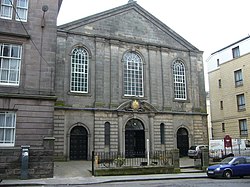
L'Edinburgh College of Art (ECA) est une école d'art de l'Université d'Édimbourg à Édimbourg, en Écosse. L'université compte cinq facultés : art, musique, histoire de l'art, design et architecture. Environ 3 000 étudiants y étudient.

1. Histoire

L'école d'art a été fondée en 1760 pour enseigner les arts appliqués dans le centre d'Édimbourg. Au XIXe siècle, l'attention s'est déplacée vers les arts visuels. En 1907, l'école a déménagé dans un nouveau bâtiment, l'emplacement actuel sur Lauriston Place.

1. Bâtiments

Le bâtiment principal a été achevé en 1909 selon les plans de l'architecte écossais John Wilson dans le style Beaux-Arts. Il a été classé monument de catégorie A en 1970. Le bâtiment d'architecture a été construit en 1961 et le bâtiment Hunter en 1977. En 2003, l'Evolution House de neuf étages a été construite pour la bibliothèque et les bureaux.

1. Notes et références

(de) Cet article est partiellement ou en totalité issu de l’article de Wikipédia en allemand intitulé « Edinburgh College of Art » (voir la liste des auteurs).

1. Liens externes

(en) Site officiel Ressources relatives aux beaux-arts : Art UK (lieux d'art) Union List of Artist Names Ressource relative à la musique : MusicBrainz

Portail de l’architecture et de l’urbanisme Portail de l’éducation Portail des arts Portail de l’Écosse Portail des monuments classés au Royaume-Uni

Nearby Places View Menu
100 m

Edinburgh School of Architecture and Landscape Architecture

The Edinburgh School of Architecture and Landscape Architecture (ESALA) is part of Edinburgh College of Art at the University of Edinburgh in Scotland. The school was ranked 5th in the UK in the 2013 Guardian University Guide and 4th in the Complete University Guide, for architecture. In 2016 Edinburgh ranked 3rd in the country for Architecture according to the Complete University Guide.
Location Image
112 m

Edinburgh College of Art

The Edinburgh College of Art (ECA) is a department within the College of Arts, Humanities and Social Sciences at the University of Edinburgh in Scotland. Tracing its history back to 1760, it provides higher education in art and design, architecture, history of art, and music disciplines for over three thousand students and is at the forefront of research and research-led teaching in the creative arts, humanities, and creative technologies. ECA comprises five subject areas: School of Art, Reid School of Music, School of Design, School of History of Art, and Edinburgh School of Architecture & Landscape Architecture (ESALA). ECA is mainly located in the Old Town of Edinburgh, overlooking the Grassmarket; the Lauriston Place campus is located in the University of Edinburgh's Central Area Campus, not far from George Square. The college was founded in 1760, and gained its present name and site in 1907. Formerly associated with Heriot-Watt University, its degrees have been issued by the University of Edinburgh since 2004. The college formally merged with the university on 1 August 2011, combining with the School of Arts, Culture and Environment and continues to exist with the name Edinburgh College of Art as an enlarged school in the College of Arts, Humanities and Social Sciences.
Location Image
125 m

Sacred Heart, Edinburgh

Sacred Heart, Edinburgh, formally known as the Catholic Church of the Sacred Heart of Jesus, is a Roman Catholic church run by the Society of Jesus, close to the city centre of Edinburgh, Scotland, United Kingdom. It is situated in Lauriston, midway between the Grassmarket and Tollcross, on the edge of Edinburgh’s historic Old Town. The church building was opened in 1860 and is a category A listed building.
Location Image
131 m

Argyle House, Edinburgh

Argyle House is a building in Edinburgh, Scotland. The building is located in the city's Old Town on Lady Lawson Street and Castle Terrace. Competed in 1968, it was originally used as government offices, but has since been sold many times. Today, it's used as office space by over a dozen companies and institutions, including the University of Edinburgh. The building has a series of relief panels facing Castle Terrace (opposite Castle Terrace Car Park).
148 m

Digital Curation Centre

The Digital Curation Centre (DCC) was established to help solve the extensive challenges of digital preservation and digital curation and to lead research, development, advice, and support services for higher education institutions in the United Kingdom. Throughout its history the DCC has been an active organisation in the realm of digital preservation. In partnership with other institutions, the DCC has created and developed tools for tackling issues in digital preservation and curation. Such tools include a lifecycle model for data curation, a risk assessment for digital repositories, and an interview protocol to assist institutions in understanding their research data collections. Since July 2016, the DCC is no longer supported by Jisc funding.