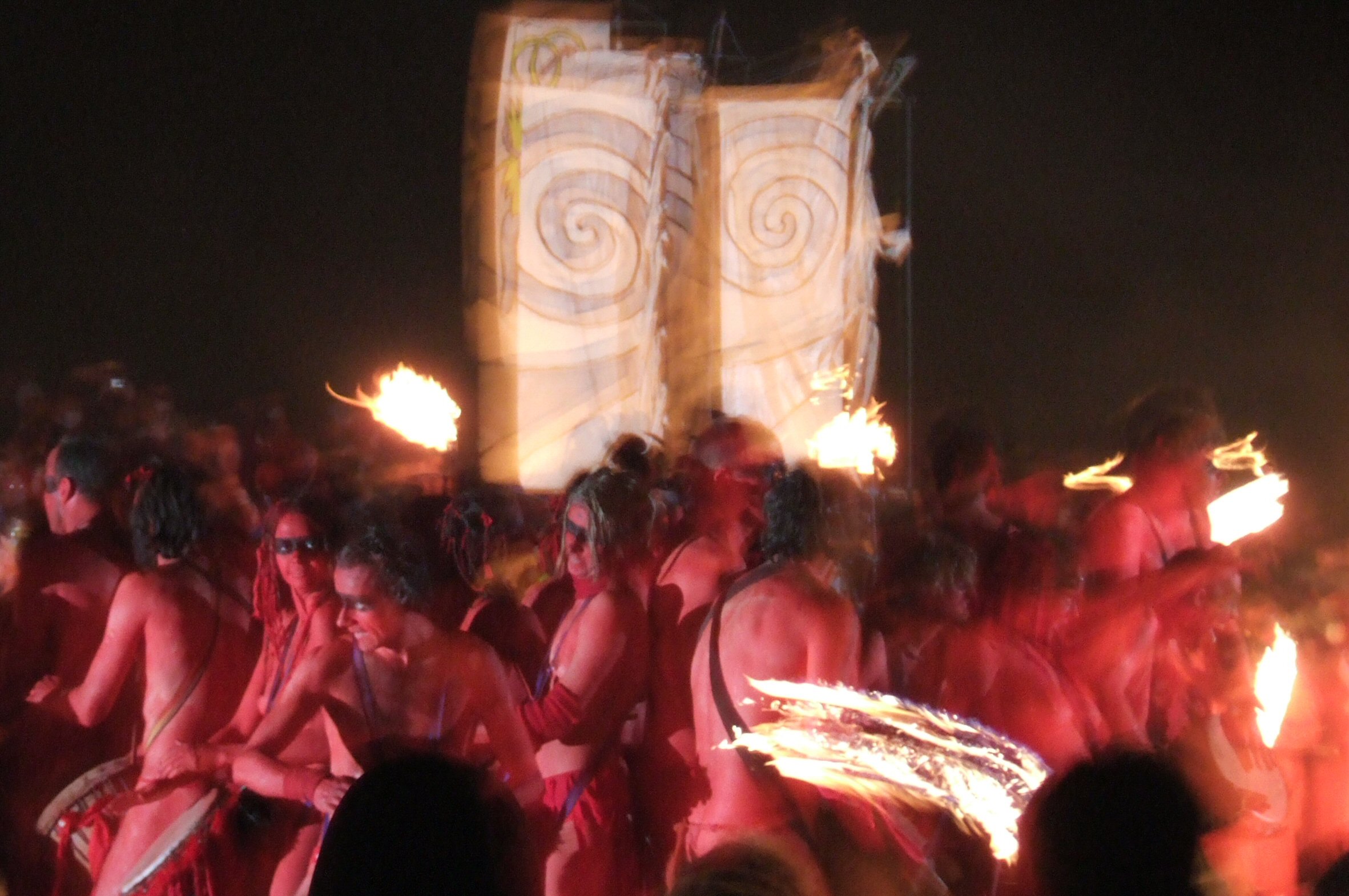
Le Festival du feu de Beltane (anglais : Beltane Fire Festival) est un festival et un rituel d'arts participatifs annuels, qui se tient le 30 avril de chaque année à Calton Hill à Édimbourg pour célébrer l'arrivée de l'été en Écosse.

1. Contexte historique

Le festival moderne s'inspire de l'ancien festival gaélique de Beltane qui commençait la veille du 1er mai et marquait le début de l'été. Alors que le festival puise ses scènes dans une variété d'influences historiques, mythologiques et littéraires, les organisateurs ne prétendent pas qu'il soit autre chose qu'une célébration moderne de Beltane, évoluant avec ses participants.

1. Fête moderne

Le festival moderne a été lancé en 1988 par un petit groupe de passionnés, dont Angus Farquhar du collectif musical Test Dept, le chorégraphe Lindsay John, des danseurs de Laban, ainsi que l'ethnologue gaélique Margaret Bennett avec le soutien académique de la School of Scottish Studies de l'Université d'Edimbourg. Depuis lors, le festival s'est développé et implique désormais plus de 300 collaborateurs et artistes bénévoles, les billets disponibles étant souvent épuisés. Initialement destiné à avoir lieu sur Arthur's Seat, le lieu des célébrations antérieures de Beltane, pour des raisons pratiques, l'emplacement a été déplacé à Calton Hill. La chorégraphie, l'iconographie et la performance ont été façonnées par les recherches des créateurs sur les récits historiques de Beltane et leurs propres influences (par exemple tambours du département de test, carnaval trinidadien, et danse rituelle et performance). Le festival est géré par l'association Beltane Fire Society et tous les artistes sont des bénévoles. À l'origine, le festival était gratuit et peu encadré, cependant à mesure que l'événement gagnait en popularité et en raison de la capacité de la colline, le festival est devenu ces dernières années un événement payant.

1. Références

Portail de l’Écosse Portail de la culture Portail du monde celtique

Nearby Places View Menu
Location Image
0 m

Dugald Stewart Monument

The Dugald Stewart Monument is a memorial to the Scottish Enlightenment philosopher Dugald Stewart (1753–1828). It is situated on Calton Hill overlooking the city of Edinburgh and was designed by Scottish architect William Henry Playfair.
Location Image
0 m

Calton Hill

Calton Hill (; Scottish Gaelic: Cnoc Coilltinn) is a hill in central Edinburgh, Scotland, situated beyond the east end of Princes Street and included in the city's UNESCO World Heritage Site. Views of, and from, the hill are often used in photographs and paintings of the city. Calton Hill is the headquarters of the Scottish Government, which is based at St Andrew's House, on the steep southern slope of the hill. The Scottish Parliament Building and other prominent buildings such as Holyrood Palace lie near the foot of the hill. Calton Hill is also the location of several monuments and buildings: the National Monument, the Nelson Monument, the Dugald Stewart Monument, the old Royal High School, the Robert Burns Monument, the Political Martyrs' Monument and the City Observatory. The area lies between the Edinburgh districts of Greenside and Abbeyhill.
Location Image
67 m

National Monument of Scotland

The National Monument of Scotland, on Calton Hill in Edinburgh, is Scotland's national memorial to the Scottish soldiers and sailors who died fighting in the Napoleonic Wars. It was intended, according to the inscription, to be "A Memorial of the Past and Incentive to the Future Heroism of the Men of Scotland". The monument dominates the top of Calton Hill, just to the east of Princes Street. It was designed during 1823–1826 by Charles Robert Cockerell and William Henry Playfair and is modeled upon the Parthenon in Athens. Construction started in 1826 and, due to the lack of funds, was left unfinished in 1829. This circumstance gave rise to various nicknames such as "Scotland's Folly", "Edinburgh's Disgrace", "the Pride and Poverty of Scotland" and "Edinburgh's Folly".
Location Image
92 m

Collective Gallery

Collective is a contemporary art centre in Edinburgh, Scotland. It is situated on Calton Hill, in the former City Observatory and City Dome site. It offers a programme of exhibitions, guided walking tours, audio walking tours, and events.
Location Image
93 m

City Observatory

The City Observatory was an astronomical observatory on Calton Hill in Edinburgh, Scotland. It is also known as the Calton Hill Observatory. The site is enclosed by a boundary wall with a monument to John Playfair, president of the Edinburgh Astronomical Institution, in the southeast corner. The oldest part is the Gothic Tower in the southwest corner, facing Princes Street and Edinburgh Castle. It is also known as Observatory House, the Old Observatory, or after its designer James Craig House. The central building with the appearance of a Greek temple is the Playfair Building, named after the building's designer William Henry Playfair. This houses the 6-inch (15 cm) refractor in its dome and the 6.4-inch (16 cm) transit telescope in its eastern wing. The largest dome of the site is the City Dome in the northeast corner. During the early 20th century this contained a 22-inch (56 cm) refractor. In 2018, the entire site was restored and new buildings were added. The City Observatory site was opened freely to the public for the first time on 24 November 2018 as the new site for Collective, a centre for contemporary art.