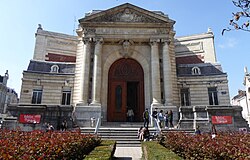
Location Image

Bibliothèque de Sciences Po Lille

La bibliothèque de Sciences Po Lille a été créée en 1991 et portait, jusqu'au déménagement, le nom de François Goguel, juriste et ancien membre du Conseil constitutionnel et de la Fondation nationale des sciences politiques, qui a fait don au centre de documentation d'une grande partie de son fonds personnel.

1. Description

La bibliothèque dispose d'un bâtiment dédié, face au bâtiment principal d'enseignement, constituant le campus urbain de la place Georges Lyon. Il permet ainsi aux étudiants de s'y rendre en traversant la rue. Elle est ouverte de 9h à 22h du lundi au dimanche. Née de la réhabilitation partielle de la Maison de l’Éducation Permanente, autrefois bibliothèque universitaire de l'université de Lille, le bâtiment a retrouvé sa vocation première en janvier 2017. L'aspect majestueux et institutionnel du lieu historique, qui s'étend sur plus de 1500 mètres carrés, a été maintenu et adapté à ce que sont les bibliothèques aujourd'hui : des lieux offrant les ressources nécessaires à l'étude, au développement de l'esprit critique, tout autant que des lieux de vie et de découverte[réf. souhaitée]. Ce centre de documentation comprend, en février 2010, plus de trente cinq mille ouvrages, six-cent soixante quinze mémoires et thèses, et deux cent soixante-dix-sept collections de périodiques. Plus de mille cinq cents ouvrages sont commandés chaque année, dont 20 % en langues étrangères. Il comprend également un fonds de documents anciens, dont des ouvrages du célèbre juriste et doyen Maurice Hauriou, comprenant certains de ses lettres et manuscrits. En 2022, elle reçoit le prix de la meilleure bibliothèque francophone.

1. Historique

Le bâtiment ouvert en 1906 est celui de l'ancienne bibliothèque de l'Université de Lille.

1. Notes et références


1. Voir aussi


1. = Articles connexes =

Institut d'études politiques de Lille Bibliothèque de Sciences Po

1. = Liens externes =

Site officiel Bibliothèque de Sciences Po Lille sur OpenStreetMap Sciences de l’information et bibliothèques Portail de l’architecture et de l’urbanisme Portail de la métropole européenne de Lille

Nearby Places View Menu
Location Image
38 m

Lille Synagogue

Lille Synagogue (French: Synagogue de Lille) is a Jewish congregation and synagogue, located at 5, rue Auguste Angellie, in Lille, in the Hauts-de-France region of France. The congregation worships in the Ashkenazi rite.
Location Image
134 m

École supérieure de journalisme de Lille

The École supérieure de journalisme de Lille (French pronunciation: [ekɔl sypeʁjœʁ də ʒuʁnalism də lil], Superior School of Journalism of Lille, abbr. ESJ Lille) is a private non-profit institution of higher education, a French Grande École in Lille dedicated to journalism and related studies. The ESJ is a graduate school of the University of Lille as part of a public-private partnership. It has been elected best French journalism school in 2013 by Le Figaro. It is one of the top 3 journalism schools in France, alongside the CFJ at the Paris-Panthéon-Assas University and the Sciences Po Journalism School.
Location Image
176 m

Musée d'Histoire Naturelle de Lille

The Musée d'Histoire Naturelle de Lille, or Lille Natural History Museum, was founded in 1822. It houses zoological and geological collections. Its holdings have recently been enhanced by ethnographic specimens from the Musée Moillet and industrial objects from the old Musée Industriel et Commercial de Lille. The museum's address is 19 Rue de Bruxelles.
Location Image
243 m

Christ Church, Lille

Christ Church Lille is an English-speaking Anglican Church located in the city of Lille in Nord-Pas-de-Calais, the Flemish area of France. Christ Church Lille is part of the Church of England, Diocese in Europe.
Location Image
313 m

Palais des Beaux-Arts de Lille

The Palais des Beaux-Arts de Lille (Lille Palace of Fine Arts) is a municipal museum dedicated to fine arts, modern art, and antiquities located in Lille. It is one of the largest art museums in France. It was one of the first museums built in France, established under the instructions of Napoleon I at the beginning of the 19th century as part of the popularisation of art. Jean-Antoine Chaptal's decree of 1801 selected fifteen French cities (among them Lille) to receive the works seized from churches and from the European territories occupied by the armies of Revolutionary France. The painters Louis Joseph Watteau and François-Louis-Joseph Watteau, known as the "Watteau of Lille", were heavily involved in the museum's beginnings - Louis Joseph Watteau made in 1795 the first inventory of the paintings confiscated during the Revolution, whilst his son François was deputy curator of the museum from 1808 to 1823. The museum opened in 1809 and was initially housed in a church confiscated from the Récollets before being transferred to the city's town hall. In 1866, the "musée Wicar", formed from the collection of Jean-Baptiste Wicar, was merged into the Palais des Beaux-Arts. Construction of the Palais's current Baroque-revival-style building began in 1885 under the direction of Géry Legrand, mayor of Lille, and it was completed in 1892. The architects chosen to design the new building were Edouard Bérard (1843–1912) and Fernand Etienne-Charles Delmas (1852–1933) from Paris. During the early 20th century, Victor Mollet served as its official architect. The building is located on the place de la République, in the center of the city, facing the préfecture of Lille. It was renovated during the 1990s and reopened in 1997. At the start of the 1990s, the building's poor state and the moving of Vauban's relief models of fortified towns to Lille forced the town to renovate the building. Work began in 1991, under the architects Jean-Marc Ibos and Myrto Vitart, and was completed in 1997. This allowed the creation of a new 700 m2 basement room for temporary exhibitions, as well as departments for the relief models and for 19th-century sculpture. Overall the museum covers 22000 m2 and held 72430 pieces as of 2015, one of the largest provincial collections of fine art. The collection includes works by Raphael, Donatello, Van Dyck, Tissot, Jordaens, Goya, El Greco, David, Corot, Courbet, Toulouse-Lautrec, Delacroix, Rubens, Rodin, Claudel and Jean Siméon Chardin.