
La rue Celetná (Zeltnergasse) est une voie de Prague. Située dans la Vieille Ville, elle relie la Place de la Vieille Ville à la Tour poudrière. C'est l'une des rues les plus anciennes de Prague, elle fait partie de la Voie Royale.

1. Origine du nom

La rue est nommée d'après le pain qui était cuit au four dans la région au cours du Moyen Âge.

1. Historique

Celetná est une ancienne route commerciale de Prague. La rue est devenue une partie de la Voie Royale au XIVe siècle. Le Défilé du Couronnement descendait par Celetná. Les Templiers l'ont utilisée pour tenir des réunions au Temple, au numéro 27. Après la fin des Templiers en 1312, les réunions secrètes ont été tenues par les Chevaliers au sous-sol. Le bâtiment est ensuite devenu un hôpital, puis une maison en 1784. Franz Kafka avait des liens avec la rue, après avoir été avocat au palais Pachta. Le palais du numéro 36 est l'ancien siège du Commandement Militaire de Prague, de 1784 jusqu'en 1849. Kafka a vécu de 1888 jusqu'en 1889 avec sa famille dans la maison Sixt au numéro 2. Il a vécu à partir de 1896 jusqu'en 1907, Aux Trois Rois, au numéro 3. À l'Ange d'Or, au numéro 29, est une ancienne auberge, qui a été habitée par Wolfgang Amadeus Mozart. À l'Aigle Rouge, au numéro 21, est un ancien café. Dans Le Miracle Secret de Jorge Luis Borges, le personnage principal, Jaromir Hladik, réside dans cette rue en mars 1939. L'italien Giovanni Battista Alliprandi a conçu le bâtiment numéro 12, le palais Hrzan de Harasov.

1. Bâtiments remarquables

Architecturalement, de nombreuses maisons ont été rénovées dans les styles baroque et classique. Certains bâtiments ont encore des fondations romanes et gothiques. La Maison à la Vierge Noire est elle aussi située dans la rue.

1. Voir aussi

Quartiers de Prague

1. Références

Portail de l’architecture et de l’urbanisme Portail de Prague

Nearby Places View Menu
Location Image
51 m

Church of Our Lady before Týn

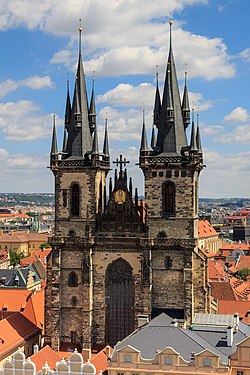
The Church of the Mother of God before Týn (in Czech Kostel Matky Boží před Týnem, also Týnský chrám ("Týn Church") or just Týn), or Church of Our Lady before Týn, is a Gothic church and a dominant feature of the Old Town of Prague, Czech Republic. It has been the main church of this part of the city since the 14th century. The church's two towers are 80 m high, and each tower's spire is topped by eight smaller spires in two layers of four.
Location Image
59 m

Stone Bell House

The Stone Bell House (Czech: Dům U Kamenného zvonu) is located on the Old Town Square in Prague. It is located next to the Kinský Palace on the corner of Old Town Square and Týnská street.
Location Image
61 m

Old Town Square

Old Town Square (Czech: Staroměstské náměstí [ˈstaroˌmɲɛstskɛː ˈnaːmɲɛsciː] or colloquially Staromák [ˈstaromaːk] , German: Altstädter Ring) is a historic square in the Old Town quarter of Prague, the capital of the Czech Republic. It is located between Wenceslas Square and Charles Bridge.
Location Image
61 m

Kingdom of Bohemia

The Kingdom of Bohemia, sometimes referenced in English literature as the Czech Kingdom (Czech: České Království), was a medieval and early modern monarchy in Central Europe. It was the predecessor state of the modern Czech Republic. The Kingdom of Bohemia was an Imperial State in the Holy Roman Empire. The Bohemian king was a prince-elector of the empire. The kings of Bohemia, besides the region of Bohemia itself, also ruled other lands belonging to the Bohemian Crown, which at various times included Moravia, Silesia, Lusatia, and parts of Saxony, Brandenburg, and Bavaria. The kingdom was established by the Přemyslid dynasty in the 12th century from the Duchy of Bohemia. It was later ruled by the House of Luxembourg, the Jagiellonian dynasty, and from 1526 the House of Habsburg and its successor, the House of Habsburg-Lorraine. Numerous kings of Bohemia were also elected Holy Roman Emperors, and the capital, Prague, was the imperial seat in the late 14th century, and again at the end of the 16th and the beginning of the 17th centuries. Shortly before the dissolution of the Holy Roman Empire in 1806, the kingdom became part of the newly proclaimed Habsburg Austrian Empire, and subsequently the Austro-Hungarian Empire from 1867. Bohemia retained its name and formal status as a separate Kingdom of Bohemia until 1918, known as a crown land within the Austro-Hungarian Empire, and its capital Prague was one of the empire's leading cities. The Czech language (called the Bohemian language in English usage until the 19th century) was the main language of the Diet and the nobility until 1627 (after the Bohemian Revolt was suppressed). German was then formally made equal with Czech and eventually prevailed as the language of the Diet until the Czech National Revival in the 19th century. German was also widely used as the language of administration in many towns after the Germans immigrated and populated some areas of the country in the 13th century. The royal court used the Czech, Latin, and German languages, depending on the ruler and period. Following the defeat of the Central Powers in World War I, both the Kingdom and Empire were dissolved. Bohemia became the core part of the newly formed Czechoslovak Republic.
62 m

European Association of Archaeologists

The European Association of Archaeologists (EAA) is a membership-based, not-for-profit association, open to archaeologists and other related or interested individuals or bodies in Europe and beyond. It was founded in 1994 at an inaugural meeting in Ljubljana, Slovenia, where its Statutes were formally approved, and recognized by the Council of Europe in 1999. EAA has had over 15,000 members on its database from 75 countries. EAA holds an annual conference (Annual Meetings) and publishes the flagship journal, the European Journal of Archaeology. The EAA also publishes an in-house newsletter, The European Archaeologist (TEA), and two monograph series (Themes in Contemporary Archaeology and Elements: The Archaeology of Europe). The registered office of the association is in Prague, Czech Republic.