

 English
 Français
Bataille de Marrakech (1908)
La bataille de Marrakech s'est déroulée le 23 août 1908, et opposa les forces marocaines du sultan Moulay Abdelaziz aux forces de son frère rebelle, Moulay Abdelhafid qui remportèrent la bataille.
1. Notes et références


1. Liens externes
Portail du Maroc Portail de l’histoire militaire
Nearby Places View Menu

0 m
Battle of Marrakesh
The Battle of Marrakesh was a central battle in the Hafidiya, in which Abd al-Hafid seized power from his brother Abd al-Aziz, fought outside Marrakesh, Morocco on 19 August 1908. A battalion led by Abd al-Aziz departed from Rabat and was ambushed and defeated on its approach to Marrakesh by forces loyal to Abd al-Hafid.
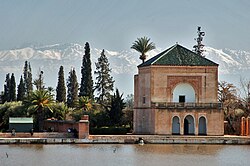
0 m
Marrakesh
Marrakesh or Marrakech (; Arabic: مراكش, romanized: murrākuš, pronounced [murraːkuʃ]) is the fourth-largest city in Morocco. It is one of the four imperial cities of Morocco and is the capital of the Marrakesh-Safi region. The city lies west of the foothills of the Atlas Mountains.
The city was founded circa 1070 by Abu Bakr ibn Umar as the capital of the Almoravid dynasty. The Almoravids established the first major structures in the city and shaped its layout for centuries to come. The red walls of the city, built by Ali ibn Yusuf in 1122–1123, and various buildings constructed in red sandstone afterwards, have given the city the nickname of the "Red City" or "Ochre City". Marrakesh grew rapidly and established itself as a cultural, religious, and trading centre for the Maghreb. After a period of decline, Marrakesh regained its status in the early 16th century as the capital of the Saadian dynasty, with sultans Abdallah al-Ghalib and Ahmad al-Mansur embellishing the city with an array of sumptuous monuments. Beginning in the 17th century, the city became popular among Sufi pilgrims for its seven patron saints who are buried here. In 1912, the French Protectorate in Morocco was established and T'hami El Glaoui became Pasha of Marrakesh and generally held this position until the independence of Morocco and the reestablishment of the monarchy in 1956.
Marrakesh comprises an old fortified city packed with vendors and their stalls. This medina quarter is a UNESCO World Heritage Site and contains the Jemaa el-Fnaa square, a large number of souks (markets), the Kutubiyya Mosque, and many other historic and cultural sites. The city serves as a major economic centre and tourist destination. Property and hotel development in Marrakesh have grown dramatically in the 21st century. Marrakesh is particularly popular with the French, and numerous French celebrities own property in the city.
Marrakesh is served by Marrakesh Menara Airport and by Marrakesh railway station, which connects the city to Casablanca and northern Morocco. Marrakesh has several universities and schools, including Cadi Ayyad University. A number of Moroccan football clubs are based here, including Najm de Marrakech, KAC Marrakech, Mouloudia de Marrakech and Chez Ali Club de Marrakech. The Marrakesh Street Circuit hosts the World Touring Car Championship, Auto GP and FIA Formula Two Championship races.

259 m
El Harti Stadium
El Harti Stadium (Arabic: ملعب الحارثي) is a multi-use stadium in Marrakesh, Morocco. It is used mostly for football matches and athletics and hosted the home games of Kawkab Marrakech. The stadium holds 10,000 people. It was replaced by Stade de Marrakech in 2012.

799 m
Marrakesh Railway Station
The Marrakesh Railway Station (Arabic: محطة قطار مراكش) is a railway station in Marrakesh, Morocco; it is currently the southern end-point of the Moroccan railway system. The current station was opened on August 10, 2008.
From Marrakesh there is a direct rail link to Casablanca and Fez. Station Casablanca Voyageurs offers connections to Tangier or Oujda.
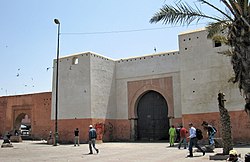
1.0 km
Bab Doukkala
Bab Doukkala (Arabic: باب دكالة, lit. 'gate of the Doukkala') is the main northwestern gate of the medina (historic walled city) of Marrakesh, Morocco.