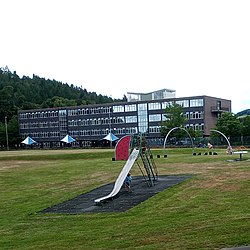
Location Image

Paton Street drill hall, Galashiels

The Paton Street drill hall is a military installation in Galashiels, Scotland.

1. History

The building was designed as offices for Mid Mill, sometimes known as Valley Mill, which was located to the immediate north of the site, and completed in the late 19th century. It was acquired by the War Office for use by the 4th Battalion, the King's Own Scottish Borderers in 1908. The battalion was mobilised at the drill hall in August 1914 before being deployed to Gallipoli and then to the Western Front. The 4th and 5th battalions amalgamated to form the 4th/5th Battalion, with its headquarters at the Paton Street drill hall in 1961. The battalion headquarters moved to Dumfries in 1967 with just a single company left at the Paton Street drill hall. This unit evolved to become No. 3 (The King's Own Scottish Borderers) Company, 2nd Battalion, 52nd Lowland Volunteers in 1971, B (King's Own Scottish Borderers) Company, 2nd Battalion, 52nd Lowland Volunteers in 1992 and D (King's Own Scottish Borderers) Company, 52nd Lowland Regiment in 1999. In 2006 D Company was disbanded but an Anti-Tank Platoon and a Rifle Platoon, forming part of A (Royal Scots Borderers) Company, 52nd Lowland, 6th Battalion The Royal Regiment of Scotland, was retained and remains based at the Paton Street drill hall.

1. References
Nearby Places View Menu
Location Image
114 m

Galashiels Burgh Chambers

Galashiels Burgh Chambers is a municipal building in Albert Place, Galashiels, Scotland. The building, which was the headquarters of Galashiels Burgh Council, is a Category B listed building.
Location Image
258 m

Old Gala House

Old Gala House is a museum and conference centre situated in the Old Town area of Galashiels in the Scottish Borders. The building was originally built as a tower house in 1457 by the Hoppringill (Pringle) family, who had been granted the lands of Gala by the Earl of Douglas. In 1583, Andrew Hoppringill carried out much improvement and extended the house as his family home. Further expansion took place in 1611, before Andrew returned to live at the family seat of Smailholm Tower in 1635, when his daughter, Jean, married Hugh Scott. A ceiling painting was rediscovered in 1952 celebrating that marriage. Hugh Scott, the new laird, carried out more improvements and extended the house. Further extensions were carried out in the 17th and 18th centuries, completing the edifice we see today. The five bay, U-shaped house is built of rubblestone and is embraced on three sides by gardens complete with water features. In 1872, Hugh Scott 9th of Gala commissioned Scottish architect David Bryce to design and build a new house. On completion the family moved to New Gala House, abandoning the old house. New Gala House was demolished in 1985 around the time the Scottish Borders Council renovated the old house and converted it to a venue. As well as being a museum and conference centre, the house plays a role in the graduation ceremonies of the local university and also caters for all forms of meetings including marriages. The house also holds the archives of Borders Family History Society.
Location Image
435 m

Galashiels railway station

Galashiels is a railway station on the Borders Railway, which runs between Edinburgh Waverley and Tweedbank. The station, situated 33 miles 22 chains (53.6 km) south-east of Edinburgh Waverley, serves the town of Galashiels in Scottish Borders, Scotland. It is owned by Network Rail and managed by ScotRail.
Location Image
512 m

Galashiels Academy

Galashiels Academy is the high school in Galashiels, Scotland, that serves the surrounding area including Stow. Refounded in 1938, the school's history goes back as far as 1696. The current building was built in 1964. A new building, The Galashiels Community campus, was completed in 2025 and opened to pupils and public in January of 2026.