Location Image

Instituto Tecnológico de Buenos Aires

The Buenos Aires Institute of Technology (Spanish: Instituto Tecnológico de Buenos Aires, ITBA) is a top private university in Buenos Aires, Argentina. Its focus is primarily on Engineering, Information Technology and Business studies. ITBA maintains cooperation agreements with over 50 universities in 20 countries.

1. History

ITBA was created on November 20, 1959, by a group of Navy officers and professionals, with the purpose of advancing the teaching of engineering in Argentina. Its first rector was Viceadmiral Carlos Garzoni, followed by Leandro Maloberti, who served briefly as the Navy's Chief of Naval Operations in 1962. The main building is located in the neighborhood of Puerto Madero, on the grounds of the old Argentine Navy Hospital. The new campus is located in the Parque Patricios neighbourhood.

1. Ranking

According to the QS World University Rankings, ITBA is ranked #951-1000 best university globally.

1. Rigorous admissions

ITBA is renowned for its highly challenging entrance exams, which are designed to identify the most qualified and motivated students.

1. Notable alumni

Emilio Basavilbaso – Executive Director of the National Social Security Administration (ANSES), 2015–2019. Leandro Cuccioli – industrial engineer; Administrator of the Federal Administration of Public Revenues (AFIP), 2018–2019. Mario Dell'Acqua – president of Aerolíneas Argentinas (2016–2018). Miguel Galuccio – CEO of YPF (2012–2016); founder and chief executive of Vista Energy. Javier Iguacel – Minister of Energy (June–December 2018). Silvia Lospennato – National Deputy (member of Republican Proposal). Nicolás Posse – Chief of the Cabinet of Ministers under President Javier Milei (10 December 2023 – 27 May 2024).

1. See also

Aeroitba Petrel 912i Sabato Institute of Technology

1. References


1. External links

Official website

Nearby Places View Menu
131 m

Six Days of Buenos Aires

The Six Days of Buenos Aires was a former six-day cycling event, held in Luna Park stadium, Buenos Aires, Argentina. As many as 27 editions took place from 1936 until 2000, though there were at times single years or even long gaps (such as 1950-55 and 1965-82) when the event was not raced.
Location Image
145 m

Estadio Luna Park

Estadio Luna Park (commonly known as Luna Park) is a multi-purpose arena in Buenos Aires. Located at the corner of Avenida Corrientes and Avenida Bouchard; in the San Nicolás neighborhood. Initially, the arena primarily hosted boxing and other sporting events. In the 1950s, it was expanded to host stage shows and concerts. The stadium has hosted countless internationally famous personalities, including Pope John Paul II, several ballets, tennis and volleyball matches, world championship and important non-championship boxing fights involving Nicolino Locche, Hugo Corro, Santos Laciar, Carlos Monzón, Omar Narvaez, Juan Roldán, Julio César Vásquez and many other famous boxers, circuses, the Harlem Globetrotters, Holiday on Ice and many more. The arena also hosted the 1950 FIBA World Championship, the final phase of the 1990 Basketball World Championship and the 1976 Basketball Intercontinental Cup in which Real Madrid won the competition. The arena also hosted the Six Days of Buenos Aires cycle race.
Location Image
153 m

Libertad Palace

The Libertad Palace, Domingo Faustino Sarmiento Cultural Center (Spanish: Palacio Libertad, Centro Cultural Domingo Faustino Sarmiento) is a cultural centre located in Buenos Aires, Argentina. It is the largest of Latin America, and the third or fourth largest in the world. The building was originally opened in 1928 as the Buenos Aires Central Post Office ("Palacio de Correos"), operating until 2002. During successive years, it was refurbished and reopened in 2015 as a cultural center. It was named for a few years after former president of Argentina Néstor Kirchner, who had overseen its conversion. The name is politically polarizing in Argentina, with the country's presidency announcing the name would be changed in March 2024. Despite this, the name "Palacio Libertad" only applies to the building itself. As of October 10, 2024, the building was renamed "Domingo Faustino Sarmiento". The nine-floor centre has a concert hall; five other auditoriums for theater and concerts; 18 halls for poetry readings, performance art, and other events; 40 rooms of art and history galleries totaling 15,000 square meters (160,000 sq ft) on six floors; 16 rehearsal rooms; and two rooftop terraces. It is possible to reach the centre with Line B and Line E of the city's underground, at Leandro N. Alem and Correo Central respectively.
Location Image
173 m

ARA Uruguay

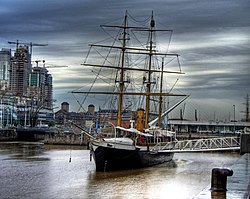
The corvette ARA Uruguay, built in England, is the largest ship afloat of its age in the Armada de la República Argentina (Argentine Navy), with more than 140 years passed since its commissioning in September 1874. The last of the legendary squadron of President Sarmiento, the Uruguay took part in revolutions, expeditions, rescues, and was even floating headquarters of the Navy School. During its operational history 1874–1926 the Uruguay has served as a gunboat, school ship, expedition support ship, Antarctic rescue ship, fisheries base supply ship, and hydrographic survey vessel, and is now a museum ship in Buenos Aires. The ship was built in 1874 at Laird Bros. (now Cammell Laird) shipyard of Birkenhead, England, at a cost of £32,000. This ship is rigged to a barque sailplan (three masts, two of which have cross spars). The ship's steel hull is sheathed in teak. The ship's namesake is an earlier Argentine Navy schooner, a seven-gun combatant in the Battle of Juncal, 1827.