Le Grand Incendie de New York de 1835 est un sinistre ayant détruit la Bourse de New York et la plupart des bâtiments de la pointe sud de Manhattan près de Wall Street les 16 et 17 décembre 1835.

1. Historique

L’incendie se déclara, alors que la ville était recouverte par la neige, dans la soirée du 16 décembre dans un entrepôt de cinq étages sis 25 Merchant Street à l’intersection avec Pearl Street entre Hanover Square et Wall Street et fut alimenté par des vents violents soufflant du nord-ouest vers l’East River. Avec des températures avoisinant les −27 °C, l’East River était gelée, les pompiers furent obligés de percer des trous dans la glace pour se procurer une eau, qui se mit à geler dans les tuyaux et les pompes. Les tentatives pour faire sauter les édifices dans son chemin furent contrecarrées par un manque de poudre à canon. Des pompiers venus de Philadelphie prêter main-forte à leurs collègues leur dirent que les signes de l’incendie étaient visibles de chez eux. Vers 2 h 0, les Marines revinrent du New York Navy Yard avec la poudre et firent sauter des bâtiments en travers de l’incendie, qui couvrait désormais 50 hectares, 17 rues de Manhattan, détruisant entre 530 et 700 bâtiments, sur une zone signalée comme allant de Coenties Slip au sud à Maiden Lane au nord, la rue William à l’ouest jusqu’à l’East River. Les pertes furent estimées à vingt millions de dollars, ce qui, en valeur actuelle équivaut à des centaines de millions. Seules deux personnes perdirent la vie.

Le siège de plusieurs compagnies d’assurance ayant brulé, ces entreprises avaient fait faillite et se trouvaient dans l’impossibilité d’indemniser leurs assurés. Il existe une description du sinistre dans l’History of the City of New York de Martha Joanna Lamb et Burton Harrison : « Beaucoup de magasins étant neufs, avec des volets en fer et des portes et des toits en cuivre, ils brulaient comme s’il s’agissait d’immenses fonderies à ciel ouvert. Par moments, la chaleur faisait fondre les toitures de cuivre dont le liquide en fusion coulait à grosses gouttes. La tempête soufflait en direction de l’East River. On entendait mur après mur s’effondrer comme une avalanche. Des langues de feu, s’élançant des toits et des fenêtres le long de rues entières, semblaient s’affronter. L’eau de la baie ressemblait à une vaste mer de sang. Les cloches sonnèrent pendant un moment avant de cesser. Les deux côtés de Pearl Street et de Hanover Square étaient en même temps dans la gueule du monstre affamé. »

Une enquête attribua la cause de l’incendie à un tuyau de gaz éclaté qui fut enflammé par un poêle à charbon. Comme cet incendie eut lieu au milieu d’un boom économique provoqué par l’ouverture récente du canal Érié, le bois des bâtiments détruits fut rapidement remplacé par de la pierre et de la brique moins sujettes aux incendies majeurs. Le feu suscita également la construction d’un nouvel aqueduc municipal, aujourd’hui connu sous le nom de « Croton Aqueduct ». Les services d’incendie furent réformés et agrandis. Ceci eut pour conséquence d’être le dernier grand incendie de New York. La seule perte majeure pour New York fut les compagnies d’assurance qui, ayant perdu leurs locaux dans l’incendie, décidèrent que la reconstruction ne valait pas le risque et préférèrent déménager leurs services à Hartford dans le Connecticut, où elles sont toujours à l’heure actuelle, cette ville étant aujourd’hui connue comme la « capitale mondiale des assurances ».

1. Notes et références


1. Sources

(en) Cet article est partiellement ou en totalité issu de l’article de Wikipédia en anglais intitulé « Great Fire of New York » (voir la liste des auteurs). Portail de New York Portail des années 1830 Portail des risques majeurs

Nearby Places View Menu
Location Image
0 m

Great Fire of New York

The 1835 Great Fire of New York was one of three fires that rendered extensive damage to New York City in the 18th and 19th centuries. The fire occurred in the middle of an economic boom, covering 17 city blocks, killing two people, and destroying hundreds of buildings, with an estimated $20 million of property damage (equivalent to $640 million in 2024).
Location Image
8 m

Duane Reade

Duane Reade Inc. ( dwayn REED) is a chain of pharmacy and convenience stores owned by Walgreens. Its stores are primarily in New York (metropolitan New York City and Nassau, Suffolk, Westchester, Rockland, and Fairfield counties) in addition to in New Jersey. They are known for high-volume and small store layouts in densely populated Manhattan locations. In 2012, the company headquarters moved to 40 Wall Street in Lower Manhattan which is the location of its newest flagship store.
Location Image
25 m

Wall Street bombing

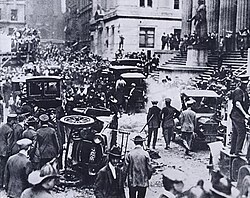
The Wall Street bombing was an act of terrorism on Wall Street at 12:01 pm on Thursday, September 16, 1920. The blast killed 30 people immediately, and another eight later died of wounds that they sustained in the blast. There were 143 seriously injured, and the total number of injured was in the hundreds. The bombing was never solved, although investigators and historians believe it was carried out by Galleanists, a group responsible for a series of bombings the previous year.
Location Image
28 m

40 Wall Street

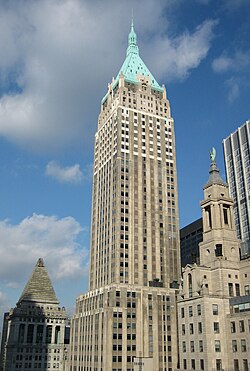
40 Wall Street (also the Trump Building; formerly the Bank of Manhattan Trust Building and Manhattan Company Building) is a 927-foot-tall (283 m) neo-Gothic skyscraper on Wall Street between Nassau and William streets in the Financial District of Manhattan in New York City, New York, U.S. Erected in 1929–1930 as the headquarters of the Manhattan Company, the building was designed by H. Craig Severance with Yasuo Matsui and Shreve & Lamb. The building is a New York City designated landmark and is listed on the National Register of Historic Places (NRHP); it is also a contributing property to the Wall Street Historic District, an NRHP district. The building is on an L-shaped site. While the lower section has a facade of limestone, the upper stories incorporate a buff-colored brick facade and contain numerous setbacks. The facade also includes spandrels between the windows on each story, which are recessed behind the vertical piers on the facade. At the top of the building is a pyramid with a spire at its pinnacle. Inside, the lower floors contained the Manhattan Company's double-height banking room, a board room, a trading floor, and two basements with vaults. The remaining stories were rented to tenants; there were private clubs on several floors, as well as an observation deck on the 69th and 70th floors. Plans for 40 Wall Street were revealed in April 1929, with the Manhattan Company as the primary tenant, and the structure was opened on May 26, 1930. 40 Wall Street and the Chrysler Building competed for the distinction of world's tallest building at the time of both buildings' construction; the Chrysler Building ultimately won that title. 40 Wall Street initially had low tenancy rates due to the Great Depression and was not fully occupied until 1944. Ownership of the building and the land underneath it, as well as the leasehold on the building, has changed several times throughout its history. Since 1982, the building has been owned by two German companies. The leasehold was held by interests on behalf of Philippine dictator Ferdinand Marcos in the mid-1980s. A company controlled by developer and later U.S. president Donald Trump bought the lease in 1995.
Location Image
34 m

Federal Hall

Federal Hall was the first capitol building of the United States established under the Constitution. Serving as the meeting place of the First United States Congress and the site of George Washington's first presidential inauguration, the building was located on Wall Street facing the northern end of Broad Street in Lower Manhattan, New York City, from 1703 to 1812. The site is occupied by the Federal Hall National Memorial, a Greek Revival–style building completed in 1842 as the New York Custom House. The National Park Service now operates the building as a national memorial commemorating the historic events that occurred at Federal Hall. The original structure on the site was built from 1699 to 1703 as New York's second city hall. The building hosted the 1765 Stamp Act Congress, before the American Revolution. After the United States became an independent nation, it served as the meeting place for the Congress of the Confederation, the nation's first central government under the Articles of Confederation, from 1785 to 1789, and the building was expanded and updated. With the establishment of the United States federal government in 1789, it hosted the 1st Congress and the inauguration of George Washington as the nation's first president. It was demolished in 1812. The current structure, designed by Ithiel Town and Alexander Jackson Davis, was built as New York's U.S. Custom House, before serving as a Subtreasury building from 1862 to 1925. The Subtreasury building continued to be used as a governmental office building for a decade, and it opened as a public memorial in 1940. The building is constructed of Tuckahoe marble. Its architectural features include a colonnade of Doric columns, in addition to a domed rotunda designed by the sculptor John Frazee. In front of the building is a large statue of George Washington by John Quincy Adams Ward. The facade and part of the interior are New York City designated landmarks, and the building is also a contributing property to the Wall Street Historic District, listed on the National Register of Historic Places.