

 English
 Français
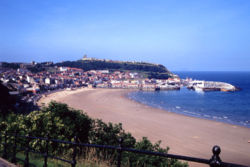
Scarborough (Yorkshire du Nord)
Scarborough est une ville sur la mer du Nord dans le comté du Yorkshire du Nord en Angleterre, Royaume-Uni. La ville moderne se situe entre 30 et 70 m au-dessus du niveau de la mer sur des falaises calcaires. La vieille ville entoure le port qui est protégé par une pointe de rocher. Les villes situées à proximité comprennent Kingston-upon-Hull, York et Leeds.
Nearby Places View Menu

155 m
Albemarle Baptist Church, Scarborough
Albemarle Baptist Church is a Grade II listed church located on Albemarle Crescent, central Scarborough, North Yorkshire, England. It was designed in the Gothic Revival style by the Bradford architect Henry Francis Lockwood, and opened in 1867.
230 m
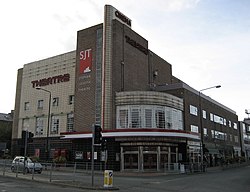
Stephen Joseph Theatre
The Stephen Joseph Theatre is a theatre in the round in Scarborough, North Yorkshire, England that was founded by Stephen Joseph and was the first theatre in the round in Britain.
In 1955, Joseph established a tiny theatre in the round on the first floor of Scarborough Library.
The theatre flourished and in 1976 moved to a supposedly temporary home on the ground floor of the former Scarborough Boys' High School.
However, a permanent home proved difficult to find and it was not until late 1988 and the closure of the local Odeon cinema by Rank Leisure that the theatre's long-standing Artistic Director, Alan Ayckbourn, found a suitable venue. Ayckbourn launched a £4 million appeal to transform the old cinema with a view to opening it up in 1995.
The new theatre, known simply as the Stephen Joseph Theatre, opened in 1996 and comprises two auditoria: The Round, a 404-seat theatre in the round, and The McCarthy, a 165-seat end-on stage/cinema. The building also contains a restaurant, shop, and full front-of-house and backstage facilities.
The Round boasts two important technical innovations: the stage lift, facilitating speedy set changes, and the trampoline, a Canadian invention which allows technicians particularly easy access to the lighting grid.
It is also the place where the image used for the cover of Richard Hawley's album Coles Corner was taken.

252 m
Capitol, Scarborough
The Capitol is a historic building in Scarborough, North Yorkshire, a town in England.
The building was designed by Edwin Sheridan Evans and constructed between 1928 and 1929. It opened as a variety theatre with a fly tower, orchestra pit, dressing rooms and 2,100 seats, but was principally used as a cinema. In the 1970s, it was renamed as the "Classic Cinema", but this closed in 1977, and it was converted into a Mecca Bingo hall. The building was grade II listed in 2000. Closure of the club was announced in November 2025.
The building has a steel frame, the front is in white faience, on a plinth, and the other walls are in brick. Above the central entrance is a canopy and there are four more entrances with moulded surrounds and keystones. Above the main entrance are three tall round-headed windows, over which is a pediment with a coved cornice and a cartouche. At the top is a decorated frieze with central lettering. The interior retains much of its original decoration, including the proscenium arch with ornamental ironwork either side and a Classical frieze above. There is a barrel-vaulted ceiling. The original organ has been removed, and the former cafe at balcony level has been converted into an additional foyer.

316 m
Scarborough railway station
Scarborough, formerly Scarborough Central, is a Grade II listed railway station serving the seaside town of Scarborough, North Yorkshire. It lies 42 miles (68 km) east of York and is one of the eastern termini on the North TransPennine route; it is managed by TransPennine Express. and is also served by Northern Trains. The station is also at the northern end of the Yorkshire Coast line and is reputed to have the longest station seat in the world at 456-foot (139 m).
From 1907 until 2010, the station approaches were controlled from a 120-lever signal box named Falsgrave; this is sited at the outer end of platform 1 and close to the former excursion station at Scarborough Londesborough Road. In its final years, Falsgrave box controlled a mixture of colour-light and semaphore signals, including a gantry carrying 11 semaphores. The signal box was decommissioned in September 2010 and the gantry was dismantled and removed in October 2010. Its new home is at Grosmont railway station, on the North Yorkshire Moors Railway. The new signalling is a relay-based interlocking with two- and three-aspect LED signals controlled from an extension to the existing panel at nearby Seamer. Simplification of the track layout and major renewals took place at the same time.

339 m
Scarborough Windmill
Scarborough Windmill, also known as Victoria Mill, is a historic building in Scarborough, North Yorkshire, a town in England.
The windmill was built in about 1785 by Thomas Robinson. It was built on land owned by Scarborough Corporation and was originally known as the "Common Mill". The corn mill changed hands regularly before being purchased by Francis and Moses Harrison in about 1850. The brothers ran a business selling both corn and seeds. The mill originally had six sails, but these were badly damaged in a storm in 1880, one falling and killing a cow, and after repair it had only four sails. These were removed in 1898 and the mill was then powered by an engine. The mill closed in 1927 and was disused for many years before in 1988 being converted into part of a hotel. In 1997, it became self-catering accommodation, and in 1999, the sails and cap were replaced.
The windmill is built of brick on a stone plinth. It is tapering, and has a circular plan and six storeys. Steps lead up to the doorway that has a segmental brick arch. There is another higher doorway, and the other openings are rectangular and decreasing in size towards the top. Inside, there are two apartments, each over two floors. Both have a combined lounge and kitchen area, and an en suite bedroom. The building has been grade II listed since 1987.