
Location Image

Capitol, Scarborough

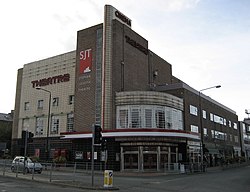
The Capitol is a historic building in Scarborough, North Yorkshire, a town in England. The building was designed by Edwin Sheridan Evans and constructed between 1928 and 1929. It opened as a variety theatre with a fly tower, orchestra pit, dressing rooms and 2,100 seats, but was principally used as a cinema. In the 1970s, it was renamed as the "Classic Cinema", but this closed in 1977, and it was converted into a Mecca Bingo hall. The building was grade II listed in 2000. Closure of the club was announced in November 2025. The building has a steel frame, the front is in white faience, on a plinth, and the other walls are in brick. Above the central entrance is a canopy and there are four more entrances with moulded surrounds and keystones. Above the main entrance are three tall round-headed windows, over which is a pediment with a coved cornice and a cartouche. At the top is a decorated frieze with central lettering. The interior retains much of its original decoration, including the proscenium arch with ornamental ironwork either side and a Classical frieze above. There is a barrel-vaulted ceiling. The original organ has been removed, and the former cafe at balcony level has been converted into an additional foyer.

Nearby Places View Menu
Location Image
118 m

Albemarle Baptist Church, Scarborough
Albemarle Baptist Church is a Grade II listed church located on Albemarle Crescent, central Scarborough, North Yorkshire, England. It was designed in the Gothic Revival style by the Bradford architect Henry Francis Lockwood, and opened in 1867.
Location Image
186 m

Stephen Joseph Theatre

The Stephen Joseph Theatre is a theatre in the round in Scarborough, North Yorkshire, England that was founded by Stephen Joseph and was the first theatre in the round in Britain. In 1955, Joseph established a tiny theatre in the round on the first floor of Scarborough Library. The theatre flourished and in 1976 moved to a supposedly temporary home on the ground floor of the former Scarborough Boys' High School. However, a permanent home proved difficult to find and it was not until late 1988 and the closure of the local Odeon cinema by Rank Leisure that the theatre's long-standing Artistic Director, Alan Ayckbourn, found a suitable venue. Ayckbourn launched a £4 million appeal to transform the old cinema with a view to opening it up in 1995. The new theatre, known simply as the Stephen Joseph Theatre, opened in 1996 and comprises two auditoria: The Round, a 404-seat theatre in the round, and The McCarthy, a 165-seat end-on stage/cinema. The building also contains a restaurant, shop, and full front-of-house and backstage facilities. The Round boasts two important technical innovations: the stage lift, facilitating speedy set changes, and the trampoline, a Canadian invention which allows technicians particularly easy access to the lighting grid. It is also the place where the image used for the cover of Richard Hawley's album Coles Corner was taken.
Location Image
199 m

Belvoir Terrace

Belvoir Terrace is a historic building in Scarborough, North Yorkshire, in England. The terrace of six houses was built between 1832 and 1833, to a design by R. H. and Samuel Sharp. It lies on the street named The Crescent, although the terrace itself is straight. There is a central garden area in front of the houses, which Historic England describes as a "major example of terrace architecture" in the town. From 1856 to 1857, a vicarage was constructed to the rear of 6 Belvoir Terrace. 1 Belvoir Terrace was later converted into the Crescent Hotel, with 22 bedrooms, while many of the other houses have been divided into flats. The terrace, including the former vicarage, has been grade II* listed since 1953. The terrace is built of stone, the ground floor with horizontal rustication, and has a hipped slate roof. Most of the houses have four storeys and three bays, and the six bays at each end project slightly. Steps with iron railings lead up to the doorways, which have architraves and oblong fanlights. Above the ground floor is a stone balcony with decorative cast iron railings. Between the houses on the upper two floors are pilasters and an entablature, and the middle floor contains French windows.
Location Image
206 m

Borough of Scarborough

The Borough of Scarborough () was a non-metropolitan district with borough status in North Yorkshire, England. In addition to the town of Scarborough, it covered a large stretch of the coast of Yorkshire, including Whitby and Filey. It bordered Redcar and Cleveland to the north, the Ryedale and Hambleton districts to the west and the East Riding of Yorkshire to the south. The district was formed on 1 April 1974, under the Local Government Act 1972. It was a merger of the urban district of Filey and part of the Bridlington Rural District, from the historic East Riding of Yorkshire, along with the municipal borough of Scarborough, Scalby and Whitby urban districts, and Scarborough Rural District and Whitby Rural District, from the historic North Riding. In 2007, the borough was threatened with extinction. In March of that year, North Yorkshire County Council was shortlisted by the Department for Communities and Local Government to become a unitary authority. If the bid had been successful then the Borough of Scarborough would — along with all other districts and boroughs in the present county of North Yorkshire — have been abolished then. The bid, however, was unsuccessful and the districts remained as they were previously constituted. However, in July 2021 the Ministry of Housing, Communities and Local Government announced that in April 2023, the non-metropolitan county would be reorganised into a unitary authority. Scarborough Borough Council was abolished and its functions were transferred to a new single authority for the non-metropolitan county of North Yorkshire.