

 English
 Français

Didsbury railway station served the suburb of Didsbury, in south Manchester, England. It was located on Wilmslow Road, just north of the junction with Barlow Moor Road and opposite Didsbury Library. Nothing now remains of the old station buildings, which have been demolished, but the surviving white Portland stone clock tower is a local landmark. The suburb is now served by Didsbury Village tram stop, which is close to the site of the former station.
Nearby Places View Menu

223 m
Didsbury
Didsbury is a suburb of Manchester, England, on the north bank of the River Mersey, 5 miles (8 kilometres) south of Manchester city centre. The population at the 2011 census was 26,788.
Within the boundaries of the historic county of Lancashire, there are records of Didsbury existing as a small hamlet as early as the 13th century. Its early history was dominated by being part of the Manor of Withington, a feudal estate that covered a large part of what is now the south of Manchester. Didsbury was described during the 18th century as a township separate from outside influence. In 1745 a section of the Jacobite army including the Duke of Perth crossed the Mersey at Didsbury in the Jacobite march south from Manchester to Derby.
Didsbury was largely rural until the mid-19th century, when it underwent development and urbanisation during the Industrial Revolution. It became part of Manchester in 1904.
The Royal Society for the Protection of Birds was formed in Didsbury in 1889.

278 m
Didsbury Village tram stop
Didsbury Village is a tram stop on the South Manchester Line on the light-rail Metrolink network in Greater Manchester, England. It serves the South Manchester suburb of Didsbury.

626 m
St Paul's Methodist Church, Didsbury
St Paul's Methodist Church is a former Methodist church in the Manchester suburb of Didsbury. The building was designed by the architect H.H. Vale as a church for the nearby Wesleyan Theological Institution and opened in 1877. The building was converted into an office space in 1990. It is recorded in the National Heritage List for England as a designated Grade II listed building.
654 m
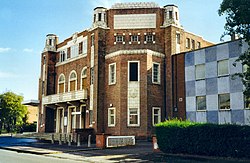
Capitol Theatre, Manchester
The Capitol Theatre was a cinema in Didsbury, Manchester later used as television studios by ITV contractor ABC Weekend TV from 1956 to 1968.
The building opened as a cinema in 1931, but was badly damaged by fire in April 1932 and was closed for repairs until August 1933. The cinema was equipped for the production of live shows, and was used for occasional pantomimes and amateur theatrical performances. In 1956 it was converted into television studios for ABC Weekend TV. Programmes such as Opportunity Knocks and Police Surgeon were made in the studios.
Following the merger of Associated Rediffusion and ABC to create Thames Television (on air from July 1968) the studios were leased to Yorkshire Television in 1967 for recording pre-launch programming whilst their own studios were being constructed and in 1970 was sold to Manchester Polytechnic and was the base for their theatre and television school from 1971. Renamed the Horniman Theatre, it staged performances by students of the college, including early performances by Julie Walters, Bernard Hill, and David Threlfall.
The theatre reverted to its original name in 1987, and the polytechnic was granted university status as "Manchester Metropolitan University" on 15 September 1992 under the provisions of the Further and Higher Education Act 1992.
As part of the university restructuring in 1997, the building was sold to a development company and demolished to make way for blocks of flats. The School of Theatre moved its faculty and performance space to the All Saints campus on Oxford Road, where there is now a new Capitol Theatre, a 140-seat studio space.