

 English
 Français

Blyth Cambois TMD
Blyth Cambois TMD was a traction maintenance depot located in Blyth, Northumberland, England. The depot was situated on the west side of the branch line from Bedlington Junction to Blyth Docks. The depot code, under TOPS, was BL.
Nearby Places View Menu


1.1 km
Blyth Power Station
Blyth Power Station (also known as Cambois Power Station) refers to a pair of now demolished coal-fired power stations, which were located on the Northumberland coast in North East England. The two stations were built alongside each other on a site near Cambois in Northumberland, on the northern bank of the River Blyth, between its tidal estuary and the North Sea. The stations took their name from the town of Blyth on the opposite bank of the estuary. Blyth A Power Station was built and opened first but had a smaller generating capacity than its sister station, Blyth B Power Station, which was built to its west four years later. The power stations' four large chimneys were a landmark of the Northumberland skyline for over 40 years; the A Station's two chimneys each stood at 140 metres (460 ft); the B Station's two chimneys were taller, at 170 metres (560 ft) each.
Construction of the B Station began shortly after the A station was completed. The stations were built during a period in which there were great advances in power station technology, and in the scale of production, which led to them having a variety of intermediate generator set sizes along with a mix of design styles. Blyth A had a generating capacity of 480 megawatts (MW) and the B Station 1,250 MW. Their combined capacity of 1,730 MW briefly made Blyth Power Station the largest electricity generation site in England, until Ferrybridge C Power Station came into full operation in 1966. The stations were capable of generating enough electricity to power 300,000 homes.
The A Station first generated electricity in 1958, a year after the creation of the Central Electricity Generating Board, and the stations operated until 2001. They were operated by the successors of the CEGB, including National Power, following the privatisation of the UK's power industry. After their closure in 2001, the stations were demolished over the course of two years, ending with the demolition of the stations' chimneys on 7 December 2003. RWE Npower proposed the construction of a clean coal-fired power station on the site, but the plans were postponed. In December 2020, the site was confirmed as the location for a new automotive battery manufacturing plant.
1.2 km
River Wansbeck
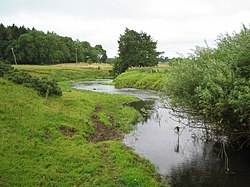
The River Wansbeck runs through the county of Northumberland, England. It rises above Sweethope Lough on the edge of Fourlaws Forest in the area known locally as The Wanneys (Great Wanney Crag, Little Wanney Crag; thus the "Wanneys Beck"); runs through the town of Ashington before discharging into the North Sea at Sandy Bay near Newbiggin-by-the-Sea.
The River flows through the village of Kirkwhelpington, Hartburn, where the tributary Hart Burn joins, the village of Mitford, where the River Font joins, and the town of Morpeth.
The River Wansbeck is nicknamed the River Wanney. The term 'The Wilds of Wanney' is used by people of Tyneside to refer to the rural areas of Northumberland where the Wansbeck rises.
The River lent its name to the former Wansbeck district which was based in Ashington, and included Newbiggin-by-the-Sea, Bedlington and Stakeford.
Castle Island is an ait of the River Wansbeck.

1.6 km
North Blyth Biomass Project
The North Blyth Biomass Project was a proposed biomass-fired power station planned to be located at North Blyth, Northumberland on the north bank of the River Blyth near its tidal estuary. When commissioned it would have had a generating capacity of 100 megawatts, enough electricity to provide for 170,000 homes.
Renewable Energy Systems, the station's developer, was granted government consent on 24 July 2013 to build the £250m project.
Although the Secretary of State granted a Development Consent Order as a nationally significant infrastructure project, the project was cancelled on 6 March 2014.